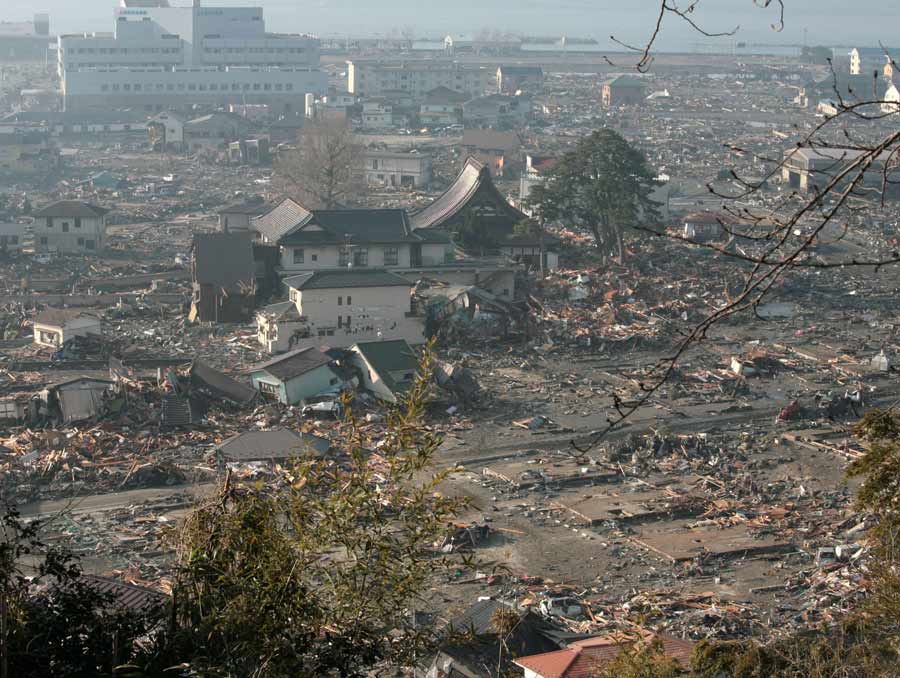
New findings published in the journal Science help explain why the 2011 earthquake off the coast of Japan created such a large tsunami. An international team of geologists and geophysicists drilled into the ocean floor, setting a record for the deepest scientific ocean drilling in the process, to better understand the fault that generated the earthquake.
On March 11, 2011, a devastating earthquake, the fourth largest ever recorded, caused a massive tsunami on the Pacific coast of Japan. Tsunami waves traveled up to six miles inland. An estimated 19,759 people died as a result. Japan had prepared for the possibility of a tsunami and installed sea walls along the coast, but the tsunami wave was bigger than anyone expected it could be, in places over 130 feet high. The tsunami breached the seawalls, leading to tragedy.
After the earthquake and tsunami, scientists, government officials and the public began to ask questions about why the earthquake and tsunami were so large. Seismologists and geologists from all over the world, including Jamie Kirkpatrick, an associate professor at the University of Nevada, Reno and one of the drilling project co-leaders, began their work to answer those questions.
Japan is prone to earthquakes because it lies along a subduction zone, where an oceanic tectonic plate, the Pacific Plate, is being shoved beneath Japan. Friction builds up at the boundary between the Pacific Plate and Japan, causing movement of the Pacific Plate to stall. Earthquakes happen when the friction is overcome, causing the rocks on either side of the fault to suddenly slip by one another, which is what happened in 2011.
“We know subduction zones make the biggest earthquakes in the world, but they don’t always generate tsunamis,” Kirkpatrick, who studies rock deformation from tectonic and seismic processes, said.
To better understand the geological picture and investigate the cause of the tsunami, Kirkpatrick and his colleagues took part in an ocean drilling expedition run out of the Japan Agency for Marine-Earth Science and Technology, or JAMSTEC, to drill a borehole into the seafloor. The expedition is the subject of a 30-minute documentary to be released on the JAMSTEC YouTube channel. The borehole they drilled reached into the fault at the plate boundary and provided core samples of the materials in and around the fault. A state-of-the-art drill ship owned by JAMSTEC was deployed to drill more than 2,600 feet into the seafloor where the ocean is over four miles deep, a record-breaking drilling operation.
Unusually for a subduction zone earthquake, the 2011 earthquake breached the seafloor and caused the seafloor to move about 165 feet toward the east, over half a football field, which was more than double the slip deeper below the seafloor where the earthquake originated.
“It was the largest amount of slip that’s ever been seen from an earthquake, and because it occurred so near to the seafloor, it was a major contributor to the huge size of the tsunami,” Kirkpatrick said.
The selected drill site targeted the part of the fault where the slip was biggest. The recovered cores showed the tectonic plates at the fault boundary are separated by a thin layer of extremely weak, slippery clay along the fault. When the earthquake released the friction between the tectonic plates, the clay provided little resistance and the plates glided past each other easily.
“The presence of this thin clay layer, sandwiched between stronger rocks above and below, combined to enable the extreme movement along the fault, which displaced the seafloor and pushed the ocean water,” Kirkpatrick said. “We believe this is what caused the tsunami wave to be so high and so catastrophic.”
The research, done in collaboration with many JAMSTEC scientists and other scientists from around the world, suggests that future large earthquakes along the same coast are likely to also generate huge tsunamis, due to the unusual fault conditions, which make the Japan Trench more prone to large-scale sliding. This provides important geological insights that will help experts better understand the potential scale of tsunamis generated by earthquakes along the coast of Japan.
On Dec. 8, a magnitude 7.6 earthquake struck the northern part of the Japan Trench and caused a smaller tsunami, reminding the scientists why the work they do is crucial.


