
Thank you to the team at the University Libraries @One Center for producing and editing this episode.
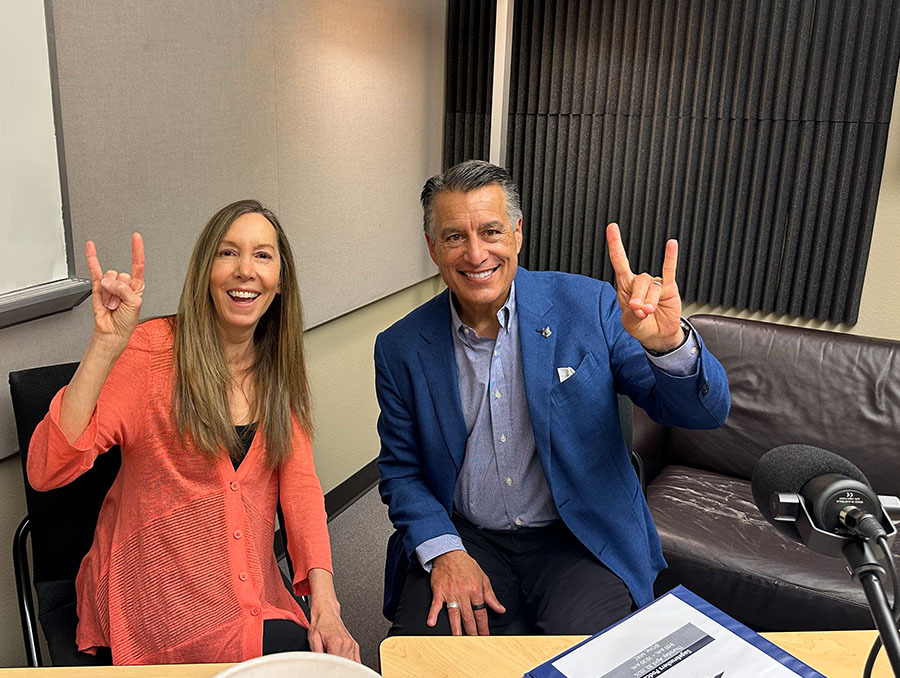
In this episode of Sagebrushers, University of Nevada, Reno President Brian Sandoval speaks with Valerie Fridland, professor of linguistics in the College of Liberal Arts.
Fridland discusses her books, including “Why We Talk Funny: The Real Story Behind Our Accents.” Fridland shares how her personal experience of growing up in the South shaped her interest in language variation and accent perception. She explains why all speakers are influenced by the communities around them.
Sandoval and Fridland also explore common misconceptions about language, from stereotypes tied to regional speech to the history of English accents. Fridland highlights how accents have evolved over time and how language, identity and society intersect.
Sagebrushers is available on Spotify, Apple Podcasts and other major podcast platforms, with new episodes every month.

Sagebrushers season 5 episode 4: Linguistics Professor Valerie Fridland
In this episode of Sagebrushers, University of Nevada, Reno President Brian Sandoval speaks with Valerie Fridland, professor of linguistics.
President Brian Sandoval: Welcome back, Wolf Pack Family. I'm your host, Brian Sandoval, a proud graduate and the president of the University of Nevada. Have you ever had a conversation with someone and wondered if you were speaking the same language? If you have kids like me, you've experienced this situation many times.
Today's guest is an expert in why we choose the words we do and how our language differs among different groups of people. Joining us is Dr. Valerie Fridland, a professor of linguistics in the College of Liberal Arts. Dr. Fridland is the author of “Like Literally Dude: Arguing for the Good and Bad English” and the new book, “Why We Talk Funny: The Real Story Behind Our Accents.” She is a two-time National Endowment for the Humanities fellow and the recipient of the Linguistic Society of America's Linguistics Language and the Public Award. Dr. Fridland has appeared as a language expert in a variety of media outlets such as NPR, Armchair Expert, NBC, The Washington Post, The New York Post, The Wall Street Journal and The New York Times.
Today's episode is being recorded in the @One Podcast Studio of the Matthewson-IGT Knowledge Center. Dr. Fridland, thank you for being here today. We're very excited to have this conversation.
Valerie Fridland: Well, thanks for having me. I'm always happy to talk about this University and my many years here.
Sandoval: Alright. So, let's dive in. I guess a really basic question, how did you find your way into linguistics?
Fridland: Well, I think no one grows up at five thinking I'm going to be a linguist, thankfully, probably. But, I did always have an interest in language because my parents were actually not native speakers of English. So, I grew up in the south and they had a French accent. And of course, the first thing anybody that came to my house would say is, "Why do you sound like that?” Especially my five-year-old friends.
And so, I think I was really aware at a young age about the social power of language, but I, of course, had no idea that what I would end up being a linguist until I sat in a linguistics class in college. I went to Georgetown, and I was a language major. We had to take linguistics. I would've never probably signed up for a class that sounded so boring, but I took this class and it was social linguistics and it truly completely changed my mind about language. It was a way of looking at language from a scientific and historical perspective that I had never even knew was out there. And so, it just radically reshaped what I thought about how I interacted with the world and how I thought about people from the way they talked. And then when I was graduated and was looking for a job and thought, "Well, grad school sounds good." I thought, “Well, I really enjoyed those classes and linguistics. Let me just see what possibilities there would be.” And that's kind of how I fell into linguistics, and I think it's worked out okay.
Sandoval: Yeah. So two-part question. Talk a little bit about your journey to the University of Nevada, your academic journey and then what has your career been like as a professor here at the University of Nevada?
Fridland: Sure. Well, I've been here 27 years going on, so I have seen a lot of change.
Sandoval: Wow, I didn't even know that.
Fridland: Yeah, I'm an old timer. Yeah, of course that means I started at 10. So, I've been here a long time and honestly, this was my first “real job.” I graduated with my doctorate from Michigan State University in social linguistics. And then I did a visiting professorship in Istanbul, Turkey, at Boğaziçi University, which was so amazing. It was such a great experience to sort of have an experience outside of an English university and just absorb the culture. And that was when I was doing my interviews. And so, I came to an interview here, and I honestly loved the place and the people before I even got the job offer. And I was in the plane on the way back home because I was teaching at Macalester University for the off semester from Istanbul and I thought, "Gosh, I'm going to be really sad if I don't get this job," because they had taken me all over the city and shown me the mountains, but also just the way that people here interacted was very different than any other campus interview.
And so, when they offered me the job, I did not hesitate. It was an absolute yes. And then I haven't looked back. That's 27 years ago this July. And I think what really has made my experience here good and what has really encouraged my own growth as a scholar and as a teacher is that there has always been a lot of mentorship here. I can't speak to other departments, but when I came, they essentially gave me a mentor who would be there if I had questions but also observe my teaching because honestly as a grad student, I was a TA, but not a single day did anybody ever give me advice on how to teach. And it wasn't until I got here that people were coming and watching and saying, "Hey, I love how you do this, have you thought about this? " And so, that actually helped me become happy to teach as well as happy to do research, which had been my first love. I think that I've continued to grow on that path as hopefully a mentor to some of the new faculty coming in, and it's just been a great experience.
Sandoval: So has anything changed since the time you started until now?
Fridland: Oh my gosh, how long do we have? The University has changed drastically. It's had its ups and downs. And one thing I have learned is there are always these cycles of fear for what's coming, this sort of retraction of things we offer and maybe hiring, but then we go through these explosive periods of growth as well where we move forward. And so, I kind of don't get as stressed about those as I think a lot of new faculty do.
One thing that has changed is definitely the model of education. I think the last few years, especially with AI, with sort of this move away from long-form reading, I think the biggest change has been trying to adapt to the different needs of students because what I will say hasn't changed is that our students are still really inquisitive, curious, smart people. I have a lot of faith in our young people because I see them with a new generation every year, but we have to adapt to both the realities of what they're doing and also the realities of not being complacent with accepting maybe things that are changing in ways that are not fundamentally helpful for education. So, really pushing the students to do more and do better. I think it's easy to sometimes just sit back and kind of throw your hands up in the air, but I feel like the University has never taken that stance and it still doesn't. So, there's been a lot of changes, just different cycles, but in the end, I think it's the same place and the same spirit as when I started.
Sandoval: That’s wonderful. Now, I should probably ask this question first, but what is a sociolinguist?
Fridland: Well, if you've ever wondered why you can't talk to your teenagers, which I think you definitely have, or why people here in the West sound like they don't have an accent to many people versus if you go to the South, it feels like everybody has an accent that's different than yours. Those are all questions that sociolinguists like me try to answer from a scientific and historical perspective. So, we're really interested in that intersection between how language works from science and history. So what's happened over time and why it happens from an articulatory and cognitive standpoint but also how that really meshes in with our social lives and social identities so that we don't all talk the same way even though we have the same cognitive and motor skills. So, we want to know: Why is that? What is it about our life that triggers these changes that we notice in language around us?
Sandoval: So, is that a learned behavior then? I grew up saying “y'all want to go,” or if you're in Boston, “park the car.” Talk a little bit about that.
Fridland: Absolutely. Everything we know about language, we're born with. So, we can be born into any language and learn that language because we have the whole skill set for anything that humans can do linguistically. But, what happens is when you're born, you get input and that input is what actually shapes what you sound like. So, the accents that we have, the things we learn to say, they start as soon as we're out of the womb. In fact, even before we're out of the womb, we start getting the melody of our own language down. Even five-month-old babies prefer the accents they hear at home over those of strangers. So, we're very attuned very early to these social differences that mark something for us. And what happens is the people around us — and the peer group, particularly for children, which is why your children don't sound like you. They become incredibly important to the formation of not just social identity but linguistic identity. And so, we are going to talk like those that mean something to us. And most of the time, that happens well before you're 20 or 30, which is why it's so hard to change your accent when you leave.
Sandoval: I was going to ask that.
Fridland: Yeah.
Sandoval: Yes.
Fridland: Because you start off with the accent of the people you love, and we'd like to think that's your parents, but sorry, mom and dad. It rapidly changes. So, by age five, you're doing something that we fancy linguists call vernacular reorganization, which is where you shift from the model of your parents who have given your fundamental system to you. So, you know the vowels and the consonants and things like that. But then you model yourself after the people that appeal to you at some sort of way cooler level, the ones that you want to sound like and those are usually your peers. And of course, we branch off in the type of peer groups we have in high school. So, some kids are more oriented outside of their communities. Those are the ones that tend to pick up more external norms, more standard English accents, or you can be very tied to your local community and not want to leave and have a really tight community there.
And those are the people that generally have more regional accents because those are really the accents that will be important to them socially. And then as we get older and we move, those are already set and our brains have lateralized and become less elastic. So, we're just not as good at picking up new linguistic features.
But also, we've had an incredible motor memory for what we've been doing our whole lives and anybody who's ever tried to learn to have upright posture, for example, when they're walking, they automatically kind of go back to that hunt shoulder. The same thing happens with your mouth. So, you have these sounds you've learned to make them a certain way and then all of a sudden someone's telling you to straighten up and hold your shoulders back and you'll do it for a second, but it's really hard to do that at every moment of your life. And once you've already learned something, it becomes your established pattern. And so, it's really hard to pick up these new, often very complex patterns of a new dialect area. That's why we end up saying something like, "Y'all, if you go to the South," because that's easy to pick up. There's not a fundamental structure to it. But if I move to New York, it's really hard for me to learn to drop my Rs because that's actually really, really patterned. And there's just one specific linguistic environment it happens in, because you don't drop them from the beginning of words and you drop them at a very particular place called post vocalically and no one learns that. So nobody moving there would pick that up naturally. And so that's really the difference in a child and adult accent.
Sandoval: That's just fascinating. So, you've done a lot of research and writing for an academic audience, but also more recently have written several books on language for general audiences. What inspired you to expand beyond the scholarly realm?
Fridland: I think the real answer is that I was giving a talk almost 15 years ago at a linguistic conference and I've always been a person that really tried to make what I said relatable. I think it's just my own personality. I don't want to hear things in that kind of academic jargon. And so, I write and I talk to the average person even when those are my peers. So, I'm doing something scholarly, but I try to make it sort of fun and accessible. So, I was giving a talk and someone happened to be in an audience that was a talent scout for The Great Courses.
Sandoval: Oh, I listen to those.
Fridland: Oh right, yes.
Sandoval: Yeah.
Fridland: So, I had no idea, but afterwards they contacted me and asked if I'd like to audition to be one of their professors. So, they flew me out into the Washington D.C. area and they asked me to write an episode that would be a video they'd send out. And it was just really fun and I enjoyed being able to answer some of the questions that I had as a young person about language. So not necessarily the really nitty-gritty kind of stuff I study in linguistic scholarship. Which is where is this vowel produced, but more why is that vowel different than the vowels you hear elsewhere? Why do kids speak differently? So, the big questions that I think when we study language as a scholar we don't often talk about and it was so much fun and it really went over well with their audience. So they asked me to come do a 24-lecture series. And that was the first time that I realized I can actually do both where I can do this for a sort of scholarly audience and then also talk about what I do to a non-scholarly audience and there's actually an audience for it. So I ended up just sort of doing more talks and gradually ended up with an agent who then was able to get me a book deal with Penguin Random House and I've been writing for them ever since.
Sandoval: So let’s talk about. And I love, pretty provocative title in your first book and it was called “Like Literally Dude Arguing for the Good and Bad English”. So, what was that book about and what inspired it?
Fridland: Well, first, I love that you have the perfect intonation for that. Like literally, dude. It's so funny when you have people say that title a lot of times, especially people that that's not native like, they'll be like, literally, dude. It just doesn't roll off the tongue. But yeah, that book was really about what people ask me most about when I give talks and it didn't matter what I was giving a talk on. But they would say, "Why do people say ‘like’ all the time?" Or, "I'm really self-conscious about how I ‘um.’" And so, I thought, well, let's just kill all these questions with one fell swoop by putting them in a book about all the speech habits we love to hate — sort of the science and the history and psychology behind them.
Sandoval: That's great. And I was guilty of that because I would vocalize my pauses and say “um” and — I got over that.
Fridland: Well, actually it's very good for you. There's a lot of research that says “umming” and “ahing” before you say certain things helps your audience remember them. So, there's actually some good support that you should and at different points, maybe not all the time.
Sandoval: Well, I have to admit I haven't read your book yet, so I need to read it now.
Fridland: That chapter particularly.
Sandoval: Yeah. So, let's talk about your second book, “Why We Talk Funny, The Real Story Behind Our Accents.” Talk about that. It just came out, right?
Fridland: That just came out. Yeah. And that was really a sort of passion project of mine because of my life experience of having accents feature so prominently in my early life and being from the South where there are a lot of stereotypes about accents that I really wanted to debunk some of the myths we have about accents, but also sort of point to the beautiful unity that underlies all our accents even if we don't realize it. So first we all have an accent and as you travel, you start to realize that. But second, there's a science behind our accents and incredibly rich and long history. Accents are ancient — they're probably 50,000 years old — and they have served a function both from an evolutionary and social perspective for that whole time where; we wouldn't have them. We're also pre-programmed to notice them since young babies can do it before they have any social awareness. So, I think if we start looking at what drives our accents and what creates them, which are the same principles for everybody, even though the outcomes might be different, we can understand that really they should unite us even when they sound different on the surface. And it's also just a lot of fun. So, there's little chapters in there like, why do we hate the sound of the word ‘moist’ and what's the most beautiful language and how do we determine that? So,it was a fun book to write.
Sandoval: Again, can't wait to read it. So, another quick question, and I don't know if this is within your sphere of teaching, but if I time traveled to 1500, would I be able — and went to the East — would I be able to understand the people there, and would they be able to understand me?
Fridland: Well, you would definitely sound different. So, if we think about colonial times, what we noticed in the writings from the late 1600s, early 1700s when there had been a formative period of what was a new world English at the time, the big thing people commented on is how it had developed very uniformly so that all the colonies sounded very similar and they sounded markedly different from the speech back in Britain. So that was really the main comment, not so much that there were regional differences yet, but they were very different than Britain, but it still would’ve been Shakespearean English. And if you’ve read Shakespeare, you realize you can understand it, but it takes some work and it would’ve sounded quite different. I think what people don’t realize, because what we see in Shakespearean adaptations today is this kind of elitist received pronunciation where it sounds very fancy, but most of what we would hear if we went back to 1600 would be basically stuff that sounded kind of folksy and sort of rural to us. So, for example, “acts” instead of “ask,” “doctor” instead of “daughter,” things like that, “Sari” instead of “Sarah.” So, a lot of what we think of as folk speech would’ve actually been what people everywhere talked like in the 1600s.
Sandoval: Thank you. I was really curious about that. So, we're almost out of time. So, you've been at the University for a long time. What do you love most about the University and about living in Northern Nevada?
Fridland: Well, I love to be outside. So, I think the Northern Nevada part is obviously access to Tahoe has always been super special to us. And my husband and I used to spend every weekend searching new trails out and things like that. And then of course we got kids and that created all sorts of other issues, but it's a great community here. So, I've loved living in this space. But at the University, I really would say that I've had colleagues that have always been gracious and kind and supportive, and I don't think that's always typical of universities. I've also had the support of my deans for the whole time I've been here, and that is a really important relationship to me, from the very first dean when I came here who encouraged me to apply for my first grant, literally after I'd been here a month, that was turned out to be successful, to the dean I have now who has always been encouraging and supportive of my work. I really think the people are what make this place special.
Sandoval: Well, thank you. And thank you, Dr. Fridland. And for the listeners, go out and buy those books. I think it'd be really interesting. But unfortunately, that's all the time we have left for this episode of Sagebrushers. Thank you for joining us today, and join us next time for another episode of Sagebrushers as we continue to tell the stories that make our University special and unique.


