Thank you to the team at the University Libraries @One Center for producing and editing this episode.
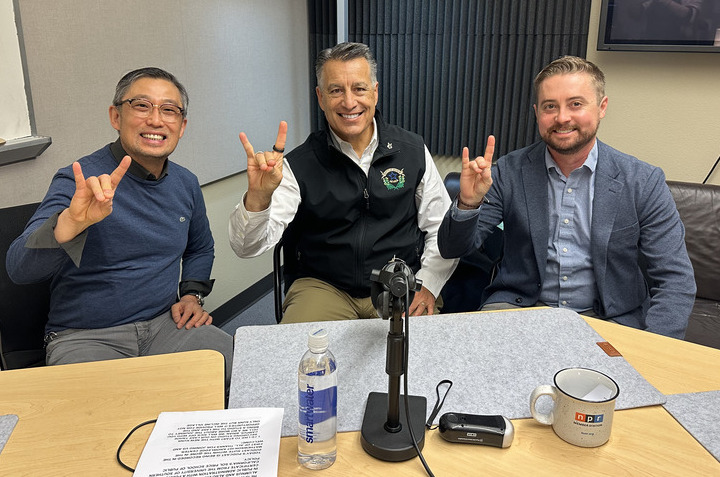
In this episode of Sagebrushers, University of Nevada, Reno President Brian Sandoval speaks with Dr. Gi Yun, dean of the Reynolds School of Journalism, and Brian Duggan, general manager of KUNR Public Radio. Yun and Duggan discuss the importance of local and global journalism, the role of student journalists, and the evolving media landscape.
Duggan emphasizes KUNR’s mission as nonprofit, community-owned media, and its partnership with the University, including the new location recently added to the University of Nevada, Reno at Lake Tahoe campus. Duggan discusses the station’s efforts to expand coverage in underserved areas, including Elko.
Yun highlights the Reynolds School’s initiatives to combat news deserts in Nevada and expand multilingual reporting, including the school’s Spanish-language project, Noticiero Móvil. Yun also shares how students gain international experience through reporting projects in Paris and Costa Rica, combining sports, culture, science and health journalism.
Sandoval, Yun and Duggan also explore how these programs not only prepare students for professional success but also strengthen the public’s access to quality journalism across Nevada.
Sagebrushers is available on Spotify, Apple Podcasts and other major podcast platforms, with new episodes every month.

Sagebrushers Season 4 ep. 9: The future of journalism
In this episode of Sagebrushers, University of Nevada, Reno President Brian Sandoval speaks with Reynolds School of Journalism Dean Gi Yun, and KUNR's General Manager Brian Duggan.
President Brian Sandoval: Welcome back, Wolf Pack Family. I'm your host, Brian Sandoval, a proud graduate and the president of the University of Nevada. Today’s guests are working to change the journalism landscape in Northern Nevada through truth-seeking, advancing the media professions and serving the public good in a complex world. Joining us today is Dr. Gi Yun, dean of the Reynolds School of Journalism. Yun has researched health communications, social media, machine bias, information production and consumption, and local media agenda-setting on immigration stories, among other topics. His research projects are funded by the National Science Foundation, Google and the Online News Association. He earned his Ph.D. and master’s degree in journalism and mass communication from the University of Wisconsin–Madison and his undergraduate degree in journalism and mass communication from Hanyang University in Seoul, South Korea. Also joining us today is Brian Duggan, general manager of KUNR Public Radio. He’s an award-winning local media leader with more than 15 years of experience, much of it covering Northern Nevada as a journalist. Before joining KUNR, he served as the executive editor of the Reno Gazette Journal. Prior to that, he covered business for the Nevada Appeal and state politics for the Bismarck Tribune in North Dakota. He’s a Reynolds School of Journalism alumnus and also earned a master’s degree in public administration with a public policy certificate from the University of Southern California’s Sol Price School of Public Policy. Today’s podcast is being recorded in the podcast suite within @One Studios recording studio at the Mathewson-IGT Knowledge Center. First of all, thanks for joining us, and welcome.
Brian Duggan: Thanks for having us.
Gi Yun: Thank you.
Sandoval: Excited to have some of the most prominent journalists in the great state of Nevada. So, first, I’d like to start with the new KUNR recording studio on our Lake Tahoe campus. Brian, will you kick off the conversation and tell me a little more about the journey to bring a studio to the lake and the opportunities that it will provide not only for KUNR, but for the Lake Tahoe community?
Duggan: Yeah, of course. And thanks again for having us. We opened our studio on the UNR at Lake Tahoe campus in March. It was a project supported by UNR’s administration and the provost’s office directly, so I thank you for that. This studio is located on the third floor of the Prim Library. I like to brag it’s the first KUNR office with windows, which is great. Maria Palma, one of our reporters in the newsroom, is now covering Lake Tahoe from that studio each week, and we’ve really increased the amount of coverage we do in that region. That includes Incline Village stories, South Lake Tahoe stories and even collaborating with faculty at the UNR at Lake Tahoe campus, where there’s a lot of interesting research about lake clarity and other environmental impacts. So, it’s really introduced us to a whole new community of people. Because we’re there, we’re now collaborating with other institutions and groups. In fact, Dr. Paul Mitchell at the Reynolds School of Journalism and I are talking with a 10th grader at Incline Village High School who wants to start a student paper there. We’re trying to figure out what else the Reynolds School and KUNR can do to help promote local journalism in what’s frankly now a news desert, especially on the north Lake side, where the Lake Tahoe Bonanza no longer prints. We’re there to reinvigorate local journalism.
Sandoval: No, and that’s part of the genesis of all this. I remember having conversations up there, and the locals had nothing. They didn’t know what to do. I’m so thankful to both of you for making this a reality. I’m just curious, with a little more specificity, about the types of stories that Maria covers.
Duggan: We just had a story about a bear named Hope, the bear whose mother was breaking into homes in one of the Lake Tahoe communities. Maria did a really rich story about this group of people trying to protect the bears. She captured natural sound of the mother and her cub up in a tree. Unfortunately, the state of California had to euthanize the mother bear, but the baby, Hope, was captured, and the plan is to rehabilitate her and release her elsewhere back into the wild. The fact that Maria is there, boots on the ground, to get that natural sound and collect the voices makes a big difference. She also covers things like local business. For example, a well-known Incline Village restaurant, Sage Leaf, recently opened a second location in Midtown Reno. Her coverage really runs the gamut. Local journalism is more than just city council meetings; it’s about the lived experiences of people in that region, and we want to reflect that.
Sandoval: That’s fabulous. So, Dean Yun, I’m going to move over to you. This effort is closely aligned with the Reynolds School of Journalism’s project for the revitalization of local news. Can you speak more about that and how the school is working to address news deserts and improve community journalism throughout Nevada and beyond?
Yun: Yes, I can talk about several projects we’ve been working on. First of all, as a research institution and a leading journalism school in the state, we realized that we didn’t have comprehensive data. About a year ago, we began collecting information on the news landscape in Nevada. We’re planning to publish our findings in January. Some of the results are astounding: Nevada ranks last among the 50 states in terms of the number of journalists residing in the state.
Sandoval: I’m tired of being in the last of the bad list. So we’re going to change that, right?
Yun: Yes, we're going to change that. And without even knowing too much details, we know some of the pitfalls already. And one of the areas that we are working on is Spanish media. So, we have about 30% of our population with Latinx background. So, we started about 10 years ago with the Spanish language media project, which is called Noticiero Móvil, and we just celebrated 10th year anniversary of the project. And we've been producing stories in Spanish. Almost all of them are produced by our students and for the public. So, we've been very successful doing that and we'll keep doing continuing the production and multilingual journalism. And lastly, kind of related to what Brian Duggan just said, oh two, Brian's here, so I don't want to confuse. So, Brian Duggan said that we've been supporting Lake Tahoe projects, so our interns are working every semester, including summer collecting stories and broadcasting over K the University.
Sandoval: And I want to bring this up as well, but you also have a station in Elko, correct?
Yun: Correct.
Sandoval: Can you talk a little bit about that?
Yun: Yeah. So, our KNCCELKO has been broadcasting over ...
Duggan: More than 30 years.
Yun: More than 30 years. So it's a very challenging project because Northeast Nevada has been known as a news desert, and we had a couple of newspapers there not operating anymore. So, we are filling the void by keeping the station there. And thanks to your support and administrators’ support we've been able to broadcast and produce news in that area.
Sandoval: No, and I thank you for saying, but I have a real appreciation of how isolated folks are out in rural Nevada and how important it is for them to have access to news.
Duggan: And we have brought on Lori Gilbert. She's been a long-time broadcaster out there in Elko, and we had been talking to her for years about this project, and a little more than two years ago, we had brought her on as our host and reporter out there for KNCC. So we're in the process right now of launching our first advisory board out in Elko and kind of building these supporters out there to just continue to build capacity for Elko. This is a multi-year project. It'll take time to build. Lori's been extraordinarily gracious and professional and just a great person to work with out there. She's the perfect person to do this project. And we've also been benefiting from the hospitality of Great Basin College and President Donnelli out there continuing to vocally support us and our mission. So, it's just a matter of building. We just got to keep building.
Sandoval: Great and I know we have a lot to cover. That signal out there in Elko, how far does that reach?
Duggan: And so unfortunately, it's a very low power. It's about a hundred watts. It reaches Elko proper. After that tunnel is when you can start picking it up. Okay. It doesn't have great penetration into buildings though, unfortunately. So, we are looking at ways and generating infrastructure proposals at the state level and through private donors to potentially acquire more stronger signals. We've been looking to collaborate out there with the Elko TV district as well for possibilities to expand that signal. So, it's a work in progress. The goal is to hopefully sooner than later, get a stronger signal so that the entirety of that area can pick up KNCC.
Sandoval: That's great. So Brian, can you talk more about KUNR’s state government project as well as how the station has been impacted by recent changes?
Duggan: Yes. So, it's been obviously quite the year for public media. Of course, we were able to launch our state government project this year, and that was thanks to a grant provided to us by the Corporation for Public Broadcasting. That grant pays the salaries of two reporters. So, currently it's supporting Lucia Starbuck, our politics reporter, and Burt Johnson, he's our senior correspondent. And through this grant, their charter to cover state government every week. And we provide all that coverage for free to any Nevada media who wants to pick it up. And we've seen our stories run in newspapers across the state. And the goal, again, is to boost civic knowledge about what's happening at the state level. Lucia also does Purple Politics, Nevada, that's our monthly podcast. And we have been able to continue that project with the support of this grant. And again, the goal is we have these two just fantastic bright journalists who are supported and encouraged to do just Big J journalism. Like I mentioned, that funding was provided by the Corporation for Public Broadcasting and funding for this 60-year-plus institution was cut by Congress this summer when the Trump administration, it was called a rescission memo to Congress, asking Congress to basically claw back previously appropriated funds for public media. So, 1.1 billion that had been set aside and approved, again, voted on and approved by Congress to go to the Corporation for Public Broadcasting, which provides these grants for public media like K the University. And in late July, Congress approved that rescission memo on party lines. And so what happened is the Corporation for Public Broadcasting lost its funding as of October one, the start of the federal fiscal year. And public radio and public television stations have had to, we have been in this fight all year, starting with the first executive order from the Trump administration that told CPB to stop funding NPR and PBS. That litigation continues as we speak. We think it's an extraordinarily strong First Amendment argument in favor of public media. Besides that, though, locally, how we're dealing with this crisis at KUNR, we have been on a sprint really for the last, this entire year, in terms of communicating with our listeners, our supporters, our university and your leadership team. And of course, especially with the Reynolds School of Journalism under Dean Yun's leadership and our development director, Carol McIntosh, as a team, the three of us have really been on a constant barnstorming tour of our community telling the story, and we've been able to raise about $2 million in the last six months to help bolster the future of K the University. For comparison, we've raised about less than a quarter of that at the same period last year. So, we've seen an extraordinary response from the community. We feel confident going into the next fiscal year and beyond that, we can start doing some long-term investments. We just started our first-ever endowment for KUNR this year, thanks to some very generous donors down in Carson City. And the plan is to continue building on that resiliency fund for KUNR going forward, and we'd like to see that go from its current $300,000 to, let's get to $5 million.
Sandoval: That's tremendous. KUNR is live and well.
Duggan: Yes, we are.
Sandoval: So Dean, I'm going to move to, we've talked about locally, but RSJ students also do work globally and from Costa Rica to Paris. So, can you talk a little bit about that? And I know you've got some sports emphasis as well.
Yun: Who doesn't want to go to Paris? Right. So no, actually that's a fantastic experience for our students. So about three or four years ago, we were revamping our curriculum and we decided to move forward with more sports and what would be the event that will highlight our efforts. And one of them on the horizon was Paris Olympics. So we decided to move forward with the project. It was a very complicated project because it was first of all very expensive and also hard to acquire lodging during that specific time period. But we moved on and somehow we figured out, and it was a very successful project that the students learned a lot about international sports, not just one sport or two sports games, but international experience and one of the culturally enlightened cities in the world. So, they learn how to navigate the complex events with their journalistic concepts applied in their production. So, it was a very successful project. Then beyond that, we've been continuing the project going to Paris with French Open this year, and their experience in sports transcends in the end into culture and economy and politics and everything. So, basically this initiation will engage students beyond sports, although sports is something that they will find their first job based on our statistics and starting journalists typically get jobs in sports and then move on. So that's one. Paris alone, Costa Rica is another one. We had a very fortunate donor, whose name is Mick Hitchcock, who helped us develop a Hitchcock project for visualizing science. And that project kicked up about six years ago and it became very successful. So, we wanted to have students have international science, health science experience, and Costa Rica is the place where we happened to have our research station. So, we took our students there and produce science-related content from there. At the end of the day, I think the sports and science is the tool that they will learn and become well-rounded journalists and media professionals. That's where we came up with this idea, and it has been quite successful.
Sandoval: So, I'm going to shift subjects. I want to hear from both you on this, and Brian, I know you come from print journalism and you're the dean of the school of journalism. So obviously the dynamic has changed with journalism and just curious about your comments, how we prepare our students and what distinguishes us to make sure that they're ready for this new world with social media and such.
Yun: Yes. I think the first thing that comes to my mind that we've been working is innovative curriculum. So, we've been teaching journalism over a hundred years, so we have fantastic faculty and curriculum already, but we cannot rest on our past success. So we've been working on new areas such as drone filming or AI and society and social media, and these new topics will arm our students and prepare for future career. So definitely we're working on that area and we are collaborating with computer science and science and engineering colleges and whatnot. But I really have to say this because I mean, we're a journalism school. Writing is the base. So, we cannot talk about journalism without writing, and still students need to be able to write well. So, we have a mentorship program where we recruit professional journalists or retired professor journalists who have one-to-one sessions with our students and actually fix their writing. I think that's something that we are a developing, cutting-edge innovative curriculum and courses, but we try not to forget where we came from.
Sandoval: Brian, I'm going to give you the last word, lightning response.
Duggan: Sure. I mean, having been in print journalism for a lot of my career, we all know what's happened to that industry, and there's a lot of economic factors that we don't need to get into right now. The point is that local journalism, journalism in general is an extraordinarily dynamic field. I think for local journalism where my passions lay, especially here in Nevada where I want to see journalism strong and I want to see city councils covered and high school football games covered, et cetera, et cetera. We need that. That's the glue of society, and I think we have to sort of not dwell on what's happening to a particular platform and just continue to support the practice of journalism, which is a set of standards, a set of foundational skills like Dean Yun was saying, and ethics and an approach to how we truth tell in our society and hold leaders accountable and realize the lived experience of those who live here. So a big reason for me to come to KUNR about three years ago is the fact that it's nonprofit media, that it's directly owned by the people of this community, that we are all empowered to support this public radio station because it is for the public of the public. And last but not least, we are a teaching hospital for the Reynolds School of Journalism, and we have five to seven interns from the Reynolds School every semester in our station learning the ropes of journalism under the guidance of our managing editor, Vicki Adame, that she's been able to really take these students and mold them, give them confidence, and really kind of set them loose creatively about what journalism can be. It's more than just how we voice. It's more than just how we report and source. It's about how do we experiment with social media, how do we experiment with Instagram, how do we experiment as media practitioners? And that's really, I think, the mission of the Reynolds School and KUNR's symbiotic very successful partnership with that school where again, teaching the next generation of journalists and it's going to be a very dynamic future.
Sandoval: We could probably talk for another hour, and I really appreciate your time and sharing your wisdom with our listeners, and it's a great partnership. So, we're proud that you're here.
Duggan: Thanks for having us.
Yun: Thank you.
Sandoval: So unfortunately, that is all the time we have for this episode of Sagebrushers. Thank you for joining us again today, Dean Yun and Brian. Join us next time for another episode of Sagebrushers as we continue to tell the stories that make our university special and unique. Until then, I'm University President Brian Sandoval, and as always, Go Pack!


