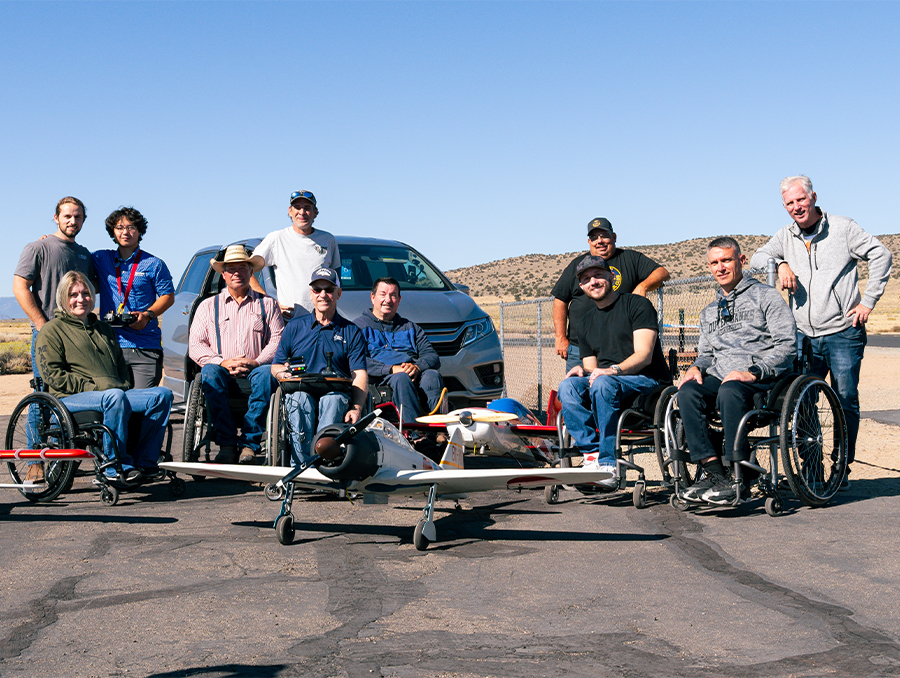
Early one morning, several adults with disabilities gathered at a small airstrip to try something many of them had never done before: fly radio-controlled airplanes.
It all started with a conversation between College of Education and Human Development colleagues and longtime friends Rod Case, Ph.D., and Scott W. Youngs. One day over coffee, Case posed a question:
“Have you ever thought about introducing this hobby I have - flying RC planes - to members of the community with disabilities?”
Case, an Associate Professor of TESOL, often spends his weekends flying model aircraft recreationally as a member of the Reno Radio Control Club (RRCC). And Youngs serves as the Project Director for the Nevada Assistive Technology Resource Center (NATRC) housed within the Nevada Center of Excellence in Disabilities (NCED). Youngs happens to be a wheelchair user.
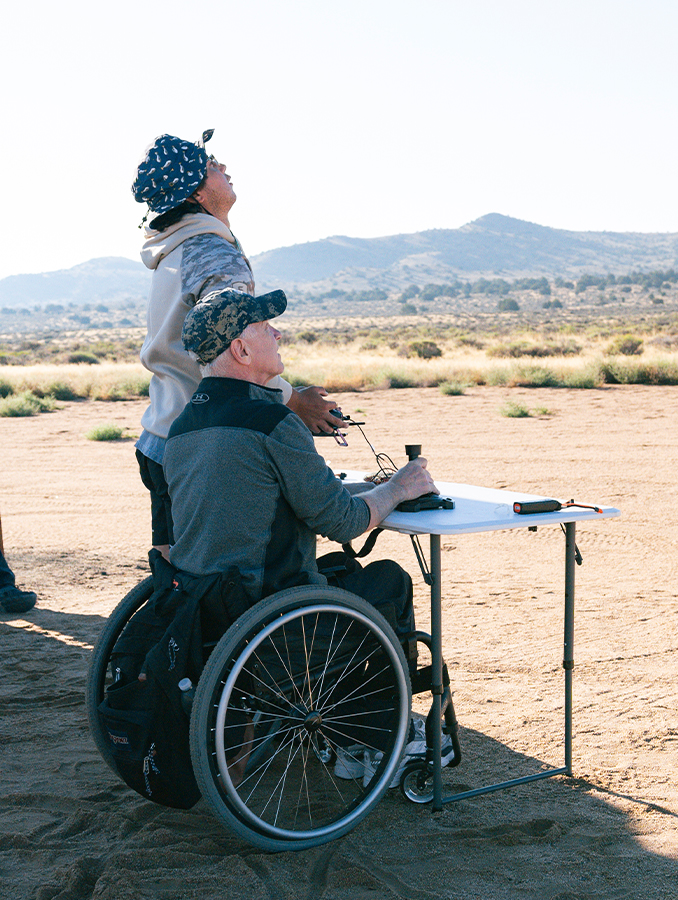
Scott Youngs flies a radio-controlled airplane.
“Many people, especially with more significant disabilities, have difficulty participating in hobbies and community activities,” said Youngs.
Not everyone can easily fly radio-controlled airplanes. Some people with physical disabilities, especially in their upper extremities, face barriers in manipulating standard radio controllers.
“The NATRC is a community-based program,” explains Youngs. “And we work to connect people with disabilities with technology that improves their functionality.”
Youngs certainly thought there would be an interest.
“We work to help people with what they're trying to accomplish, whether that be completing daily tasks or even flying RC planes,” said Youngs.
Inspired to share this hobby with an even broader audience, the two embarked on a mission to bridge the gap between accessibility and model aviation.
Initially, Case and Youngs had to brainstorm what adaptations somebody with a disability might need to use a radio controller. They enlisted the help of Ammon Dold, a student in the College of Engineering currently working at the NATRC.
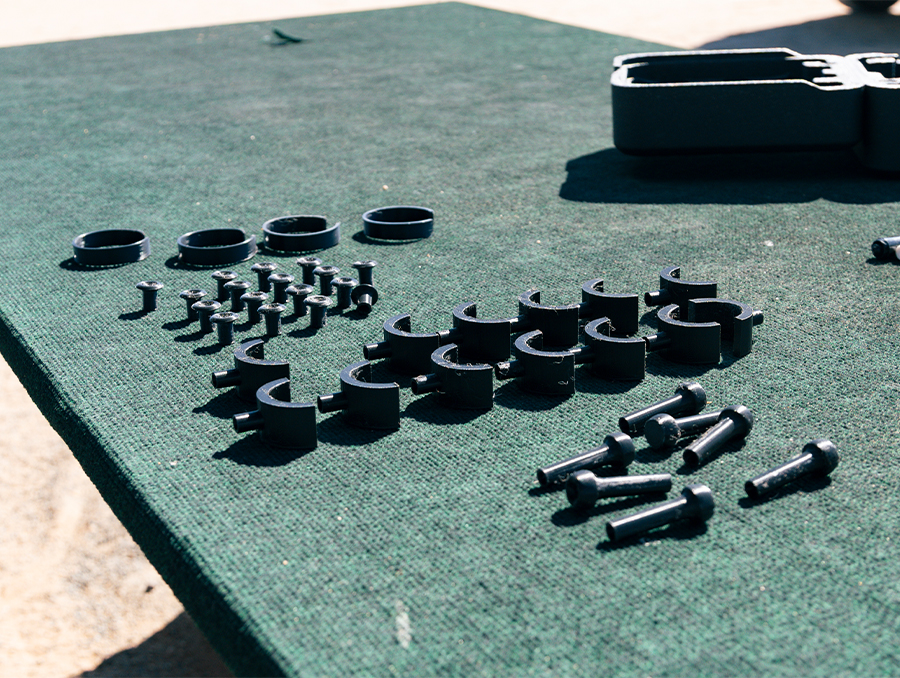
Accessible attachments for radio controllers.
Initially, Dold designed and 3D printed several attachments for radio controller sticks. Some simply extended the range of motion of the controller, while others allowed users to use their fists to manipulate the controller. However, these attachments didn’t work for everyone, so they went in a different direction.
“We had several people try a flight simulator, and found that a normal USB joystick that you would use to play a video game was easiest for them to use,” said Dold.
The joystick seemed to be the most accessible solution they were looking for, but they faced a problem: a device like a joystick sends a signal via USB cable, while model airplane controllers use a radio signal. To allow the joystick to control the plane, they needed a USB-to-radio translator module. While pre-existing translators do exist, all the options the team found were either too complex or expensive.
Drawing on his experience in coding, Dold began programming his own USB-to-radio translator module. After spending weeks on the module and writing several thousand lines of code, he had a working prototype. To refine the controller, the team recruited NCED members, RRCC members and close friends to test the module in the field and provide feedback. Both experienced model aircraft pilots and people new to the hobby were present for the test, and they gave important feedback regarding the sensitivity and maneuverability of the controller.
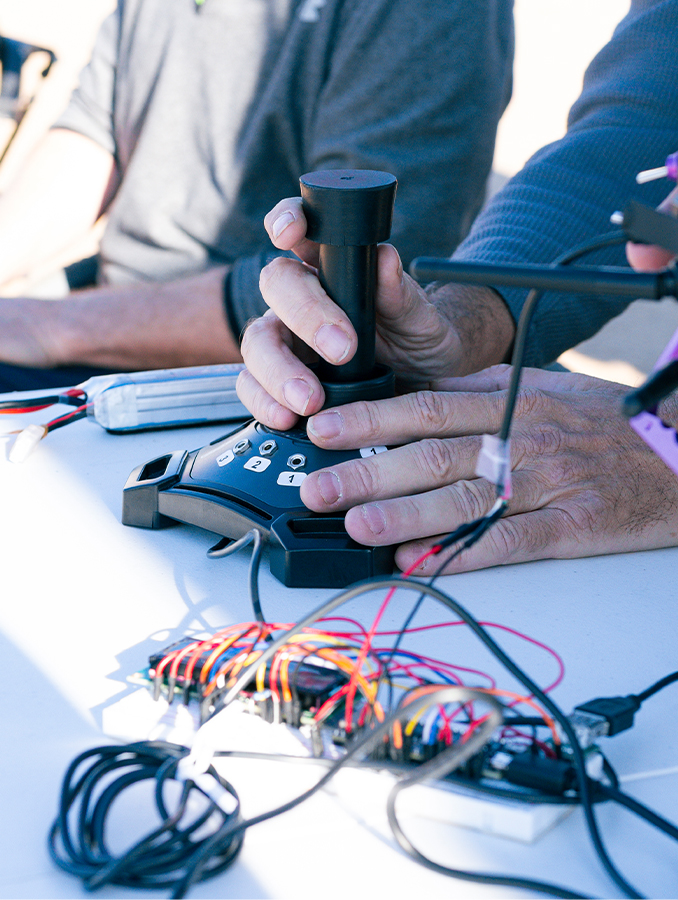
A user tries the joystick on test day.
The clock was ticking. Dold had just a few weeks remaining to implement the suggested changes before the public field day. Working through several iterations, version 4 of the module was presented at the field day on Saturday, Sept. 19. Finally, the NATRC team got to see the impact of their work with members of the community.
“It was awesome,” said Braden Bittick, an athlete and wheelchair user. Bittick was invited by Youngs, whom Bittick first met nearly two decades ago while studying at the University. “Everyone here was super helpful and put my nerves at ease, guiding and teaching.”
Bittick has experienced the challenge of finding adaptive hobbies firsthand.
“It's good to have opportunities like this, to have community and people around you, and it's just fun to be connected,” said Bittick. “It opens up your world.”
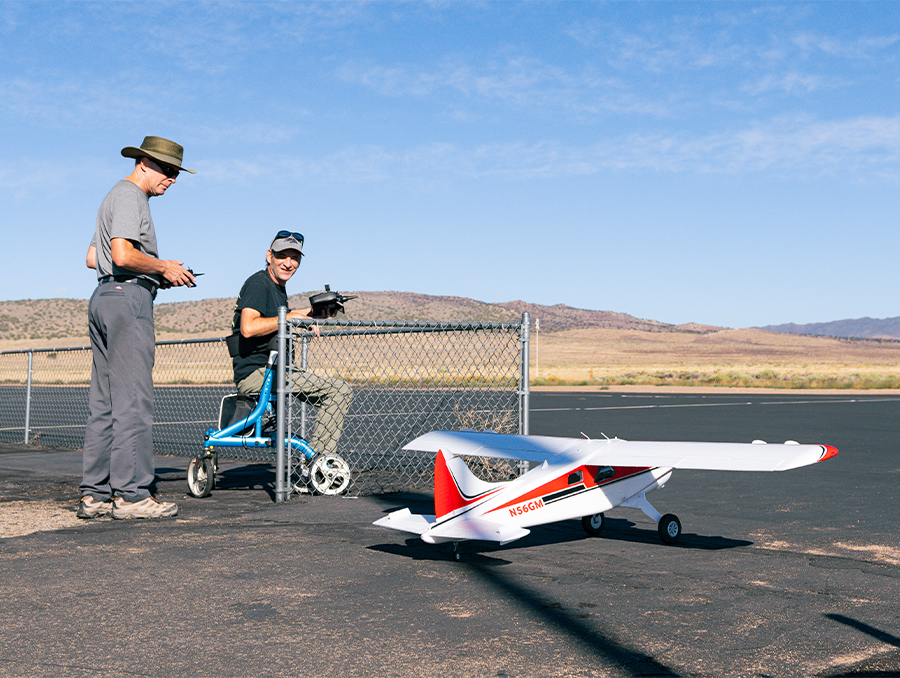
Two RRCC members prepare for takeoff.
Many radio controllers can be connected, which allows two pilots to operate one plane when one pilot is still learning. Dold’s module works by taking advantage of this feature: the USB joystick connects to a computer chip that translates the USB signal to a radio signal, then sends it via aux cord to the plane’s radio controller. This allows the joystick to take the place of the additional controller. During the field day, users with disabilities flew with the USB joystick, while RRCC members used a traditional controller to help them take off and land.
Projects like this also open opportunities for members of the disabled community who may not be able to participate in sports or other activities.
Allen Seals first met Scott Youngs in spinal rehabilitation after suffering a spinal cord injury that left him using a wheelchair. He initially learned to play several wheelchair sports, but now decades later, he can’t physically do the same things that he used to.
“I played other major wheelchair sports, but with age, I can’t do that anymore. But I can do this. And it was so cool,” said Seals.
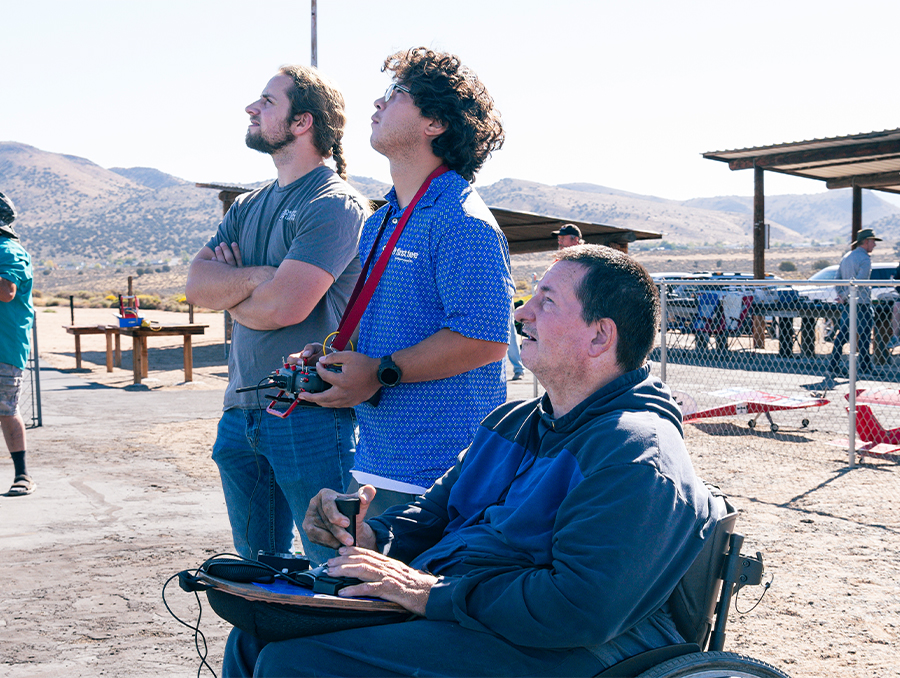
Allen Seals flies a radio-controlled airplane.
For Bittick, Seals and many others attending the field day, the accessible radio-controlled planes offered them more than just a chance to try a new activity. It reminded them of what they are capable of.
“As an engineer, one of the greatest feelings is seeing your creations used by others to improve their quality of life,” said Dold.
For the NATRC team, this is just the beginning. They want to keep hosting accessible model aircraft events and continue developing accessible controllers. Dold’s current version of the module is compatible with any kind of USB controller, and future versions are in the works that will be compatible with any kind of radio transmitter. The team also hopes to eventually create adaptive radio-controlled car and boat simulators, allowing those who might be bedridden to explore the world around them in a new way.
“For a lot of people, their social interactions are a very big need for their quality of life,” said Dold. “Getting people out, socializing, able to gain the confidence that they can do more than what they were originally told that they could do is huge.”


