On Friday, May 29, shortly before 2 p.m., a contractor working on a flooring project at the CASAT offices suffered a sudden cardiac arrest.
Several employees from the Center for the Application of Substance Abuse Technologies (CASAT), at the University of Nevada, Reno School of Public Health immediately responded. Those employees consisted of: Manda Brown, Michelle Berry, Bryana Guerra-Carrera, Sarah DiNatale, Kaitlyn Witt and Sophia Bassi. They quickly assessed the situation and moved into action. 911 was called, CPR was started and an automated external defibrillator (AED) was brought to the scene. The team continued providing care until first responders arrived.
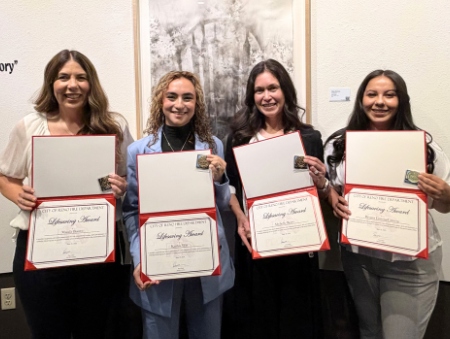
"The CASAT team and the responding University Police Department Northern Command officers’ quick thinking, calm response and willingness to act under pressure truly exemplify the very best of our community," said Muge Akpinar-Elci, M.D., MPH, dean of the School of Public Health. "This is a testament to what's possible when a community is prepared and ready to act."
First to arrive to the emergency call was University Police Department – Northern Command’s Officer Mario Mendieta, who immediately took over CPR efforts, and then Officer Ian Knight arrived to help direct Reno Fire and REMSA Health personnel to the area.
“Officer Mendieta's prompt response, decisive actions, and continued life-saving efforts helped sustain the victim during a critical medical emergency and contributed to the chain of survival that ultimately resulted in the restoration of the victim's heartbeat and transport to definitive medical care,” said Josh Reynolds, deputy chief, University Police Department - Northern Command. “This successful outcome was also the result of a coordinated response involving our public safety partners and the CASAT team who stepped forward in a time of need. Their collective actions demonstrate the shared commitment to protecting one another.”
After several defibrillation attempts, Reno Fire and REMSA were able to restore the contractor's heartbeat. He was transported to Saint Mary's Regional Medical Center for treatment and is recovering at home. The owner of the flooring company was also contacted shortly after the incident and was able to reach the contractor’s wife, helping ensure she had support and information during a difficult time.
The immediate administration of CPR and use of the AED before Fire and REMSA crews arrived were likely key factors that allowed the contractor to be revived and treated at a local hospital.
"I am incredibly proud of how staff responded that day. In an unpredictable and stressful moment, they acted, and because of that, someone is alive today. This is also a powerful reminder of why CPR and AED training matter," said Michelle Berry, MBA, executive director of CASAT.
According to the American Heart Association, immediate CPR can double or triple a person’s chance of survival after cardiac arrest. The American Red Cross also notes that survival chances decrease for every minute CPR and AED use are delayed, underscoring the importance of quick action in the first moments of an emergency.
The University’s Environmental Health and Safety department offers American Heart Association Heartsaver CPR/AED training for University students and employees at no cost. The course teaches adult CPR and AED use, as well as how to relieve choking in an adult.
Environmental Health and Safety also oversees the University’s Public Access Automated External Defibrillator Program. AED stations are located across campus in strategic locations selected in consultation with REMSA personnel. Each station includes an alarmed cabinet and a complete AED unit.
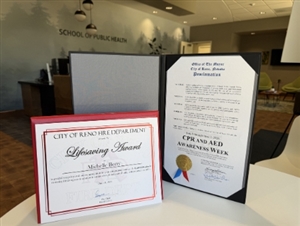
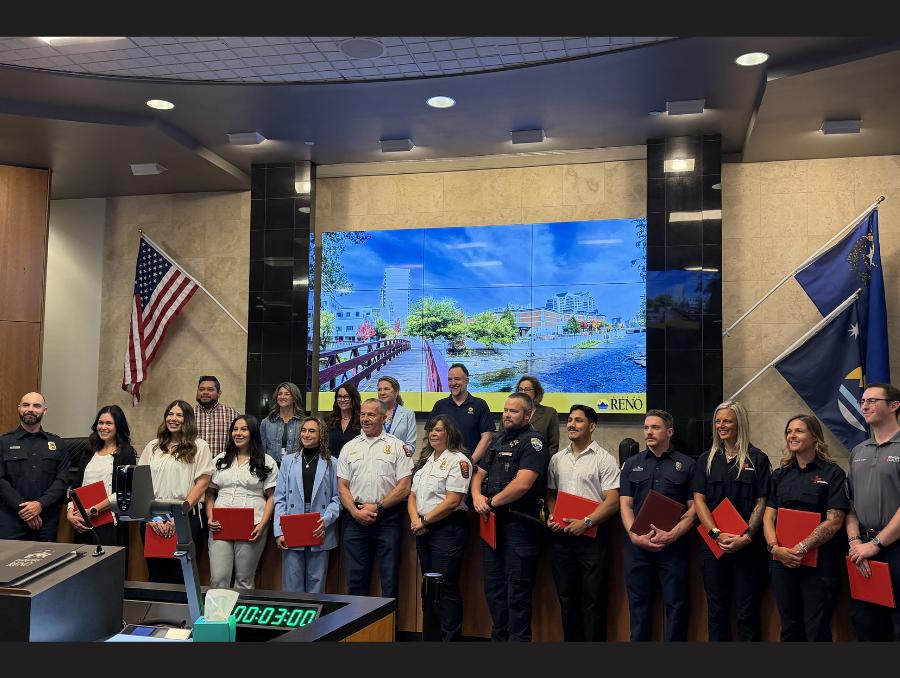
The team was later recognized during the June 10 Reno City Council meeting, where Nicholas von Foerster, M.D., medical director for the City of Reno Fire Department, described the response as an example of the “chain of survival” working the way it is intended.
Von Foerster said survival after an out-of-hospital cardiac arrest depends on several steps happening quickly, including recognizing the emergency, activating 911, beginning CPR, using an AED, providing advanced emergency care and supporting recovery at the hospital. In this case, he said, those steps aligned, beginning with the immediate response from CASAT employees.
The recognition added broader context to the team’s actions, underscoring how CPR, AED access and a willingness to act in the first moments of an emergency can help give first responders and medical teams the opportunity to save a life.
David Cochran, fire chief for the City of Reno Fire Department, also read a proclamation recognizing June 1-7, 2026, as CPR and AED Awareness Week. The proclamation highlighted the importance of CPR training, AED access and community preparedness when seconds matter most.
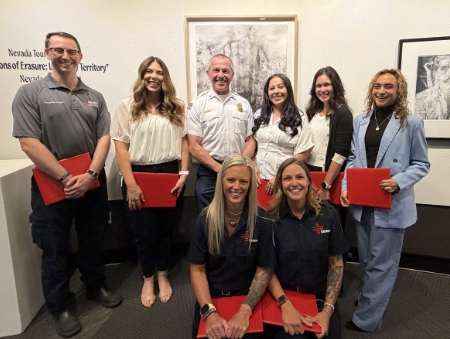
CASAT Staff, including Brown, Berry, Guerra-Carrera, DiNatlie, Witt and Bassi, were honored at the Reno City Council meeting on June 10, 2026, alongside Mendieta and Knight from UPDNC and members of the Reno Fire Department and REMSA.
For Akpinar-Elci, the emergency response and aftermath reflect the best of what it means to care for a community.
“This is a powerful reminder that public health is not only about systems, programs and research,” Akpinar-Elci said. “It is also about people being prepared and willing to act when someone’s life depends on it.”


