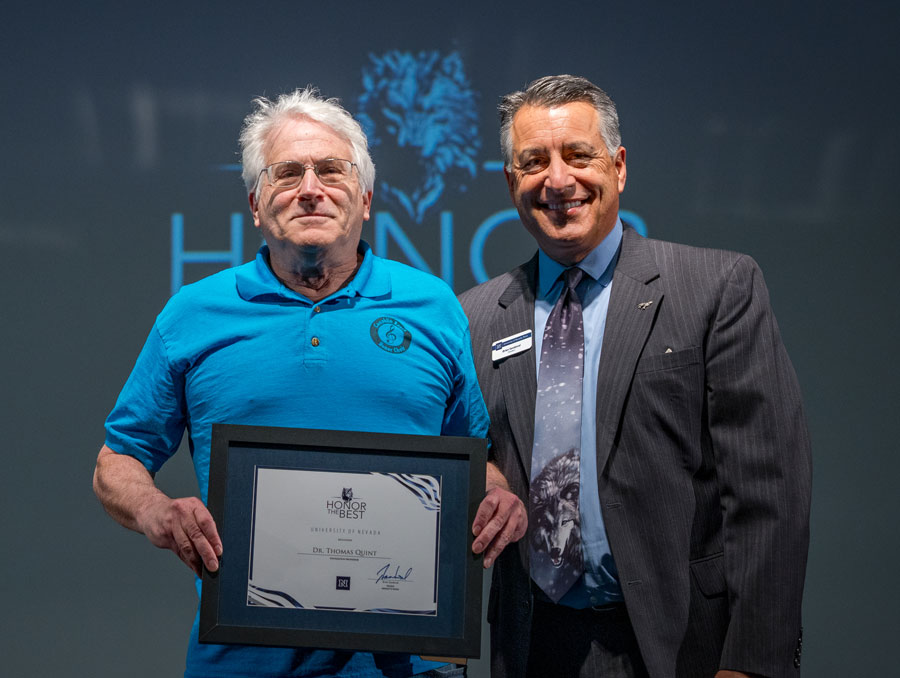
Thomas Quint, professor in the Department of Mathematics and Statistics, has worked at the University of Nevada, Reno for almost 30 years. This year, his dedication to the Wolf Pack was recognized as he was named Foundation Professor. The award comes with a $7,500 award per year for three years to be used for professional work.
Quint studies game theory, which studies and analyzes conflict situations, and is an advisor for undergraduate students. He shares some reflections on his career below.
After nearly three decades of working at the University, how have your research interests evolved over the years?
Let me start with a little background on terminology. Game theory is the modelling and analysis of "conflict situations," involving two or more players. So, think of parlor games such as bridge or chess, but also other situations such as firms competing in a market, politicians vying for power, or even single people navigating a "marriage market." It further divides into noncooperative game theory (in which we emphasize modelling the way players choose strategies to maximize their own payoff in the presence of others), and cooperative game theory (in which we emphasize modelling the way players take into account which coalitions of other players to join up with).
Like many academics, I started out doing research in the area of my doctoral dissertation. For me, that was in the theory of matching games. Matching games are cooperative games in which the main object is for players to "match up" with other players in an optimal way — an example being the "marriage game" mentioned above. From there I branched out, writing papers on other areas within cooperative game theory, then noncooperative game theory, the "theory of money," graph theory (also known as network theory), and then the use of game theory to model phenomena within cell phone markets. Throughout all this, my interest has always been in mathematical theory, not applications. To me, that’s where the art is.
You are one of only three professors to earn the title Foundation Professor this year. To what do you attribute your success?
My impression is that the Foundation Professor award is for career achievement as a tenure-line faculty member at the University. As such, I think one needs to contribute in all three areas – research, teaching, and service – in order to be considered. So, many people around the University campus know me as the guy that knows a bit about game theory, but others know me as the guy that developed the math courses in discrete math, operations research and game theory. Others know me as the guy who has been an undergraduate advisor for our majors since the 1990s. And still others know me as the guy who has scheduled all of the Math and Stats Department courses over the years.
What have you learned from teaching incoming freshmen the basics of math?
Doing this helped me come up with a basic philosophy of teaching. It includes writing a lot on the board (so that even students not following will at least have a good set of notes for later), having the students work on a lot of homework problems, and maintaining a collegial atmosphere in the classroom. That last part sometimes requires a sense of humor!
A transformative moment for me occurred early in my career at the University. It was early in the semester, I was teaching calculus, and we were going over some homework problems in class. In particular, I was discussing a problem in which the students needed to calculate the force of gravity on a spaceship as it travelled through the atmosphere. I asked the students for ideas on how to solve the problem. No response. I stood in front of the class, hands on hips, hoping for a volunteer.
Finally, out of desperation, I blurted out, "Come on people, this is an easy problem. It’s not rocket science!"
But of course, it was rocket science, and the classroom erupted in laughter. The connection was made, and thereafter the class went well.
What does this award mean to you?
I am happy that my colleagues within our department and around campus, whom I respect and admire, have recognized me in this way.
In my early years after my Ph.D., I really struggled. I went through nine years of postdocs in an effort to gain a tenure-line position at a university, until this university gave me a chance. Thank you, University of Nevada, Reno! So, gaining this honor is kind of a vindication for me, and so means a lot to me. To paraphrase John Lennon, I have “passed the audition.”
What current/upcoming research projects of yours are you most excited about?
I am probably most excited about two projects I am working on with my two current graduate students. One lies within the theory of matching games, trying to determine (true or false) a conjecture that I've had since the 1990s. My master’s student showed that the conjecture is true for four-player games; is it true for larger games? The other is a more open-ended project in graph theory that I began with my co-author T.S. Michael a few years ago, before he tragically passed away. My Ph.D. student is working on that now.
What past projects or research efforts are you most proud of?
I am most proud of my 25-year collaboration with Martin Shubik. Shubik was one of the pioneers of game theory, back in the early 1950s, along with Lloyd Shapley and John Nash (who was the subject of the Oscar-winning movie "A Beautiful Mind"). Shubik and I wrote ten research journal articles together, as well as one book. It was a treat to work with such an imaginative and creative mind, as well as to hear many of the stories about the early days of game theory.


