They pull us in, literally and figuratively.
Black holes — remnants of collapsed stars — have immense mass that curves spacetime so all paths lead inward. They also capture the popular imagination as sci-fi plot devices and metaphors for the unknown. The attraction may be even greater for scientists seeking to understand cosmic mysteries.

“They’re just this crazy enigma,” Erika Gwin, physics Ph.D. student, said.
Gwin is working on a research project with physics Associate Professor Richard Plotkin and computer science Professor Sergiu Dascalu to answer a big question: why do some black holes shoot out brighter jets than others?
As Plotkin explains it, scientists study black hole X-ray binary (BHXB) systems in which a black hole and a companion star circle each other. Gas from the star falls towards the black hole, typically forming a disk shape — “kind of like a spinning pizza or Frisbee,” Plotkin said — known as an accretion disk. As the accretion disk spirals toward the black hole, it heats to extreme temperatures, releasing X-rays that can be observed with specialized telescopes. Some of the disk’s gas and particles fall into the black hole, while jets of plasma — charged particles — sometimes shoot out from opposite directions and emit radio waves.
The mystery is why some jets appear brighter than others when comparing two black holes that appear to be “eating” gas at the same rate.
“This is a big question... that we’re trying to understand in the (astronomical) community,” Plotkin said.
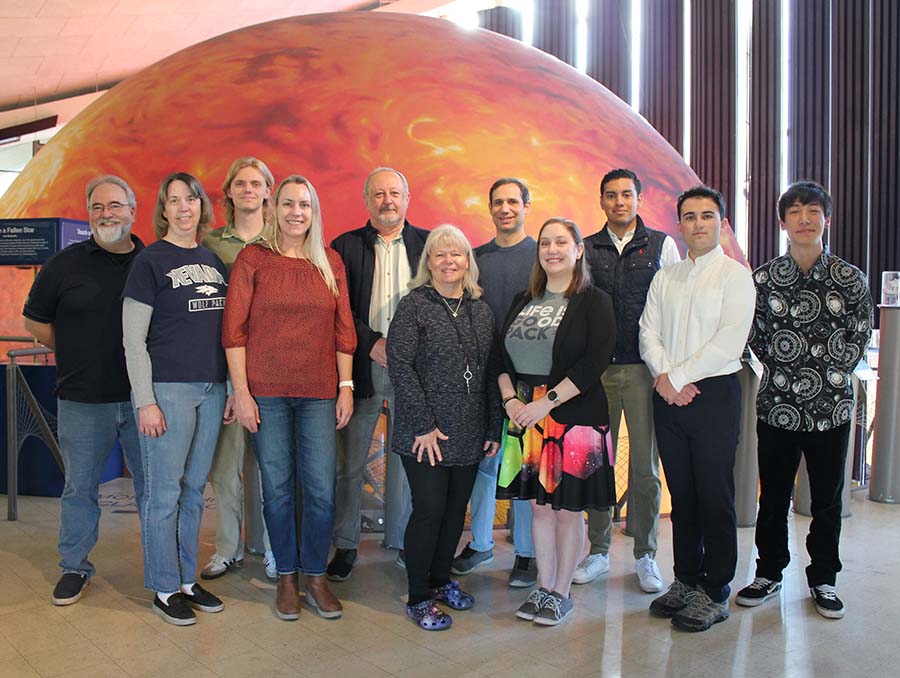
Supporting that effort, the National Science Foundation Division of Astronomical Sciences awarded a three-year, $488,967 grant in August 2025 for the project “Reimagining the Disk-Jet Connection in Hard State Black Holes.” Plotkin is the project’s principal investigator, and Dascalu — with whom he has collaborated on research papers — is the co-principal investigator. Gwin, the physics Ph.D. student, is on the research team, along with physics Ph.D. student Audrey Lang. Computer Science graduate student Joshua Galindo Lopez also is working on the project.
Getting the data — and sharing it
To answer a big question, you look at the data.
But when it comes to black holes, there’s — well — a hole in the data.
“We believe around 100 candidate black hole X-ray binaries have been observed in our Galaxy, of which we have definitively confirmed around 20 to be black holes,” Plotkin said. “But the prediction is that there’s millions of black holes out there in our Galaxy .... millions of black holes, of which tens of thousands are probably in binary systems.”
So how will they account for the missing data for black holes that haven’t yet been observed?
That’s where Dascalu, a computer scientist with expertise in data science, comes in. Through data imputation — the replacement of missing values in a dataset with statistically estimated values — the team can explore the BHXB jet question more thoroughly and provide other researchers with this enriched dataset online.
“We thought it’s a cool idea to have a website, a portal,” Dascalu said, that researchers around the world could access for analysis and investigations.
Dascalu will be working from data samples that have been gathered since the 1990s. That data came from about a dozen telescopes, most notably the Very Large Array, a radio telescope in New Mexico, and various X-ray telescopes like NASA’s Chandra X-ray Observatory and NASA’s Neil Gehrels Swift Observatory.
These data samples, however, have become “messy” over time, according to Plotkin. Various research groups have their own catalog of the samples.
“This group will publish with their catalog; this other group will publish with their catalog, and so forth,” Plotkin said. “So when you’re trying to compare...it can be hard to know if this is really the physics of what’s happening, or are you seeing something that’s unique to your version of the data?”
That’s where Gwin comes in: she’s reviewing all black hole X-ray binary research published in the past couple decades and will create a unified catalog available to all researchers. She’ll be looking at observational data such as the radio and X-ray brightness, but also energy and behavior metrics, spectral information and other details.
“There’s lots of tabulations that we’re going to be doing, so all these things are going to be conglomerated,” Gwin said. “And then we can use these regression techniques to figure out a little bit more about the physical properties of the systems. By studying black holes, we can help put together those missing puzzle pieces of the Universe.”
Lang, the other physics Ph.D. student, will use the data to try to discover new black holes in our galaxy.
“I never thought I would get to study black holes, but now I’m working on finding new ones and expanding our understanding of observable properties,” Lang said. “It’s all just really exciting.”
Galindo Lopez, the computer science student, will work with Dascalu on data visualization — or representing the data on a dashboard in various formats. Additionally, this academic year, a computer science and engineering senior project team composed of Ethan Claire, William Chuter-Davies and Jacob Xie will be developing a pilot version of the data visualization and analysis portal.
“So, you see how important the students are,” Dascalu said.
In addition to the research, the students are participating in the outreach portion of the project. Gwin and Lang, along with Plotkin and two other University of Nevada, Reno graduate students, gave a presentation on black holes and gravity at North Valleys High School in November, and Plotkin said additional presentations at middle schools around the state are planned. The team also is working with Fleischmann Planetarium and the College of Education’s NevadaTeach Program on school field trips as well as partnering with Great Basin National Park near Ely, Nevada, an International Dark Sky Park.
“We’re trying to use this to talk to students across the state to inspire the next generation of scientists,” Plotkin said.


