Look out over Lake Tahoe on a clear day and the water plays a trick on you.
Lean over the side of a boat, and you can see straight down, past your own shadow, to boulders far below. In some places the lake drops 1,645 feet, and it is so clear it can feel like there’s nothing there at all.
There is. A lot, actually.
Below that surface is a world most visitors never see: forests that grew a thousand years ago and still stand underwater, creatures too small to spot with the naked eye, and plastic fibers from someone’s laundry.
“We drive past this lake all the time, but we don’t realize how much is going on in it,” said Kylie Papson, communications and education outreach coordinator at the University of Nevada, Reno's Tahoe Institute for Global Sustainability and curator of the exhibit.
That unseen world is the focus of “What Lies Below Tahoe,” now open at the University of Nevada, Reno at Lake Tahoe. Developed by the Tahoe Institute for Global Sustainability and located in the Tahoe Center for Environmental Sciences building, the exhibit takes visitors down through the depths of the lake: the particles that determine clarity, a forest standing on the lakebed, the microscopic life and the sensor network researchers use to track it all.
Admission is free, and the exhibition runs through the fall semester. Papson hopes visitors leave the gallery more curious than they arrived and with a renewed sense that the lake’s ecological future is within our control.
"Though it can sometimes feel daunting to protect this beautiful place from increasing pressures, including from climate change, there is incredible research happening right before our eyes," she said. "It’s not just an empty void: there are plenty of people doing great work here, and to protect the lake, we must continue to support research efforts at Lake Tahoe."
Designed as a dive
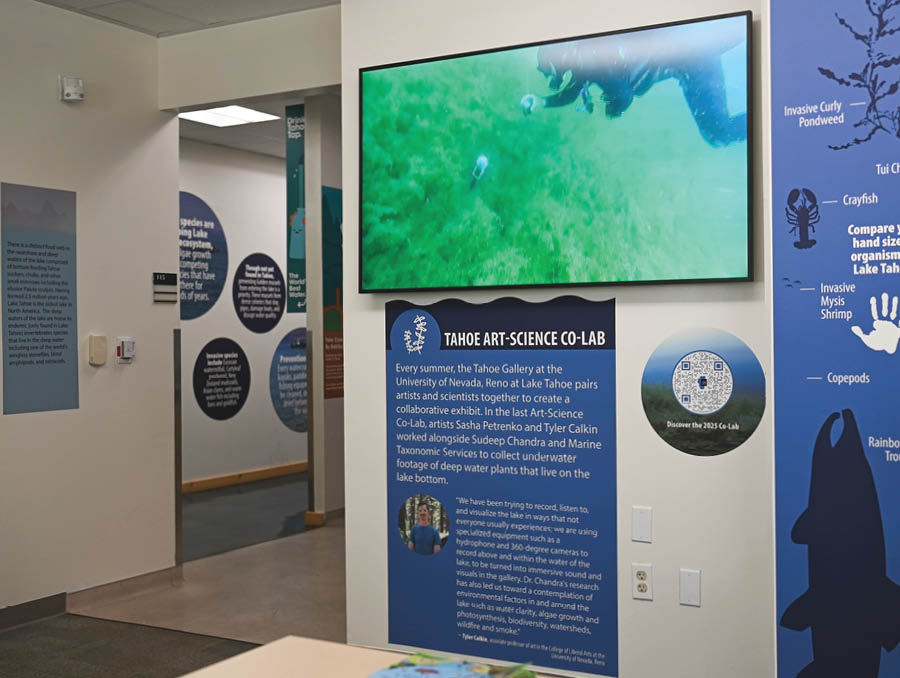
Papson designed the exhibit to feel like a dive.
“I had this idea of designing it from the shore and going deeper and deeper and deeper,” she said, “and then coming back out as you leave.”
The first section introduces visitors to some of the forces that shape Lake Tahoe, from the streams that feed the lake to the sunken ships on the lake floor, the University’s research vessel and the particles floating in its water. It also explores how scientists monitor the basin and track changes over time.
The research of Carina Seitz, research assistant professor in the Department of Biology at the University and faculty at the Institute, anchors this wall. Seitz’s research at Lake Tahoe is helping local policymakers and regional managers uncover the dynamics of water particles in the lake and how they influence water clarity.
“One part of our research looks closely at the living and non-living particles found throughout Lake Tahoe and how they influence its famous clarity,” Seitz said. “At the same time, Tahoe Environmental Observatory Network’s land-to-lake sensor network gives us a long-term view of how the Tahoe Basin is changing, helping us detect emerging threats and provide the science needed to protect the lake’s future.”
A forest at the bottom of the lake
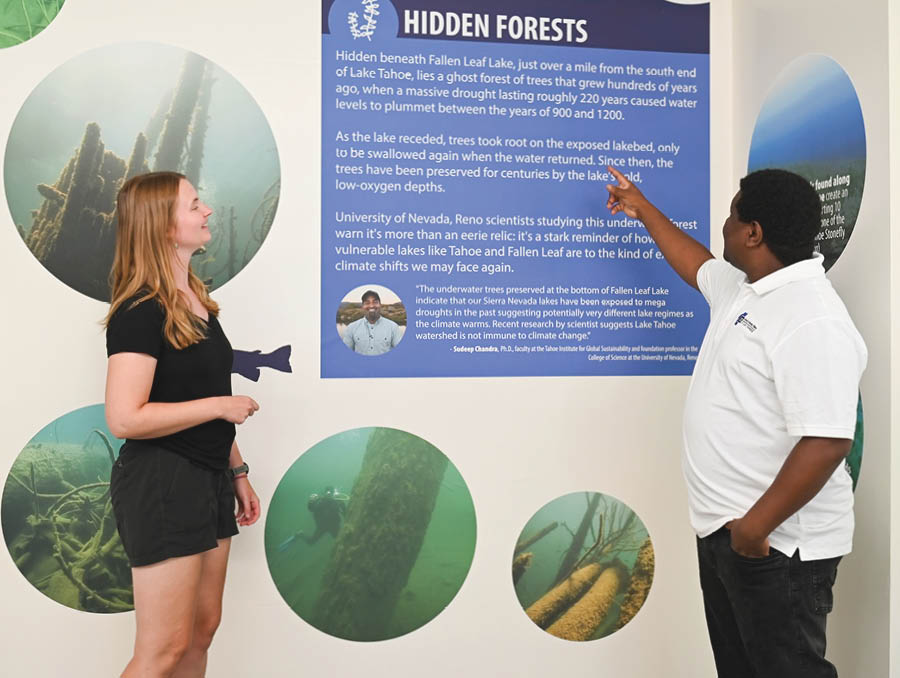
One of the exhibition's most striking features tells a story that begins centuries before modern scientific monitoring existed. Between the 900s and 1200s, prolonged drought lowered Lake Tahoe and Fallen Leaf Lake water levels enough for forests to grow in areas that are now submerged. When water levels eventually rose, the trees remained, preserved by the lake's cold depths.
Divers from Marine Taxonomic Services, working with University scientists, filmed these forests and deep-water plant beds, and that footage plays on a screen inside the exhibit. For scientists, the submerged trees offer clues about what Lake Tahoe looked like during past droughts. They also help researchers understand how the lake and surrounding landscape have changed over time. Papson calls the footage the exhibit’s must-see attraction; a discovery that caught her by surprise. Despite growing up nearby, she had never heard that Lake Tahoe and nearby Fallen Leaf Lake hid underwater forests.
“It’s a look into this secret world under Tahoe that you can’t see otherwise,” she said.
Where the plastic comes from
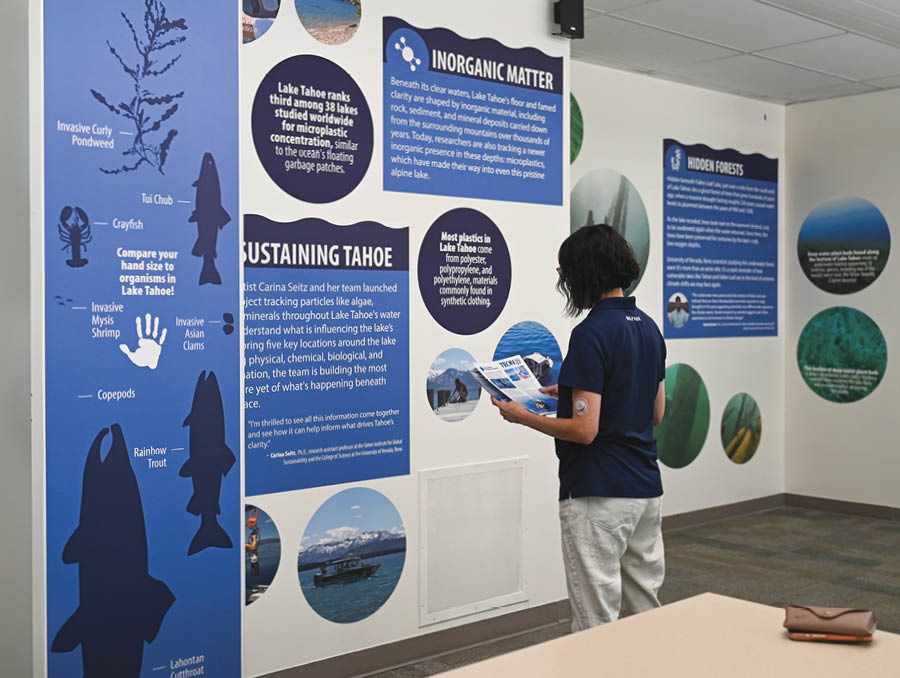 Photo by Yasmin Barbosa.
From the forests, the exhibit shifts to the lake's food web. Visitors learn about plankton, bacteria, fish and crayfish, and how species depend on one another. Much of this activity happens out of sight but plays an important role in keeping the ecosystem healthy.
The microplastics wall carries the exhibit’s most unexpected finding. A recent University study found Tahoe among the highest microplastic concentrations of dozens of lakes reviewed worldwide. Some come from synthetic clothing, which sheds fibers during washing and drying. Those fibers can eventually make their way into the environment.
“Many people know about the presence of microplastics,” Papson said. “But people might not know where the majority of that plastic is coming from.”
Watching the whole basin
The exhibit ends with a look at the newly launched Tahoe Environmental Observatory Network, or TEON, which uses sensors around the basin to track environmental change.
The idea behind TEON is simple: what happens in the forests and streams above the shoreline eventually affects the lake itself. By monitoring the whole basin, researchers can better understand what's happening in Tahoe and why.
Maintaining that network requires year-round fieldwork, including underwater operations to deploy and retrieve scientific sensors. Some of that work takes place during Tahoe's cold winter months.
Someone has to retrieve the underwater sensors. Emily Carlson, a biologist and certified scuba diver with the Institute, dives for them year-round, including in winter, when the work requires roughly 80 pounds of gear, and when the R/V Liberty is often the only boat out.
Much of the research showcased in the exhibit is published in academic journals, where the people who live around the lake are unlikely to encounter it.
"This exhibit translates our University's research into something the public can experience and learn from,” said Executive Vice President and Provost Jeff Thompson. “The words and imagery have a lasting impact that extends far beyond academic journals. As Nevada's flagship land grant university, it's our mission to ensure this research serves the public. And Lake Tahoe is one of the most meaningful places where we can bring this mission to life."
Scott Hinton, teaching assistant professor in the University’s Department of Art, Art History and Design and a professional photographer, advised on the layout, the imagery, and the installation of the exhibit.
"When visiting Lake Tahoe, it is common for us to scan across the landscape and see the mountains, the green of the forest or to gaze through the clear waters that make Lake Tahoe unique," Hinton said. "Looking through the microscope, one gets to make visible that which is invisible to the naked eye, and understand the complex makeup of good and bad particles shaping Lake Tahoe's clarity."
Plan your visit
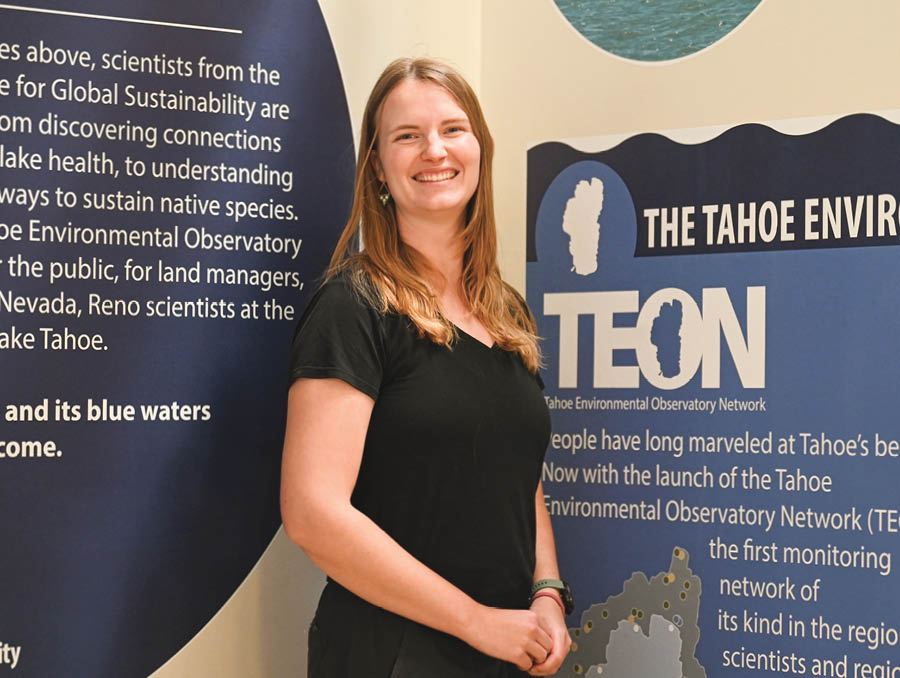 Photo by Yasmin Barbosa.
“What Lies Below Tahoe” is free and open to the public from 9 a.m. to 5 pm., Monday through Friday, at the Tahoe Center for Environmental Sciences at the University of Nevada, Reno at Lake Tahoe, and runs through the fall semester. K–12 teachers and other groups can arrange a visit, and guided tours led by the scientists themselves are available on request. Contact Kylie at kpapson@unr.edu. The Tahoe Institute is also planning public talks with the researchers featured in the exhibit, along with Tahoe Taproom Talks at Alibi Public House in Incline Village.


