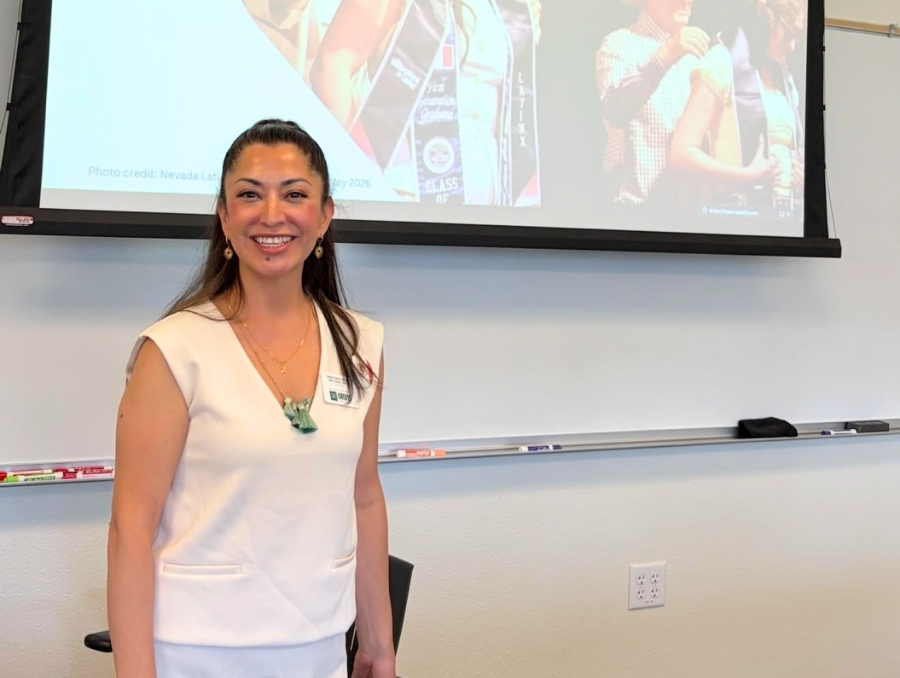
In this first-person narrative, Orvis School of Nursing professor, director of Latinx Nursing Advocacy and Advancement and doctoral student, Vania Carter-Strauss, MSN, APRN, FNP-BC, reflects on how her mother's mole recipe helped inspire her doctoral project and approach to mentorship.
I was in my third semester of doctoral studies. This was the semester every Doctor of Nursing Practice student both anticipates and fears. It was finally time to implement my doctoral project: "A Faculty Development Program to Enhance Faculty Multicultural Self-Efficacy in Support of Latinx Nursing Students."
For more than a year, I had lived and breathed this work. I had combed through hundreds of research articles, conducted exhaustive literature reviews, built Qualtrics surveys, searched for validated measurement tools, met with my faculty chair and university leaders, secured QIRC approval and written page after page of my manuscript. Every box had been checked.
Now all that remained was to teach it.
The faculty development workshop would last four hours, and I needed to create the presentation slides. I opened PowerPoint, created the title slide, introduced myself, shared why this work mattered to me, and then ...
Nothing.
I knew the evidence. I knew the statistics. Nearly one in five people in the United States identifies as Latino. Yet, only about 7% of registered nurses are Latinx, a persistent gap in representation that has implications for health equity and the communities we serve.
I knew that our students often navigate an educational pipeline shaped by systemic inequities, financial hardship, cultural isolation and countless barriers that contribute to attrition. I knew the literature. I knew the recommendations. I knew the data, and I had even lived it, as a first-generation Latina who grew up in East Los Angeles in the 80s and was a direct product of the Latino educational pipeline.
So why couldn't I tell the story?
Week after week, my deadline crept closer. I would open my slide deck, stare at the handful of introductory slides, and close my laptop without adding a single word. I wasn't experiencing writer's block.
I was experiencing something deeper.
Every version of the presentation felt like every presentation I had ever sat through - slides crowded with statistics, graphs, citations and bullet points. Everything was technically correct, yet none of it reflected the work I had devoted myself to or the communities I hoped to serve.
The project deserved more than information. It deserved an experience.
I didn't want participants to simply learn about Latinx nursing students. I wanted them to feel something. I wanted them to remember. I wanted them to leave the room understanding that culture is not a demographic variable on a slide; it is memory, identity, family, belonging and love.
"Culture is not a demographic variable on a slide; it is memory, identity, family, belonging and love."
And then one mid-week morning, after weeks of making no progress at all, I found myself walking through the aisles of our local Latino market – one of my favorite ways to procrastinate.
I filled my basket with freshly made tortillas, queso fresco, cilantro, Mexican chocolate, sesame seeds, cinnamon, garlic, onions and any ingredient that gave me comfort. I immediately felt the urge and craving to make one of my favorite childhood dishes: chicken mole!
Not just any mole. My mother's mole.
She is alive and well. I could have called her in less than thirty seconds and asked her for the recipe. She would have happily talked me through every step.
But I didn't.
Somewhere deep down, I knew that wasn't what I needed. I needed to remember it for myself.
Not just the ingredients, but the experience. The smell of toasted chiles filling the kitchen. The rhythm of my mother's hands moving effortlessly from one step to the next. The warmth of the steam rising from the pot. The sound of conversation around the table. The smokiness of her secret ingredient and, most importantly, the experiences that surrounded it.
Intentional reflection asks us to do more than remember facts. It asks us to revisit experiences so completely that we can recall their texture, their emotions and even their taste and aromas.
Without realizing it, I had stepped away from my PowerPoint and into the very lesson I had been trying to teach.
The literature tells us time and time again that mentorship matters to student success, particularly for Latino and other historically underrepresented students. Yet not every faculty member feels prepared for that part of education.
We know how to teach our areas of expertise. We know our disciplines. We know our content. Mentorship is different.
Faculty may worry about saying the wrong thing. They may wonder whether they can relate to a student whose life looks very different from their own. They may feel like they don't know the right resources or have the right answers.
But the reality is that most students don't need us to have all the answers. They don't need us to look like them or to have experienced exactly what they have experienced.
They need authentic connection.
And perhaps that connection begins not with knowing everything about someone else's story, but with being willing to reflect deeply on our own.
"Perhaps that connection begins not with knowing everything about someone else's story, but with being willing to reflect deeply on our own."
Because we have all struggled. We have all overcome something. We have celebrated successes, experienced failures, grieved losses, taken risks, or built something we are proud of. Somewhere within our own lived experiences are the emotions that allow us to connect with another human being, even when the details of our stories are entirely different.
I ran home and spread all of my ingredients across the kitchen counter.
I hadn't even started cooking, yet the colorful display in front of me was already doing something. The memories started to unlock.
I slowly began working through the steps.
Mole is not a dish you rush. Depending on the recipe, the ingredient list alone can feel endless, and every family seems to have its own variation. Recreating someone else's mole, especially one stored more in memory than on paper, can feel nearly impossible.
I boiled tomatoes, dried chiles, onions and garlic. I added aromatics to the pot with the chicken.
And, most importantly, I thought.
I thought about my own journey and what it meant to be a direct descendant of the Chicano Movement (El Movimiento). The movement that gave us Dolores Huerta’s championing of labor rights, staged high school walkouts against unequal education and the rallying cry “¡Sí, se puede!”. A movement that fought for educational opportunity, representation and the right for Latino stories to exist within the institutions that had so often excluded them.
I thought about growing up in East Los Angeles.
I thought about living through the 1992 Los Angeles uprising following the Rodney King verdict - a pivotal moment in my childhood that made it impossible to ignore how much the color of our skin can shape the way we move through the world, and how quickly our visible differences can become a source of division, inequity and even violence. I thought about my experience with LAUSD's desegregation busing program, an effort intended to create greater educational equity for marginalized communities, but one that, through the eyes of a child living it, created new barriers, dangers and distances.
I kept cooking.
The house grew warmer. The smell of chiles, garlic, spices and chocolate settled into every room. With every step of the recipe, another memory seemed to surface.
Eventually, I reached my mother's secret ingredient.
A burnt tortilla.
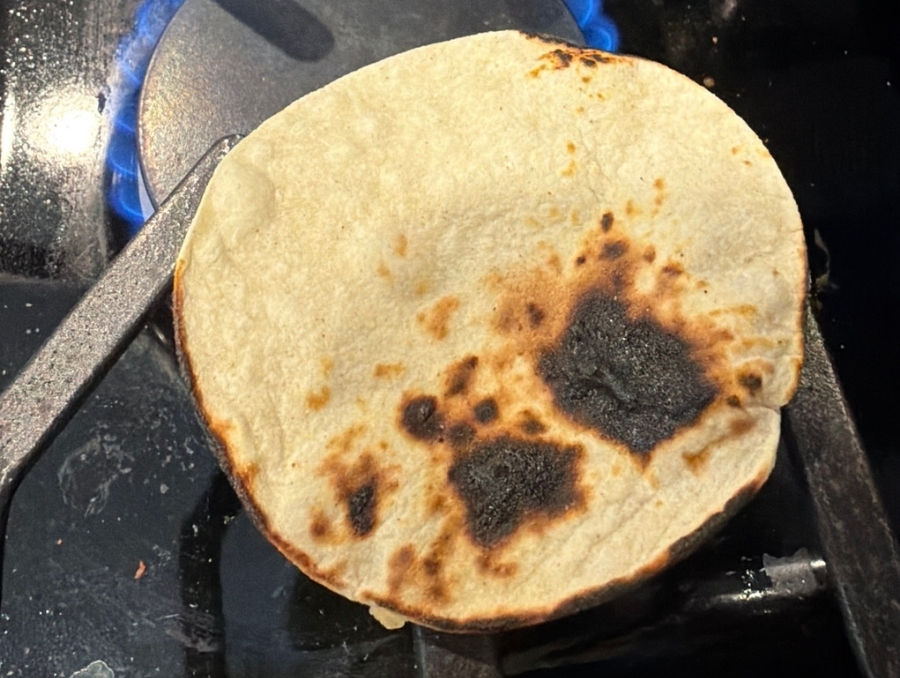
She would take a tortilla and char it directly over the flame until it became dark, almost completely black in places, before blending it into the mole. It added a smokiness and depth that I could always recognize but had never really thought much about.
Until that morning.
I placed the tortilla over the flame.
It blistered, then browned, then blackened. Smoke curled upward as I flipped it back and forth over the stove. Soon, I had filled the kitchen with it.
And standing there, holding that burning tortilla over the flame, I was suddenly overwhelmed by how deeply I could feel everything I had been trying so hard to put onto those slides.
The smoke rising from my mother's tortilla felt like more than smoke.
There was something almost spiritual about it.
"Here I was, trying to recreate a recipe passed from my mother to me while thinking about the generations that came before me; those who immigrated, adapted, endured, protested, organized and fought for access to education, creating opportunities they might never personally experience."
Here I was, trying to recreate a recipe passed from my mother to me while thinking about the generations that came before me; those who immigrated, adapted, endured, protested, organized and fought for access to education, creating opportunities they might never personally experience.
I thought about my own family, about being the first generation born in this country and the first generation to graduate from college, and about all that had to happen before me to make either of those things possible.
I thought about Saturday mornings as a child, waking up and looking down to find my uncle or grandfather asleep on the floor beside me. There would be traces of the journey still clinging to them - mud on their clothes, twigs caught here and there - and somehow, even as a child, I understood what that meant.
They had crossed the border to visit us. To stay connected to familia.
What I remember most, though, is not the mud or the hardship.
I remember their smiles and loud laughter.
That contrast has stayed with me my entire life. I knew there had been sacrifice, exhaustion, fear and probably pain that I was too young to fully understand. Yet what they brought into our home was laughter. Stories. Warmth. Joy.
My family taught me early that hardship and happiness could exist in the same room. That sometimes you laughed in the face of adversity. You made light of the pain; not because it wasn't real, but because you refused to let it be the only part of the story.
And somehow, standing in my kitchen all those years later, those memories were still there.
And now their descendant was standing in her kitchen, burning a tortilla while trying to finish her doctorate.
I hoped it was one of their wildest dreams.
The significance of that was not lost on me.
And suddenly, I understood exactly what I needed to do.
Well, first I needed to finish the mole.
I chopped large chunks of chocolate Ibarra and dropped them into the pot, watching them slowly disappear into the sauce as it transformed into a thick, dark, almost mystical black.
When my mother made mole, I always stole a few pieces of the chocolate before she could add them to the pot. So, naturally, I couldn't skip that part either.
I stole a piece.
"And for just a moment, I wasn't a doctoral student worried about deadlines, implementation plans, measurement tools or faculty development. I was a little girl in my mother's kitchen again, recalling all of the experiences that had made me who I was today."
And for just a moment, I wasn't a doctoral student worried about deadlines, implementation plans, measurement tools or faculty development. I was a little girl in my mother's kitchen again, recalling all of the experiences that had made me who I was today. Some were joyful. Some were shocking. Others were challenging and painful. But all of them had added something.
They had given my life flavor, ¡sabor!
I finished the mole and ate dinner with my family, secretly hoping the smoke from the burnt tortilla still lingered in the air. Enough to settle into my children’s hair, their clothes, and somewhere deeper. Enough that, years from now, the smell might find them again and bring them back to this moment, just as it had brought me back to my mother's kitchen.
And afterward, I opened my laptop.
This time, I didn't stare at the same handful of slides.
I wrote.
The thoughts that I had struggled for weeks to find suddenly poured out of me. The statistics were still there. The literature was still there. The evidence hadn't changed. But now it had something I hadn't been able to find before.
Connection.
"My doctoral project started coming together much like the mole I had just made, not from any single ingredient, but from layers. Evidence. Experience. Memory. Culture. Reflection."
The parts of my project that had felt cold and distant began to take on character and meaning. My doctoral project started coming together much like the mole I had just made, not from any single ingredient, but from layers. Evidence. Experience. Memory. Culture. Reflection. Each one adding something the others couldn't provide on their own.
For the first time, the presentation felt like the work I had actually set out to do.
I built the slides.
Then I started making phone calls.
I reached out to community members, campus resources and colleagues I had worked alongside for years, the people and leaders who had been doing this work long before it became a slide in my doctoral presentation. I invited them to come.
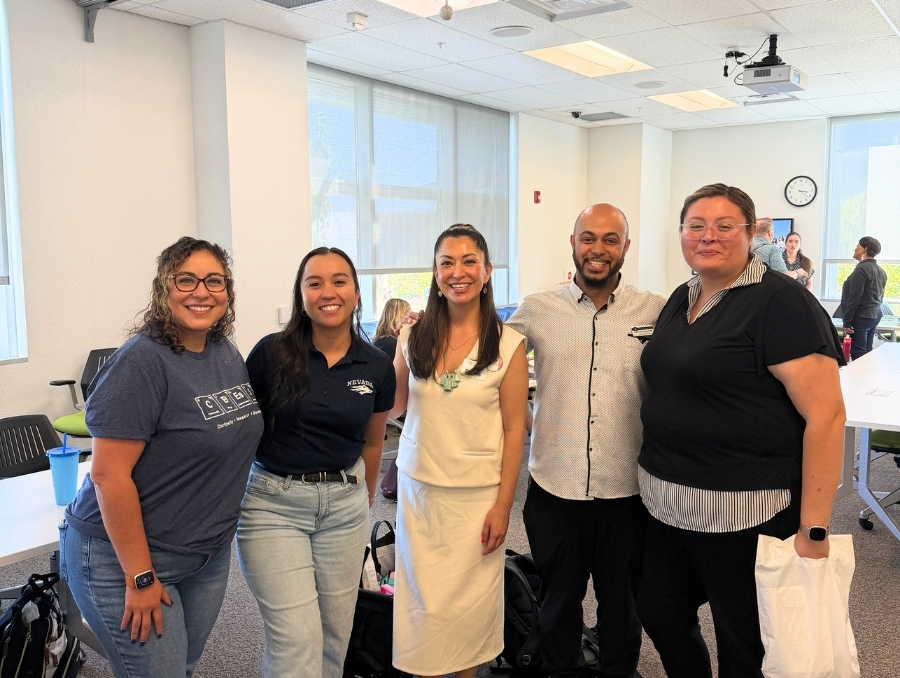
And they did.
They showed up.
When the day of my faculty development workshop finally arrived, I wanted the room itself to communicate what I had spent so many months trying to put into words.
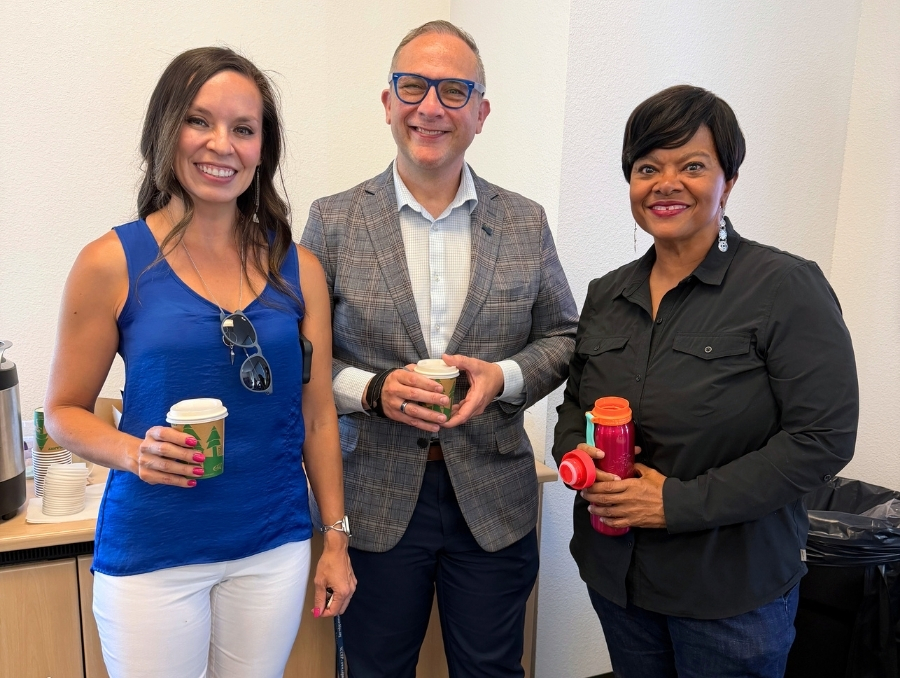 (From left to right) Jafeth Sanchez, director of the Latino Research Center, Charlie Yingling, dean of the Orvis School of Nursing and Melanie Duckworth, executive director of the Office of Diversity, Equity and Inclusion, attended the workshop.
So I served café de olla, pan dulce and fruta picada.
Because when someone comes into our home, we don't simply point them toward a chair.
We welcome them. Bienvenidos. Pásale.
There is a difference between giving a student a link to your office hours and making sure they know there is a place for them when they arrive.
There is a difference between knowing the name of a campus resource and knowing the person behind it.
There is a difference between being available and making someone feel welcome.
That was what I wanted faculty to experience that day, because that is what I hope we can offer our Latinx students.
Not perfection.
Not all the right answers.
Not a shared identity or identical lived experience.
A genuine connection.
A bienvenida.
The kind that says: I may not know exactly what your journey has been, but there is room for your story here.
That, I realized, is where mentorship begins.
My mother never wrote down her mole recipe for me. At least, not one that I followed that day. I had carried it with me in smells, tastes, movements, memories and small rituals I didn't even realize I remembered.
In many ways, I had been carrying the lesson for my doctoral project with me, too.
I just couldn't find it in the literature.
I had to find it in my own story.
So, yes, the evidence informed my doctoral project. The literature shaped it. The surveys would measure it. My committee guided it. My community and peers supported it. And eventually, the data would tell me whether the intervention accomplished what I hoped it would.
But when I couldn't figure out how to teach it, my mother's mole recipe reminded me how.
Sometimes the ingredient we're missing isn't another statistic, citation or slide. Sometimes, the knowledge we need has been with us all along.
We just have to remember where we came from to find it.
For me, it was there, in my mother's kitchen, in my family's stories and in the smoke of a burnt tortilla.


