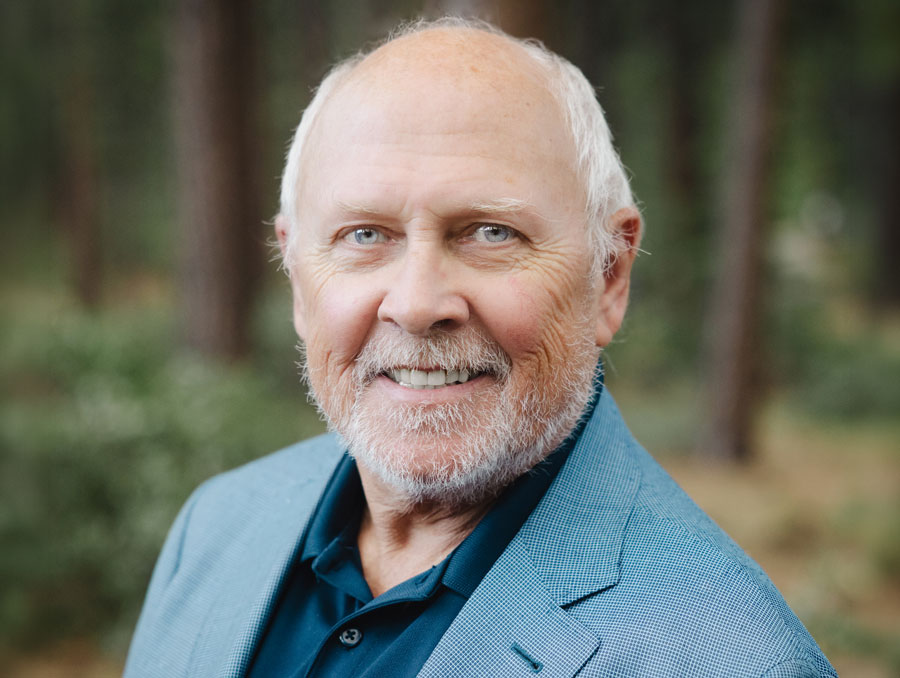
One April morning during the first year of my graduate program in the Reynolds School of Journalism, I sat at a long table in an upstairs classroom, waiting for our guest speaker – a biochemist named Mick Hitchcock, Ph.D. Our course, Science and New Media, had already introduced us to a range of science journalists and communicators. That day, however, we would hear from someone working on the other side of the story – the world of science itself.
Hitchcock, as we soon learned, was born and raised in England, where he completed undergraduate and master’s degrees in biochemistry at the University of Manchester. He earned a doctoral degree in microbiology from Melbourne University in Australia, then moved to the United States in 1976 to pursue a postdoctoral position at Georgetown University. He went on to build an impressive career in pharmaceutical development, spending 12 years in infectious disease research and development with Bristol-Myers (later Bristol-Myers Squibb) and an additional 27 years at Gilead Sciences.
Along the way, Hitchcock has navigated new challenges with an instinct that has come to define his entire career — seeing what was missing and deciding to fill the gaps. At Bristol-Myers, he built a coordination system that streamlined the company’s drug development process. At Gilead Sciences, he helped develop tenofovir, a compound that became the backbone of modern HIV treatment and underpinned a generation of drugs that transformed the disease from a death sentence into a manageable condition. Later, he contributed to the development of a hepatitis C treatment that cured more than 95 percent of patients. He has also been involved in the development and commercialization of antivirals for treatment of hepatitis B, influenza, cytomegalovirus and other diseases.
In 2009, Hitchcock moved to Reno — in part, to spend more time snowboarding — while continuing to work for Gilead. After a short stint in retirement (2019-2025), he was named CEO of Biomea Fusion, which has compounds in development for the treatment of type 1 and type 2 diabetes. As his career in pharmaceuticals continues to flourish, a quieter but no less important ripple of his commitment to the world of science has been playing out right here at the University of Nevada, Reno, where he has become an active participant and supporter of interdisciplinary science innovation, collaboration and communication.
Hitchcock currently serves on the advisory council for the University’s College of Science. He also sits on the board for the Nevada Research & Innovation Corporation, serves as a board trustee for the University Foundation, and is an adjunct professor of microbiology in the University’s medical school. Through philanthropic donations, he has funded several initiatives at the University, including the Hitchcock Center for Chemical Ecology, the Energy Solutions Forum lecture series and the Hitchcock Project for Visualizing Science in the Reynolds School of Journalism, among others.
As someone who is deeply passionate about science and health communication, I have been a direct beneficiary of the Hitchcock Project for Visualizing Science. The program has allowed me to gain skills essential to promoting science literacy, attend conferences, and engage in discussions with leading science communicators, experiences that have fortified both my academic and professional trajectory in ways I did not anticipate. Recently, I sat down with Hitchcock to better understand how a journey that began with a biochemistry degree ultimately led to a life devoted, in every sense, to making science matter.
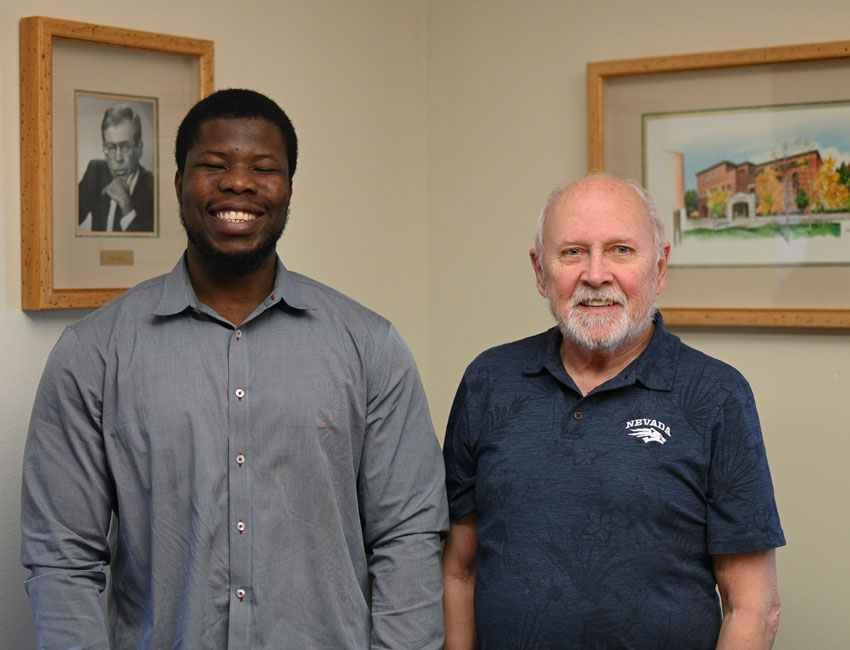
Q: Can you tell us about your early career and how you got your start in the sciences?
Hitchcock: I started out of school thinking about what to do with a biochemistry degree. I considered joining the brewing industry, but that didn't pan out. I ended up moving into a research position and pursuing a biochemistry master's degree in Manchester (England), where I'd done my undergrad. My supervisor then emigrated to Australia and invited me along, so my Ph.D. ended up being in microbiology, even though the project was essentially biochemistry.
What really pointed me toward drug development was my postdoctoral work at Georgetown University, where I worked for Edward Katz, a student of Selman Waksman, the man who discovered the first treatment for tuberculosis. That lab was all about finding compounds with therapeutic value. I learned the process of how drugs are discovered and developed, and I got connected to people in the pharmaceutical industry. It occurred to me that this was a good use of my skills and interests.
At that stage, my skills were mostly around growing bacteria, isolating and purifying proteins, and figuring out how they worked. But I couldn't find a job in pharma, so an opportunity came up to work at the National Institutes of Health on a protein called interferon — a defense molecule human cells produce in response to viral infections. The project aimed to create enough interferon to potentially use it as an antiviral drug. It was there I really began learning about antivirals, even though at the time most scientists believed the only way to tackle viruses was through vaccines.
Q: How did you transition from there into the pharmaceutical industry?
Hitchcock: After a couple of years at NIH, I got an offer from Bristol-Myers in Syracuse, (New York) to work on antibiotics. They wanted me to isolate a kidney enzyme that was degrading some of their antibiotic compounds and test their drugs for susceptibility to that degradation. That got my foot in the door at a major pharmaceutical company.
Once I was inside Bristol-Myers, I started seeing everything that was going on. It seemed a bit random; people were making compounds, testing compounds, doing toxicology — all the pieces were there, but nobody seemed to be pulling it all together and deciding which candidates to advance. I went to my boss and said we needed a system. He said, 'Okay, you're in charge of it, off you go.' I was the newest guy in the group, so it was a little scary, but I took the license he gave me and ran with it.
That's when I started learning everything: how you put a drug into a pill or a vial, how you create a stable formulation, how you sterilize an injectable, how you work with the FDA, how clinical trials are structured — all the pieces beyond the lab bench. You send the FDA a full package plus a protocol for what you want to do in the clinic; they have 30 days to say you can proceed or flag a problem. It's a very interactive process, not a one-and-done submission.
Bristol-Myers eventually started an antiviral group. Because of my background at NIH and the virology course I'd taken at Georgetown, they brought me in. We licensed in a series of compounds from the Czech Republic that looked promising. Then Bristol-Myers merged with Squibb, and Squibb decided they didn't want those compounds. They gave them back to the inventors. Meanwhile, the colleague I'd been working with moved to Gilead Sciences and brought those Czech compounds with him and he asked me to join him there. So when I walked in the door at Gilead, I already had a head start on the compounds they were developing.
Q: During your time at Gilead, you worked in project management. What did that involve, and what kinds of skills did that require?
Hitchcock: In project management, you build cross-functional teams — pharmacology, chemistry, manufacturing, formulation, clinical development, regulatory, marketing, commercial — and you try to bring everybody together around a single target: getting the drug approved and on the market. You don't have to know every detail of every discipline, but you have to know enough to coordinate everyone effectively. The role shifts from being a great scientist to being a great coordinator.
I had to go to people and say, 'What you're doing is very important. We cannot move this project forward unless your piece is done by Friday.' You cajole, you push, you make sure everyone is aligned. The key communication skill becomes writing clearly and concisely for people who aren't scientists. The CFO, financial people, and commercial people — they need to understand what's going on without all the technical detail underneath.
"The key communication skill becomes writing clearly and concisely for people who aren't scientists. The CFO, financial people, and commercial people — they need to understand what's going on without all the technical detail underneath."
I had a boss at the time named Doris McKinstry who was very rigorous about written communication. She'd bleed red pen all over everything. Her rule was: no ambiguity. And every 10-page meeting report had to have a 2-page summary, specific font, no cheating by shrinking the type. It forced you to distill things down to what decision-makers actually need to know.
Q: It sounds like science communication was a big part of your role at the time. What kinds of drugs did you and your team develop during your time at Gilead?
Hitchcock: When I joined Gilead, John Martin, the colleague I'd worked with, became CEO, and I ran the projects for him. We brought in those licensed compounds from the Czech Republic, and one of them became the cornerstone of most of our antiviral portfolio. We developed a two-drug combination called Truvada, a three-drug combination called ATRIPLA, and a whole range of products built on a compound called tenofovir. That compound came out of that Czech collaboration and underpinned everything.
Building all the infrastructure and capability around the HIV program eventually allowed us to say, okay, there are other viruses out there. That's when we turned to hepatitis C. We found that our own internal compounds didn't have the right properties for hep C, but we identified an outside company whose compound we liked. So we bought the company for $11.2 billion.
It sounds enormous, but when you sit down with commercial colleagues and calculate: how many patients have this disease, what will we charge for a course of therapy, what market share can we realistically achieve in year one, year two ... the numbers start to make sense. You build a financial story around the science. The upfront expenditure is an investment, and you have to have real numbers and a sound rationale, not just 'we think we can make a lot of money.'
Q: What are you working on currently?
Hitchcock: I worked at Gilead through 2019, and then managed to retire for about five or six years. But I was on the board of a company called Biomea Fusion, which has two compounds in development — one for the treatment of type 1 or type 2 diabetes, and one for the treatment of obesity and diabetes. The board made a leadership change, and I became the CEO. That's why I'm back at work.
Right now, many of these types of diabetes drugs are being used for their weight loss effects. For people with mild diabetes, losing weight can resolve the diabetes anyway. We're currently in a phase one trial with our compound for that weight-loss application.
Q: How did you go from being a scientist and drug developer to becoming passionate about science communication and funding the Hitchcock Project?
Hitchcock: Some of it comes from my own history, and some from spending time around the university campus after I semi-retired from Gilead. I used to run into former Reynolds School Dean Al Stavitsky at dinners and various campus gatherings. I would talk to him about the state of science journalism — how journalists often just pull the headline rather than actually reading the publication, looking for a click rather than accuracy.
Two things really crystallized it for me. The first was the Andrew Wakefield affair. Wakefield was a physician in London who published data purporting to link vaccines to autism. It turned out he had a conflict of interest — a lawyer friend was trying to win a case against a vaccine company. When investigators went back through the case records of the patients he claimed to treat, they could not find the data. He fabricated it. But once that got out and people started amplifying it, you couldn't put it back in the box. I believe poor journalism played a significant role in letting that misinformation spread.
The second was the GMO (genetically modified organisms) debate. People are afraid of GMOs without understanding why. The reality is that when you eat food, it gets broken down into basic components and reassembled after absorption; it doesn't matter whether it came from a GMO source or not. And genetically modifying an organism is simply a faster technique for achieving changes that traditional breeding does anyway, just much more slowly.
Al eventually came to me with a proposal for a program to improve science communication through journalism. He'd thought through the whole concept. Once I saw the plan and could see how it would address the problems we'd been discussing, I funded it. Jennifer Kent now has the reins and it's going in a very good direction.
Q: Do you think science misinformation has gotten better or worse over the past 30 years? Is it something you're increasingly worried about?
Hitchcock: It's an ongoing battle. There are people today who believe that if they believe something, it must be true, without any evidence whatsoever. As a scientist, you build a hypothesis and test it. If the test comes back negative, you abandon that hypothesis and move on. That's how science works. But there are people now who will post something completely unsupported — like, 'rubbing bleach on your skin does X,' get a following, and call themselves influencers. Francis Bacon said it around 1600: 'People prefer to believe what they prefer to be true.' That's pretty prophetic, and it's as true now as ever.
I sit on the board of the American Council on Science and Health, which does a lot of debunking of bad science. They're a good resource if you want to check something, and they try to make it entertaining because if your output is dry and boring, people flip to the next page. You have to connect to something relevant, add an anecdote, give people a hook.
Q: COVID was a major challenge for science communication. What lessons can be drawn?
Hitchcock: The science was evolving rapidly, and mistakes were made in interpretation. But the bigger problem was how it was delivered often in very black-and-white terms, when almost everything was actually in shades of gray. Laypeople then said: 'Last week you said this, now you're saying that. You don't know what you're talking about.' But the reason the guidance changed was because the information changed. That's how science is supposed to work.
Take masks as an example. Wearing a mask may reduce transmission by around 90 percent. It is not 100 percent, and it was never claimed to be. And when people raised the objection that the virus is smaller than the particles a mask can stop, that's technically true, but the virus doesn't travel as a free particle. It travels inside a water droplet, and a water droplet cannot pass through a mask. These are nuances that can be explained, but once the science becomes politically polarized, if you're on this side you believe this, if you're on that side you believe that, the actual evidence becomes irrelevant. We're not very good at communicating probabilistic risk to a public that wants black-and-white certainty.
Q: Do you have any advice for scientists or journalists on how to communicate science to the public while minimizing misinterpretation?
The biggest thing is to get comfortable with uncertainty, and to help your audience get comfortable with it too, without letting it seem wishy-washy. Science is not black and white; most things exist in shades of gray, and as you do more experiments you refine your understanding and move down that spectrum. The temptation, especially under media and political pressure, is to present things as more definitive than they are. Resist that.
"Science is not black and white; most things exist in shades of gray, and as you do more experiments you refine your understanding and move down that spectrum. The temptation, especially under media and political pressure, is to present things as more definitive than they are. Resist that."
Also, don't just publish it in a journal where five people in the world can read and understand it. The information needs to be translated into something a politician, a businessperson, or a member of the public can act on. That's the extra piece that programs like this one are filling. Scientists get grants, they do the work, they publish in journals. But somebody has to take that information and make it usable for people who are actually making decisions.
And to make it land, you need a hook. If it's dry and dense, people won't engage. Connect the science to something they already care about. Use an anecdote. Make it relevant. That doesn't mean dumbing it down, it means building a bridge.


