Large wildfires, such as the 2024 Davis Fire in Washoe Valley, will impact an environment long after the flames have been extinguished. Ash and debris can wash into rivers, affecting drinking water; burned land doesn’t absorb water well, causing flash floods; vegetation and wildlife may not be able to recover without human intervention.
Scientists create computer models to forecast environmental change after a wildfire, but those models are only as good as the data that goes into them, says graduate researcher Alyssa Radakovich.
 Alyssa Radakovich is the first student to participate in the University's Distinguished Graduate Research Program at PNNL.
That data is improving.
Radakovich and her colleagues at the University of Nevada, Reno and Pacific Northwest National Laboratory have identified hidden compounds in burned plant material that influence how an environment responds after a wildfire.
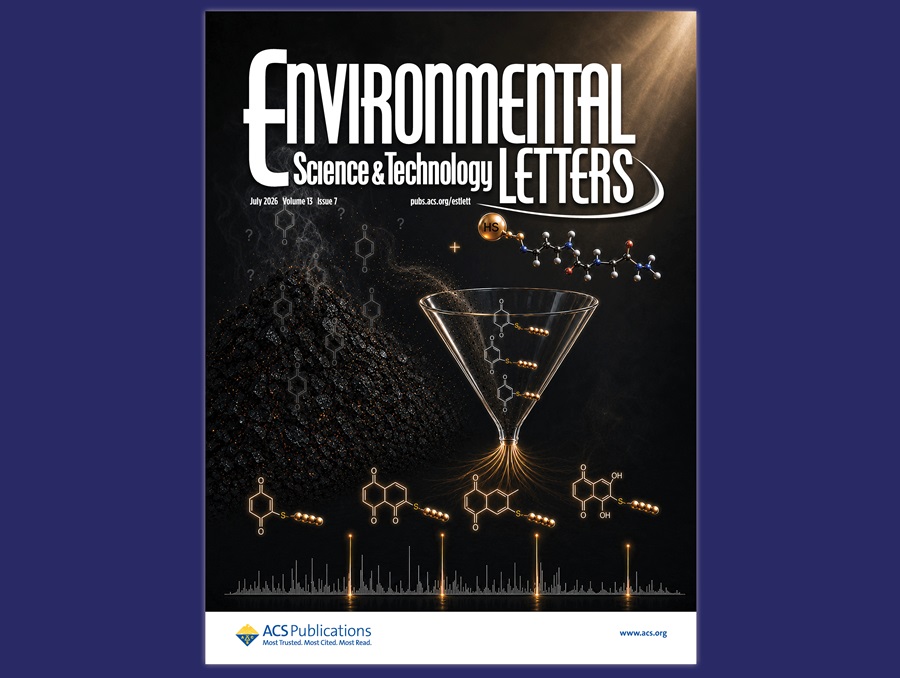
Their research was published in the June 9 issue of Environmental Science & Technology Letters. The paper, “Revealing Hidden Quinones through Diagnostic MS² Fragmentation of Peptide-Quinone Adducts,” focuses on quinones — very small organic molecules that can move electrons, or energy, through the environment. These energy flows control what happens after a wildfire, like how fast the ecosystem will recover or how water quality may be affected.
Radakovich led this research as the first student in the University’s Distinguished Graduate Research Program at PNNL: she works with Environmental Engineering Professor Frank Yang at the University as well as PNNL scientist Allison Myers-Pigg. Along with Radakovich, Yang and Myers-Pigg, the paper was co-authored by Anil Timilsina, Sudarshan Basyal, Ishtiaq A. Jawad and Rene Boiteau.
Hidden chemistry
Quinones are an essential component of many processes — from technology to human health — but in the context of Radakovich’s work, they help explain how burned organic matter can continue driving chemical and microbial activity in landscapes after fire.
“They control how energy and carbon can move through the environment,” Radakovich said. “They influence things like how microbes ‘breathe,’ how organic matter breaks down or persists, and how carbon can be transformed after events like wildfires.”
But they’re impossible to see.
“They’re on the scale of nanometer, which is a billionth of a meter,” Radakovich said, “so tens of thousands can fit across the width of human hair. On a normal microscope, you couldn’t see anything close to it.”
Anil Timilsina, a co-author on the paper, previously developed a process to identify quinones while studying at the University as a grad student. In a nutshell, a molecule with a cysteine-containing peptide tag reacts to quinones, and those molecules can be detected with a mass spectrometer.
Building on that work, Radakovich and colleagues studied the molecules tagged as containing quinones, then “broke” the molecules into pieces to confirm the presence of quinones, or quinone-like compounds.
“We use ‘quinone-like’ in the paper, because in the complex environmental samples (we were working with), we don’t always know the full structure of every molecule, so we can’t say it’s a quinone,” Radakovich said. “We’re pretty confident that they’re quinones, we just can’t say with 100% certainty that that’s what they are.”
She and her colleagues identified around 200 potential quinones — and realized that there is some diversity in their mass and potential structure.
“Now we want to know what these molecules actually do in environmental systems,” Radakovich said. “Do they increase or decrease carbon dioxide or methane production? Do these quinones differ in different fire severities or vegetation types? Ultimately, our group has been talking about connecting the chemistry to the real environmental outcomes.”
Collaborative engineering
Radakovich is the first student to participate in the University’s Distinguished Graduate Research Program at PNNL, the result of a larger institutional collaboration between the University and the national lab, according to Carrie Busha of the University’s Research & Innovation unit.
Coming to the University in 2022, Radakovich pursued a doctorate in hydrogeology under Environmental Engineering Professor Frank Yang, whose research focuses on understanding how natural chemicals control energy and pollution in the environment. Radakovich's doctoral degree is through the Graduate Program of Hydrologic Sciences, an interdisciplinary, collaborative program between the University and the Desert Research Institute.
She was accepted into Distinguished Graduate Research Program in 2025 and now is based in the PNNL facility in Sequim, Washington, where she continues working toward her degree, mentored by both Yang and PNNL scientist Allison Myers-Pigg.
Together, both institutions offer different expertise needed in Radakovich’s research, Yang said.
“(PNNL) is looking at the impact of wildfire on the large-scale ecosystem, but they do not do this molecular chemistry,” Yang said. “And for us, we are interested in this molecular chemistry, but we do not (have) the set-up for this large-scale work here. What Alyssa has been doing really brings these two sides together.”
For Radakovich, the program has allowed her to really dig into the questions she’s trying to answer.
“It’s an invaluable experience I’ve had,” Radakovich said. “A huge part of it is having different mentorship from different people, and also the access to this wide breadth of instrumentation and expertise that's available at the (PNNL) lab.”


