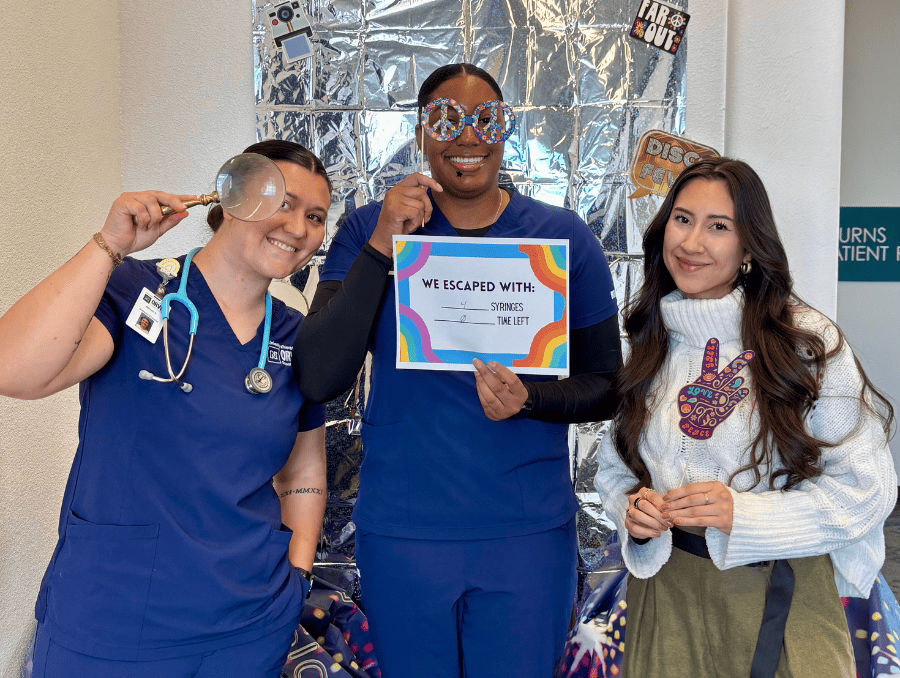
The Physician Assistant (PA) Studies program at the University of Nevada, Reno, School of Medicine (UNR Med) and the Orvis School of Nursing collaborated to create a unique interdisciplinary learning experience: a medical escape room.
In April, the programs brought together nearly 100 students and 18 faculty and staff members for an interprofessional education (IPE) medical escape room designed to strengthen teamwork, communication and clinical problem-solving skills. The event united undergraduate nursing, PA and nurse practitioner students in a fast-paced, team-based simulation that mirrored the collaborative, high-pressure nature of real clinical environments. Through the experience, participants worked together to solve medical challenges, reinforcing the importance of effective communication and coordinated patient care across disciplines.
“Healthcare professionals rarely encounter problems with clearly defined answers, unlimited time or complete information,” said Angel Cappiello, assistant professor of Physician Assistant Studies. “Instead, effective clinicians must synthesize fragmented data, communicate across disciplines, adapt to evolving situations and make collaborative decisions under pressure. Educational escape rooms offer a novel approach to developing these competencies by immersing learners in authentic, time-sensitive clinical scenarios that require teamwork rather than individual knowledge alone.”
The escape room was collaboratively developed and facilitated by faculty from each participating program, creating an engaging and immersive learning experience centered on interprofessional practice. Throughout the event, students worked together to solve clinical challenges, communicate effectively under pressure and leverage each profession’s unique strengths to care for simulated patients.
The World Health Organization in 2006 adopted a resolution that called for innovative strategies to teach healthcare, upholding interprofessional collaboration as one of the most promising solutions for a healthcare worker shortage.
“One of my favorite parts was seeing how everyone approached the same problem from a different perspective,” said Jack McCollam, a second-year PA student. “It was a fun reminder that great healthcare is truly a team sport. You could tell how much planning and thought went into creating such an elaborate experience, and it made the event both incredibly fun and engaging.”
Student feedback highlighted the value of the experience, with many participants sharing that the activity felt highly realistic and helped them better understand the importance of teamwork in healthcare. Students also appreciated the meaningful relationships formed during the event and gained a deeper appreciation for the distinct knowledge and skills each profession contributes to patient care.
“We believe this experience can be extrapolated to any medical learners,” said Cappiello. “We are currently exploring avenues to share this with the larger community of healthcare faculty outside of the University as well.”


