
Noah Huerta, a doctoral student in the Department of Chemistry, was selected for a prestigious Department of Energy (DOE) Office of Science Graduate Student Research award. Huerta is the only Nevada student to receive the prestigious yearlong fellowship and is working at the Pacific Northwest National Laboratory (PNNL) in Richland, WA.
“This is invaluable experience, especially important if students plan to pursue careers at national labs or in industry,” Professor Sergey Varganov, Huerta’s research advisor, said.
Originally from Las Vegas, Huerta decided to attend the University because he felt it was a good fit, and he was eligible for in-state tuition. Huerta received his bachelor's degree and his master’s degree from the University, both in physics. During both his bachelor’s and master’s studies, Huerta studied plasma physics with Research Professor Vladimir Ivanov at the Zebra Pulsed Power Laboratory.
“I really had a lot of fun working there,” Huerta said.
Huerta made the jump from plasma physics to chemical physics after his master’s degree as it aligned more with his interests. At first, working with molecules was intimidating, but Huerta said that much of the math is similar to that of his physics coursework, and his confidence quickly grew.
“It’s kind of easy to start spotting things after a while,” Huerta said. “There’s the metal center, what’s its oxidation state? I can figure out the spin, and that’s kind of all I really need to know.”
Huerta’s work at PNNL blends software and hardware development in quantum computing. He is currently working on three projects that aim to contribute to developing better quantum computers.
One of his projects is running calculations to better understand molecules that can leverage quantum properties to store data or function as the basic processing unit of a quantum computer, commonly known as a qubit. Huerta uses specialized calculations based on the Redfield equation to characterize the molecules and their potential for quantum computing. Another project he’s working on is writing quantum algorithms so these same simulations can run on quantum computers.
“To some degree, you theoretically could be using a quantum computer to design a better quantum computer,” Huerta explained.
The code he’s writing for the quantum computer is much more limited than what he can write on a standard computer. Right now, scientists are mostly limited to using basic Boolean logic gates for the quantum algorithms.
“The nature of the computer you’re working on is so fundamentally different that you need to start thinking about how to write code in an entirely different way,” Huerta said.
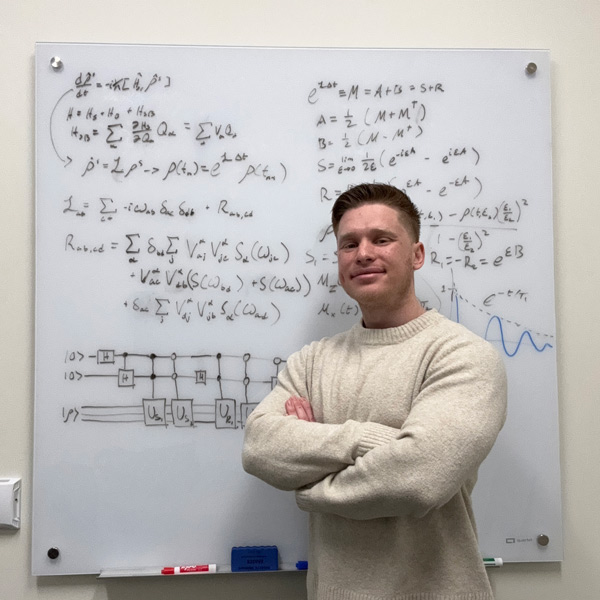
Yet the challenges Huerta encounters are related to the software on classical computers, which, when given information about a molecule, run calculations and provide different information about the molecule that can then be fed into the Redfield equation. The challenge is that the process requires significant computation time and resources.
The calculations can also fail along the way, so fixing the algorithm and running it again after fixing it makes the project take even longer. That’s where the third branch of Huerta’s research comes in: utilizing agentic artificial intelligence (AI) to manage these projects.
Huerta is developing a platform to feed information about a molecule into the AI and provide instructions on what to do with that information. The AI will utilize the software to run the calculations for him, fixing errors along the way.
These three projects all contribute to increased understanding of molecules that can be used in quantum computing applications.
Huerta actually held a three-month internship at PNNL prior to starting his fellowship. He had been in contact with Bo Peng in the Physical and Computational Science Division at PNNL, during the application process, as Huerta is collaborating with Peng during his fellowship. Peng had funding for a graduate student intern and asked Huerta if he’d like to come to Richland for an internship prior to the fellowship, and Huerta jumped at the opportunity. He said that so far, his experience at PNNL has been very positive.
“As soon as I got here, everything was set up for [me] to be successful,” Huerta said.
Being selected for the fellowship meant that Huerta was also eligible to apply for the DOE’s International Research Collaboration Award. His application was successful, and Huerta will spend six weeks in Japan this summer as a visiting researcher at RIKEN, a world-renowned research institution.
As Huerta’s AI project becomes more robust and as the molecules he’s studying become larger and more complex, he will need higher computational power than what he currently has access to.
“That’s part of the reason I’m going to Japan,” Huerta said. “They have one of the world’s most impressive supercomputers and on top of that, they have a state-of-the-art quantum computer on site.”
The scientist Huerta will work with in Japan is also an expert in high-performance computing techniques. Huerta looks forward to learning more about those techniques during his time in Japan.
Huerta’s Ph.D. research proposal and his Science Graduate Student Research Award proposal were nearly identical, so his work at PNNL directly overlaps with his doctoral research.
Varganov said developing research proposals is a crucial skill for doctoral students and that putting time and effort into helping students develop research proposals and writing recommendation letters is worth it for him and his students.
“Dr. Varganov was really pushing me to apply to fellowships,” Huerta said. “Thank God that he did, because it’s worked out.”
“The first submission was not successful, but Noah's persistence eventually paid off,” Varganov said. “The program is very competitive, and success is never guaranteed, but in the end, I was not surprised that Noah won both the SCGSR award and the additional funding to visit RIKEN.”


