Solar panels were supposed to last 25 to 30 years. Some are not lasting that long.
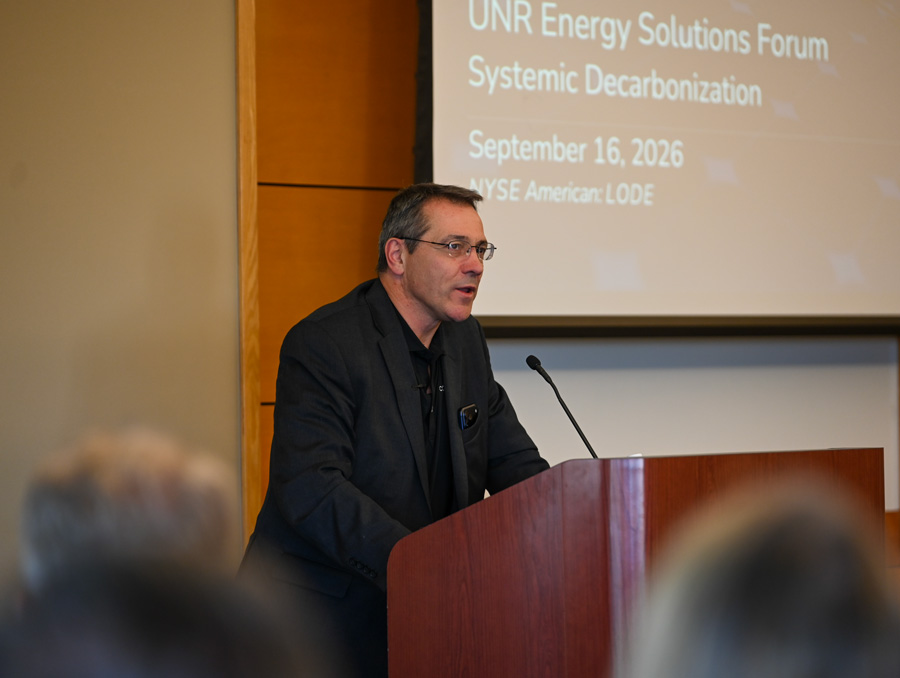
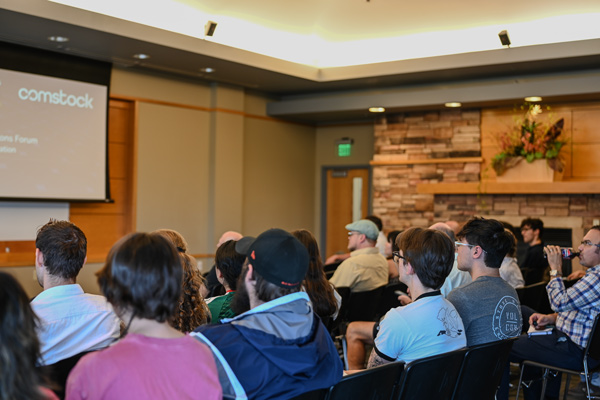
That is where Corrado De Gasperis began on Sept. 16, when students, faculty and community members gathered at the University of Nevada, Reno’s Joe Crowley Student Union for the first Energy Solutions Forum of the fall.
The series was founded by biochemist and philanthropist Mick Hitchcock. Those in attendance included Hitchcock, Mridul Gautam, senior vice president for research and innovation, and Christopher Jeffrey, director of the Hitchcock Center for Chemical Ecology. The Energy Solutions Forum has brought more than 25 speakers to campus from universities, national laboratories, nonprofits, government agencies and industry.
"It's a great way for students and faculty in the University community to connect with outside community members and local industry members," said Christopher Barile, a chemistry professor in the College of Science who coordinates the Energy Solutions Forum series.
De Gasperis is CEO of Comstock Inc., a Nevada company whose roots are in hard-rock silver and gold mining on the Comstock Lode. But about seven years ago, he said, the company changed direction. Today, it recovers aluminum, silver, copper, lead and glass from old solar panels and converts waste wood into low-carbon fuels.
"In one case, we're creating a mine that never stops producing," De Gasperis said. "In another case, we're creating an oil well that never stops producing."
Solar's waste problem came early
More than a billion solar panels have been deployed in the United States and roughly eight billion worldwide, according to De Gasperis.
"Mostly the assumption was they would last 25 to 30 years," he said. "It was a far-off problem that no one was really paying any attention to."
Instead, De Gasperis said some panels are reaching the end of their usefulness after just 15 to 17 years. He estimates three to four million panels are already coming out of service annually in the United States, a number he expects to rise significantly as existing solar installations age.
Handling millions of panels a year on a single production line, De Gasperis said, means finishing one every seven seconds.
Much of a panel can be recovered, but separating those materials is difficult. By weight, a typical crystalline-silicon panel is roughly three-quarters glass and about 8% aluminum, with copper, silicon and traces of silver making up most of the rest. Plastic, adhesives and other materials must be removed from that glass and metal efficiently enough to make recycling economical, and fast enough to operate at scale.
Handling millions of panels a year on a single production line, De Gasperis said, means finishing one every seven seconds.
"Today we can feed a panel every six and a half seconds," he said.
According to a report by the International Renewable Energy Agency and the International Energy Agency Photovoltaic Power Systems Programme, international projections suggest U.S. panel waste could roughly double depending on whether panels last their full expected lifetime or fail early.
Mining the materials Nevada already has
The idea reaches beyond solar panels. De Gasperis said the Nevada Division of Minerals has approached Comstock about whether its technology could recover metals from old mine tailings around the state.
The region's advantages are also why Barile sees the University as the right home for the series.
"The University of Nevada, Reno has been at the center of this lithium economy that we're seeing," he said, pointing to the region's geothermal energy, its mining reserves and companies at the Tahoe-Reno Industrial Center.
University Executive Vice President and Provost and former Dean of the College of Science Jeff Thompson agrees.
"Nevada is uniquely positioned to help lead these conversations," Thompson said. "By connecting students with innovators and industry leaders, we are helping prepare the next generation of problem-solvers who will shape the future of energy and sustainability."
For De Gasperis, we must be looking beyond whether a technology carries a green label.
"I think we have the ingredients, the raw materials to step up and become a leader, but it's not automatic," he said. "What's the life cycle carbon impact, and what's the true sustainability of the solution? If we hold ourselves to that standard, we will lead."
Solving one problem can reveal another
That complexity is part of the reason Barile wants students in the room.
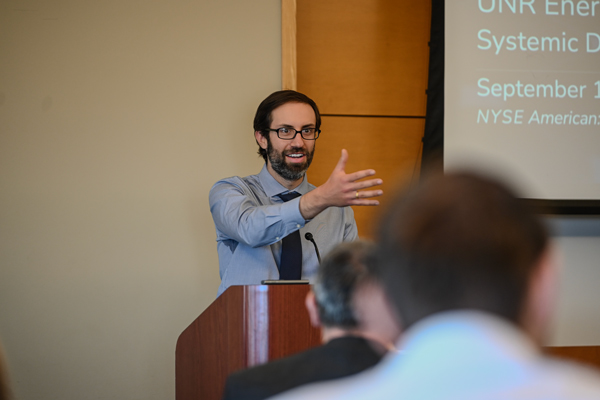
"There's no magic bullet," Barile said. Solar and wind may reduce dependence on fossil fuels, he explained, but they raise questions about energy storage and other challenges that cross science, engineering, economics and social issues.
"We really need people from all sorts of different skill sets to help come together, and people who are willing and able to work with many different types of people," he said. "Those are the people who will be the most valuable in solving this problem."
For students at the event interested in helping solve those problems, De Gasperis offered a challenge.
"The difference between an operator and a leader is (that) an operator is a reliable, trustworthy executor," he said. "A leader drives change."
"So the opportunity is to see a problem, to surface a blockage, a constraint, an obstacle, and shatter it."
Coming this fall: The Energy Solutions Forum continues Oct. 7 with Sabbie Miller of University of California, Davis on decarbonizing industrial manufacturing and Nov. 18 with Taylor Wilson, Applied Nuclear Physicist and Founder, Prometheus Industries and Talos Materials, on the future of nuclear energy technologies. The series is free and open to the public, and registration is open now via Eventbrite.


