What do Botox, rat poison, weight-loss drugs and a fictional murder investigation have in common?
At the University of Nevada, Reno they are the starting point for a new course designed to make science more engaging, accessible and relevant to everyday life while building the kind of scientific thinking that can support future study in science-related fields.
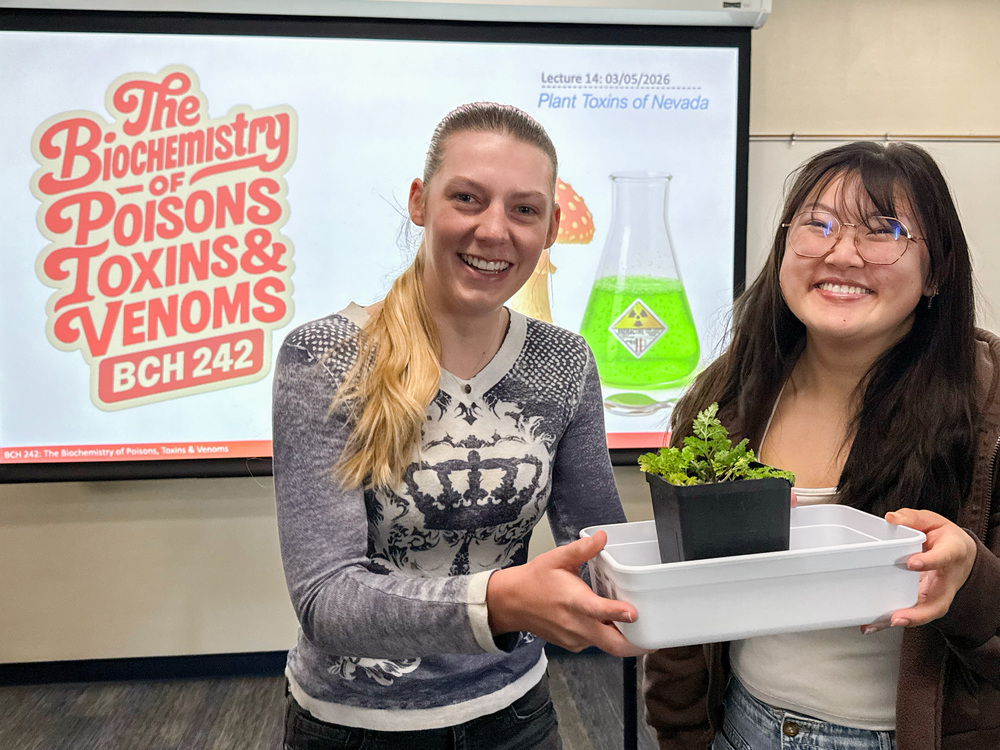
Titled "The Biochemistry of poisons, toxins & venoms," the course moves beyond a traditional focus on memorizing facts and formulas. Instead, it uses real-world examples to show how scientific concepts appear in everyday settings in unexpected ways, from medicines and cosmetics to environmental exposures and public health issues. Students are encouraged to question assumptions, evaluate evidence and consider how science informs daily decisions.
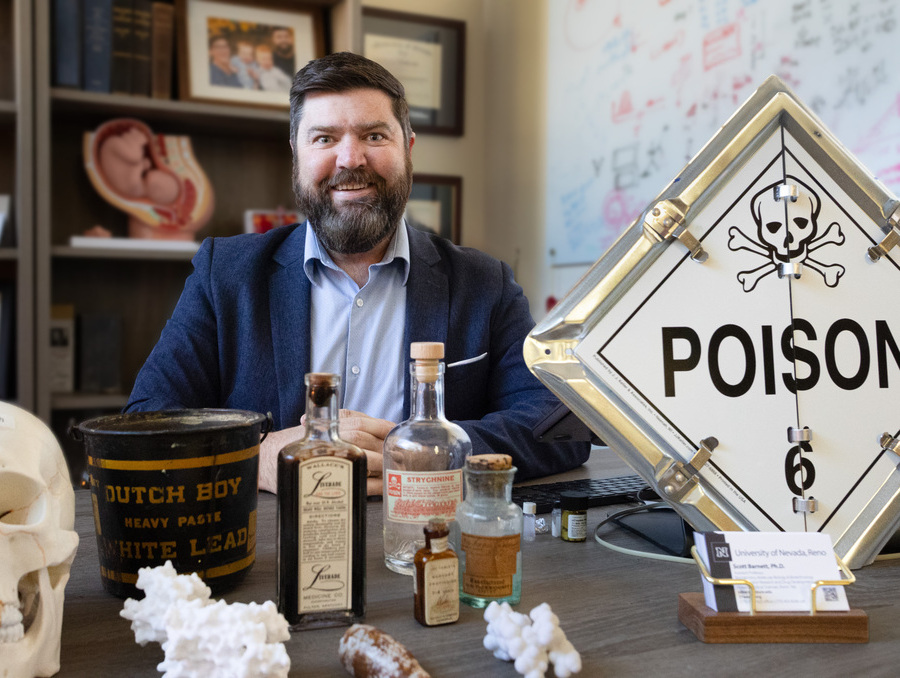
The course was developed by Assistant Professor Scott Barnett, a pharmacologist in the College of Agriculture, Biotechnology & Natural Resources’ Department of Biochemistry, Molecular Biology & Biotechnology, who began with a simple question: What class would he have wanted as an undergraduate that did not exist?
His answer was a course that begins with the most compelling parts of biology and chemistry, topics often reserved for advanced coursework or professional school, and works backward to the underlying scientific principles.
“Instead of starting with dense equations or abstract mechanisms, I wanted students to first encounter science in the real world,” Barnett said. “The class explores real-life issues involving arsenic in groundwater, lead exposure in drinking water, opioid overdoses, radiation, poisonous plants and deadly venoms.”
That approach also shapes who the course was built for.
First offered this spring, the course was intentionally designed as a “big tent” class, welcoming students from a wide range of academic backgrounds without requiring prior science coursework. The inaugural cohort included biochemistry majors, veterinary science students, liberal arts majors and others who might not have otherwise enrolled in a science-focused class.
The course fulfills the University’s Core Objective Nine requirement as part of the Silver Core Curriculum, which examines how scientific and technological developments shape society and the environment. It also serves as a directed elective for the University’s forensic studies certificate, allowing students to satisfy a general education requirement while exploring potential interests in forensic science and related careers.
The curricular structure sets the stage for how the material comes to life in the classroom.
“The dose makes the poison”
Best known for smoothing wrinkles, Botox serves as one of the course’s most memorable lessons. Students first learn about botulinum toxin, one of the deadliest substances known to science, so potent that even microscopic amounts can be lethal. The same compound, however, appears in clinics as Botox, where it is safely administered in controlled doses for cosmetic and medical treatments.
“The contrast often surprises students,” Barnett said. “What begins as a lesson about a deadly toxin quickly becomes an exploration of how the same molecule can both harm and heal.”
Barnett points to a principle dating back to Renaissance physician Paracelsus: “the dose makes the poison,” meaning chemicals are not inherently good or bad. Their effects depend on how, where and in what amount they are used.
That idea becomes the organizing thread for the next set of examples.
In one case, students learn how warfarin, originally developed as a rat poison, is now widely used as a medication to prevent strokes, heart attacks and blood clots. The example reinforces that even familiar substances, including common pain relievers such as acetaminophen, can become harmful at high doses, depending on how they are used.
The same principle then extends beyond synthetic chemicals into discoveries from nature. Long before drugs such as Ozempic and Wegovy became household names, scientists studied a peptide found in the venom of the Gila monster, a large desert lizard native to the American Southwest. The discovery helped inspire a new class of medications used to treat diabetes and obesity, showing how compounds evolved for one purpose in nature can become powerful tools in modern medicine.
By the end of the semester, students apply these concepts in a different way.
CSI meets toxicology
The semester culminates in a fictional death investigation. Working in teams, students receive case files containing interviews, symptom reports and forensic evidence. Rather than following a script, they must sort through the information, identify the most likely poison or toxin, and propose laboratory tests that could confirm their theory.
The exercise draws on the appeal of true-crime storytelling, but replaces speculation with toxicology, evidence and scientific reasoning.
For Barnett, the goal is not the mystery itself, but the process it requires: learning how to think through complex, uncertain problems using scientific evidence.
Reinforcing critical thinking: AI as a tutor
Barnett has also incorporated artificial intelligence into the course, but with a deliberate approach. Instead of using AI to provide answers, he developed a custom AI tutor that guides students through concepts step by step.
The tool points students toward relevant material, asks follow-up questions and encourages them to reason through problems rather than rely on direct solutions.
For Barnett, the goal is to create a low-pressure environment where students can explore unfamiliar ideas, build confidence and develop stronger problem-solving skills.
“My hope is that students leave the course with the confidence to ask better questions, think critically about the information they encounter and make more informed decisions about the world around them,” he said.


