 Find more answers here!
Humans hold a special reverence, and a healthy fear, of volcanoes. Eruptions have the capacity to wipe out entire civilizations (and have done so). Supervolcanoes, then, have an almost mythic reputation. Could the frequent earthquakes in the Western U.S. cause a supervolcanic eruption? Professor Philipp Ruprecht, from the Department of Geological Sciences and Engineering, explains.
“(It) would be nice to see a Yellowstone eruption,” Ruprecht said, “from a scientific perspective,” he clarified.
What is a supervolcano?
A supervolcano is a class of volcanoes that reach a magnitude 8 on the volcanic explosivity index (VEI), similar to the Richter scale for earthquakes. A VEI of 8 means a volcanic eruption releases at least 1,000 cubic kilometers of material. Ruprecht said Yellowstone, a supervolcano beneath the northwestern corner of Wyoming, has had eruptions of that magnitude or close to it at least three times before.
“The big supereruptions happened 600,000 years ago and 1.3 and 2.1 million years ago,” he said. “And in between, there have been smaller eruptions.”
Each supervolcano is different. The surrounding geology and the pressure inside the volcano can impact how the volcano behaves once it begins to erupt, which is part of why they’re enigmatic. The other reason is that there hasn’t been a supereruption in modern human history.
“We haven’t seen it, and that’s good,” Ruprecht said.
But supervolcanic eruptions aren’t uncommon, on the geologic timescale. One of the last supervolcano eruptions took place in Indonesia roughly 70,000 years ago, which has been thought to have caused extinction of some human lineages and researchers estimate one supervolcanic eruption every few ten to hundred thousand years, on average.
What are the signs a volcano might erupt?
Ruprecht gave Yellowstone as an example. Yellowstone is, famously, hydrothermally active, which is part of the reason the national park sits directly above the caldera. That activity presents itself as a shifting of the landscape; monitoring over the last decades shows that the ground sometimes rises and other times drops by up to a meter.
If Yellowstone were to become more active, “(y)ou would assume that maybe that hydrothermal activity even becomes more pronounced and the surface is starting to be shifting a lot more,” Ruprecht said.
Ruprecht added that the composition of gases released by volcanoes might change to include more carbon dioxide, which he said is typically related to deeper magmatism.
What can trigger a supervolcano to erupt?
“You have to get the volcano into the state of being close to [erupting],” Ruprecht said. “And then all hell breaks loose.”
If the volcano has a large magma body, building up pressure becomes more challenging because the large area is able to dissipate pressure more easily.
“It may be that you’re building up towards that state, but it often actually does need an outside trigger,” Ruprecht said. “And so, this brings us to earthquakes, which is one way to do that.”
Ruprecht outlined two mechanisms by which earthquakes might trigger eruptions: dynamic and static. In dynamic triggering, the shaking produced by an earthquake may loosen a fault or break the rock which results in the volcano being able release the built up pressure to the point of eruption. Static triggering results from long-term compressive stresses around the volcano produced by subduction zones being suddenly released. Fractures that were sealed by the compressive stress are opened, and the magma can move upward.
Spatiotemporal relationships are crucial for understanding the connectedness between earthquakes and volcanic eruptions. Ruprecht said the best example of this in the world is a volcano he studies in Chile, Cordón Caulle.
“There you have the largest earthquake on record, the 9.5 quake that ruptured along the Chilean coastline for hundreds and hundreds of miles,” Ruprecht said. “And then, within 48 hours, the volcano erupted 100 miles inland of the earthquake.”
However, the statistics can only indicate the likelihood that a volcano would have erupted given the presence of an earthquake, not establish a causal effect between the two events.
“What is that final straw that broke the camel's back?” Ruprecht asked. “And is that even meaningful? Is it one big earthquake, the many small aftershocks, or all the other earthquakes that push the volcano over the edge?”
He added that the movement of magma through the earth leads to changes within the system.
“If this system is changing, it will itself create earthquakes, and then you start to [have] the chicken-egg problem.”
Scientific tools like geodesy can help scientists better understand how a system is evolving, and with volcanoes that frequently erupt, they can use the data to test against and determine whether tectonic changes may impact the eruption.
This problem manifested in the eruption of Mount St. Helens in 1980, when magma filling the volcano coincided with earthquakes which triggered a landslide, followed immediately by the eruption, a case of static triggering.
What would happen if the Yellowstone supervolcano erupted?
If the Yellowstone supervolcano erupted, it could cause the largest catastrophe to impact the Western U.S. since humans arrived. Supervolcanic eruptions can launch ash as high as the stratosphere. In the case of the Yellowstone eruptions, ash has been found as far east as what is now Missouri, though the region around what is now Reno barely received any ash, due to prevailing westerly winds. The ash blocks out the sun, causing protracted cooling of the atmosphere. It also covers the landscape and can decimate crops and livestock. In the case of a Yellowstone supereruption, ash would cause the loss of many crops east of the Rocky Mountains. Ash can also travel over the landscape as a very hot debris flow known as a pyroclastic flow.
“It just rushes down as this very fast mass of gases and ash along valleys,” Ruprecht said.
Pyroclastic material killed many of the victims in Mt. Vesuvius’s eruption in 79 A.D. that buried Pompeii. Toxic gases could poison people near the eruption, and acid rain is a common feature after eruptions.
Often after a volcanic eruption, the landscape becomes depressed after ejecting all the material that had bubbled up beneath it. This feature is known as a caldera, and frequently results in the formation of lakes, such as Yellowstone Lake and Crater Lake.
On the other hand, a Yellowstone eruption won’t necessarily be a supereruption. As Ruprecht mentioned before, there have been smaller, much less catastrophic eruptions from Yellowstone.
How worried should I be about a supervolcano eruption?
Volcanologists monitor volcanic activity around the world and don’t seem overly concerned about a supervolcano. Smaller, but still catastrophic volcanic eruptions are more likely (the 79 A.D. eruption of Mt. Vesuvius was preceded by earthquakes and released over 8 cubic kilometers of material over the course of the eruption, giving it a VEI between 4 and 5).
Many factors contribute to how a volcano erupts, including the geometry and connectedness of the system, the size of the magma body, the composition of the magma, the stress states of nearby faults and more. The result of the eruption, from the quantity of ash to the presence of pyroclastic flows to the size of the material erupted from the volcano, all play a role in why volcanologists still try to understand these systems, despite their complexity.
At the end of the day, should we be worried about supervolcanoes triggered by earthquakes?
“Especially in the case of Yellowstone, I don’t think an earthquake, even a large earthquake, is going to be causing an eruption unless the volcano is about to blow anyway,” Ruprecht said.
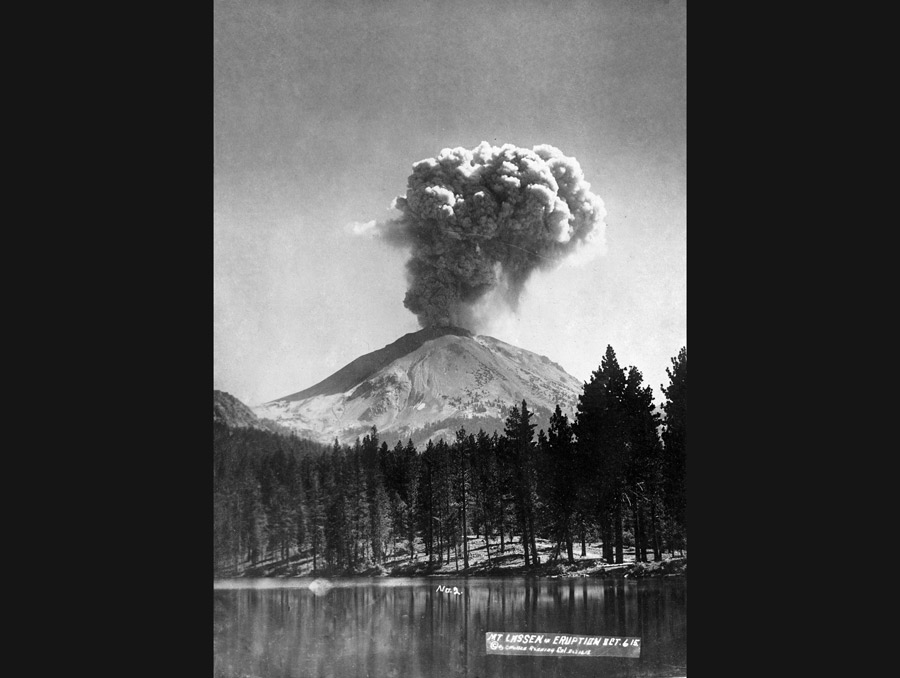
For Northern Nevada, Ruprecht said that a volcanic eruption at Lassen Peak or in the Walker Lane would be much more likely to affect the region than an eruption at Yellowstone.
“I won't lose sleep over any of this until monitoring data of emitted gases, local earthquakes and ground deformation signal continued and elevated unrest of a volcano,” Ruprecht said.
Ruprecht is part of a multi-institutional, multi-national team which is developing a framework for the National Science Foundation to study the linked hazards of volcanoes, earthquakes and landslides. The goal of the Subduction Zone 4D Initiative is to equip 30 volcanoes in the Americas with comprehensive data monitoring infrastructure beyond what is present currently on most volcanoes to have a record of geophysical data should a volcano erupt.


