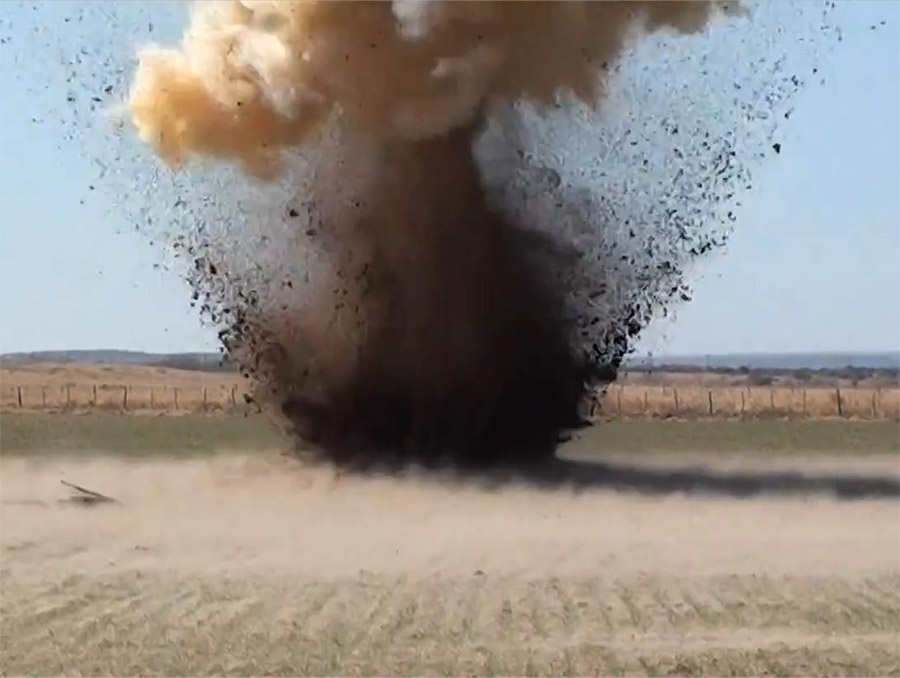

From Jan. 20-25, Reno will host the largest gathering of explosive and blasting professionals in the world. Nearly 2,000 people from more than 75 countries are expected at the annual conference of the International Society of Explosives Engineers.
Explosive engineers come to the field from various engineering disciplines, including civil, chemical, biomedical, mechanical and mining engineering — all programs at the University of Nevada, Reno. We’ll take a look at how those disciplines apply to explosives, but first, let’s take a look at what explosives are and how they work.
What are explosives?
Explosives are simple molecules that undergo a chemical reaction similar to a combustion process. If you compare it to a candle, explosives such as TNT have about 1/10th the total energy density of a candle. Burning a candle releases that energy but it occurs very slowly. In an explosive, the reaction takes place very fast. To give an idea of the rate, if there was a stick of dynamite that stretched from Reno to Las Vegas, it would take 100 seconds for the reaction to start in Reno and end in Las Vegas.
The key to explosives is that they do not have a very high energy density, but they release the energy very quickly, which is called detonation.
Are explosives only used for bad things?
When most people think about explosives, they think of bombs or military uses. However, more than 95% of all explosives are for peaceful purposes to better humanity. More than 17 million metric tons of explosives were used globally in 2025. The United States produces 775,000 metric tons of explosives annually, worth about $8 billion.
What may surprise people even more is that Nevada ranks third in the consumption of explosives in the United States (Wyoming and Minnesota use more). It should be no surprise that mining and quarrying use the largest amount of explosives in the world: it is a simple and effective way to break up rock. But explosives use does not end there.
Explosives can be used as pharmaceuticals, such as for treatment of some heart conditions; they are used in the construction of roads and tunnels; for avalanche control and even to make art and sculptures.
What are explosives engineers?
Explosives engineers are simply engineers who use the energy of explosives to do work in a safe and controlled manner. You do not necessarily have to have a degree in explosives engineering to be an explosives engineer. Chemical engineers investigate the safety and formulation of explosives. Biomedical engineers look to use explosives as drugs or drug delivery. Civil engineers use explosives to build roads, tunnels and dams as well as for demolition of buildings. Mechanical engineers often study propulsion and combustion process of explosives. Mining engineers use explosives to break rock and obtain resources from the ground. Even aerospace engineers can be explosives engineers, as explosives are used in rockets and for separation of stages during a launch. The University of Nevada, Reno has all these engineering disciplines.
Explosives engineers come from many disciplines, but they share one goal: using controlled energy to make life safer, easier and more efficient. From building tunnels and roads to advancing medicine and space exploration, their work touches nearly every part of modern life. So next time you’re filling up your car, driving through a tunnel or skiing down a mountain, remember, explosives helped make it possible.


