
Lorne Whitehead, Ph.D.
Department of Physics and Astronomy
University of British Columbia
Monday, October 12, 2026 | 12 noon-1:00 p.m. | Effie Mona Mack 100
When Psychology Meets Engineering: Rethinking Color Displays for Human Vision
Color technologies, in both lighting and image displays, have long relied on approximate models for human color perception. As narrow‑band LEDs become common and accuracy standards rise, these models are showing their limits and need updating. Because no single community maintains them, coordinating improvements is challenging. This presentation offers suggestions for achieving the color‑accuracy advances needed to better support human perception in the built environment.
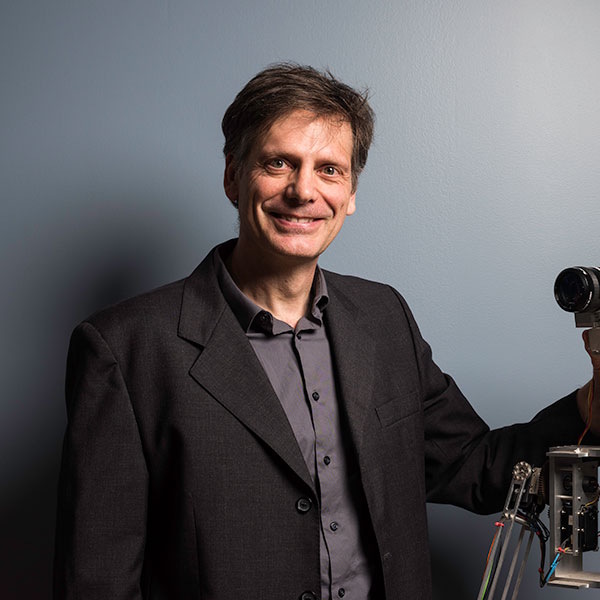
Michele Rucci , Ph.D.
Brain & Cognitive Sciences, Center for Visual Science
University of Rochester
Friday, May 1, 2026 | 4:30-5:30 p.m. |Mackay Science 215
Seeing by Moving: The Inseparable Link Between Vision and Action
Establishing a representation of space is a fundamental goal of perceptual systems. Yet spatial information is not always explicit in sensory signals. In most modalities, it must be extracted from cues embedded in the temporal flow of receptor activation, a flow that is often structured by motor behavior. Vision, by contrast, begins with a sophisticated optical imaging system that explicitly preserves spatial structure on the retina. This has encouraged the view that vision is primarily a spatial process: that constructing a representation of the world merely requires transmitting the retinal image to the cortex, much like uploading a digital photograph. However, this deceptively simple analogy is difficult to reconcile with theoretical models and experimental findings that examine vision under natural conditions of motor behavior. In this talk, I will review recent evidence supporting active space-time encoding: the idea that, like other senses, vision relies on motor strategies to represent spatial information in the temporal domain. This perspective has important implications for understanding normal visual function, the consequences of abnormal oculomotor behavior, and the design of visual prostheses.

Miguel P. Eckstein, Ph.D.
Department of Psychological and Brain Sciences
University of California, Santa Barbara
Friday, April 10, 2026 | 11 a.m. | Reynolds School of Journalism 101
Covert Attention B-sides and Horace Barlow’s Neuron Doctrine
Covert visual attention allows the brain to select specific regions of the visual world without eye movements. Attending to a location or object significantly improves perceptual performance. The reigning dogma and long-standing textbook explanation state that covert attention is a limited resource. According to this view, splitting attentional resources across locations comes at a cost, while focusing them at a single location improves processing. This dogma also posits that a specialized brain module, thought of as a spotlight or zoom, is needed to manifest attention-like behaviors. I will challenge this classic dogma by building on our lab’s eight-year+ dedication to unraveling how neural networks without any built-in attention mechanism show emergent human-like signatures of covert attention. Peeking under the hood of these networks helps us understand how a system can "attend" without explicitly building an attention mechanism and allows us to make predictions about the existence of new neuron-types mediating covert attention. Finally, I will reflect on the enduring relevance of Barlow’s neuron doctrine and the capability of simpler organisms and AI to exhibit the behavioral and neural signatures of human-like covert attention.

Bruno Olshausen, Ph.D.
Director, Redwood Center for Theoretical Neuroscience
University of California, Berkeley
Monday, March 30, 2026 | 3 p.m. | Effie Mona Mack 101
Emergence of unique hues from sparse coding of color in natural scenes
Our subjective experience of color is typically described by abstract properties such as hue, saturation, and brightness that do not directly correspond to sensory signals arising from cones in the retina. Along the hue dimension, certain colors – red, green, blue, and yellow – appear unique in that they are not perceived as a combination of other colors, and the pairs red-green and blue-yellow appear opposites. However, the anatomical and physiological correlates of these ‘unique hues’ within the brain and the reason for their existence remain a mystery. Here, we demonstrate a direct connection between these hues and the statistics of the natural visual environment. Analysis of simulated cone responses on a dataset of 503 calibrated natural images reveals a strongly non-Gaussian distribution in 3D color space, with heavy tails in distinct, asymmetrically arranged directions. A sparse coding model is then adapted to this data so as to minimize the total sum of coefficients on the basis vectors for representing the data. A six basis-vector model converges to the four unique hues in addition to black and white. Moreover, we find that the nonlinear nature of inference in the sparse coding model yields both excitatory and inhibitory interactions among latent variables; the former facilitates combining adjacent pairs of unique hues to encode intermediate hues situated between them, while the latter enforces mutual exclusivity between opposite unique hues. Together, these findings shed new light on the distribution of color in the natural environment and provide a linking principle between this structure and the phenomenology of color appearance.

Kendrick Kay, Ph.D.
Department of Radiology
Center for Magnetic Resonance Research
University of Minnesota
Minneapolis, Minnesota
Friday, March 13, 2026 | 11 a.m. | Reynolds School of Journalism Room 101
Advancing cognitive neuroscience through (good) data
I will present three diverse lines of work, all sharing the common theme of focusing on data to advance cognitive neuroscience. First, I will summarize the influential large-scale 7T fMRI Natural Scenes Dataset (NSD), which consists of whole-brain BOLD responses while each of 8 participants viewed tens of thousands of natural scenes over the course of 30-40 scan sessions. This dataset exemplifies an 'intensive neuroimaging' approach in which cognitive phenomena are extensively sampled in a small set of individuals in order to support computational modeling and detailed investigation of brain function. Second, although careful quantification and control of visual stimuli have served as the backbone of visual neuroscience, there has been less emphasis on how an observer's task influences the processing of sensory inputs. I will preview an ongoing 7T fMRI data collection effort to broadly sample how different tasks influence stimulus-driven responses in the human brain. Finally, neural response measurements are invariably corrupted by noise, and conventional trial averaging is often insufficient for adequately suppressing noise. I will discuss ongoing development of a new denoising technique based on signal-aware low-rank reconstruction. The method is robust, general (applicable to any data modality), and substantially improves recovery of signal while incurring minimal bias.