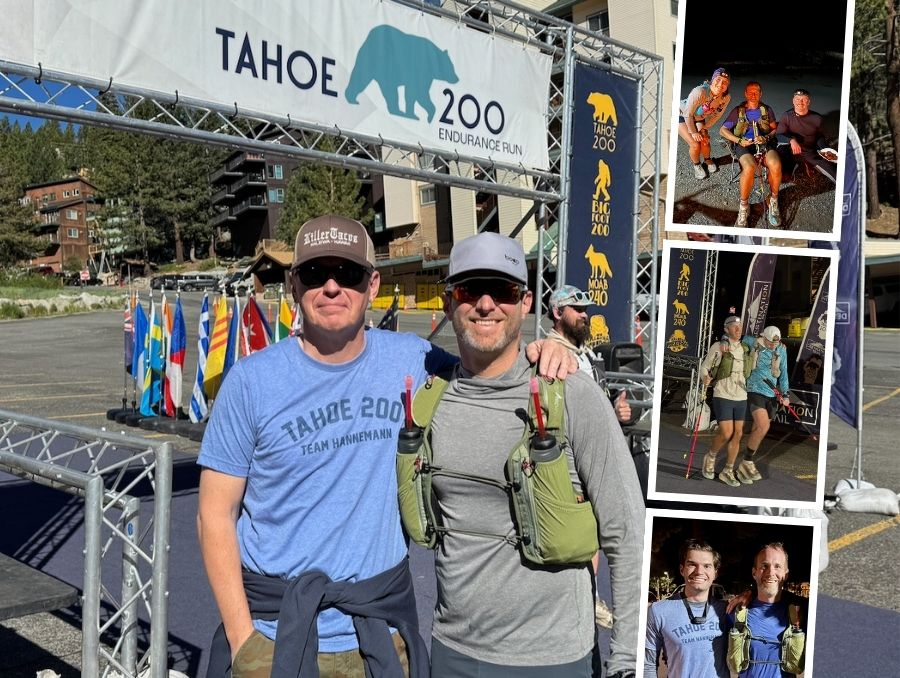
At the University of Nevada, Reno School of Medicine (UNR Med), medical training often extends beyond the classroom and clinical settings, giving students opportunities to care for patients in unique and challenging environments. One such opportunity is the Tahoe 200, an ultramarathon held each June in the Tahoe region that draws hundreds of runners from across the country.
Covering 200 miles over multiple days and nights, the race tests participants’ physical endurance, mental resilience and determination. The demanding nature of the event also requires comprehensive medical support, making it an ideal setting for medical students to apply their clinical skills while caring for athletes pushed to their limits.
This year, medical students participated in the Tahoe 200 as pacers and crew members, supporting runners through some of the race's most physically and mentally demanding stretches. The students gained firsthand experience making clinical observations while witnessing the resilience and perseverance of ultramarathon athletes. The experience offered a unique blend of medical education, teamwork and service, reinforcing the importance of compassionate care in every setting.
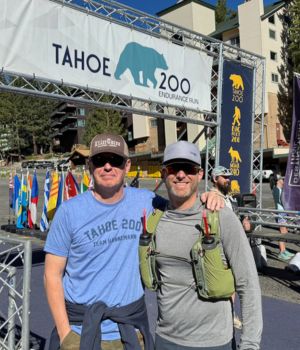
John Westhoff, M.D., MPH, (left), assistant dean of student research at UNR Med, and radiologist Nathan Hannemann, D.O., first met while deployed to Iraq in 2019, where Westhoff introduced Hannemann to long-distance running during early-morning training runs around their forward operating base. What began as preparation for a 50-mile ultramarathon evolved into a passion for endurance sports, ultimately leading Hannemann to complete the Tahoe 200, a race Westhoff had first told him about years earlier during their deployment.
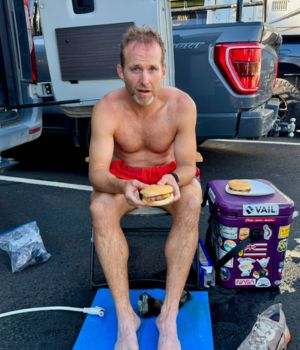
Hannemann took a brief break at Loon Lake Aid Station after covering 87.7 miles in 22 hours and 50 minutes. The overnight section had proven especially challenging, with wildfire-damaged trails, downed trees, route-finding difficulties and technical terrain slowing progress. After receiving crew support, eating a cheeseburger, tending to his feet and taking a short nap in the support vehicle, Hannemann resumed the race with his first pacer.
Hannemann (left) departed Loon Lake Aid Station with his friend and first pacer, Mason Geyer, after completing 87.7 miles of the Tahoe 200. Following a brief nap, gear check and crew stop, Hannemann resumed the race for the 39-mile section to Tahoe City. In ultramarathons, pacers serve primarily as companions and safety partners, helping runners navigate, monitor their condition, and make sound decisions as fatigue and sleep deprivation accumulate over multiple days on the trail.
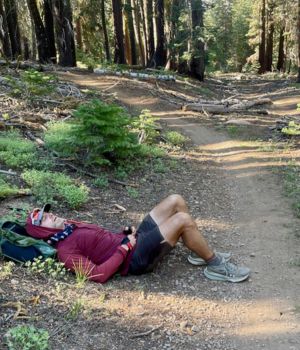
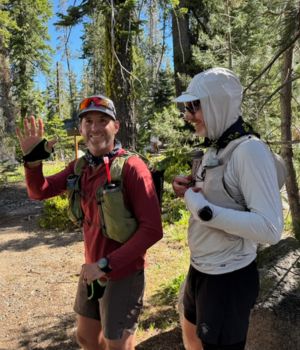
Hannemann attempted a brief trailside rest during the 39-mile section between Loon Lake and Tahoe City. Ultrarunners refer to these short, improvised sleep breaks as “dirt naps,” but in this case the combination of afternoon heat and relentless mosquitoes made meaningful rest impossible. After a few minutes, Hannemann got back on his feet and continued toward Tahoe City with pacer Mason Geyer.
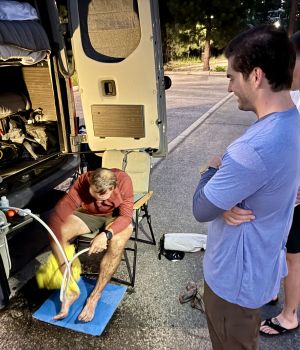
Medical students Ben Smith (foreground) and Adrian Samberg (right) look on Hannemann cleaned up and prepared for a short sleep break in the support vehicle. Following a brief rest, and after 127 miles and 35 hours 44 minutes on the course, Hannemann departed Tahoe City at approximately 11:30 p.m. with Samberg as his pacer for a 19.9 miles overnight section of trail north of Lake Tahoe.
“One of the moments I will always remember was meeting Dr. Hannemann at 11 p.m. after he had just woken up from a two-hour nap on the second day of the race,” Samberg shared. “Somehow, he emerged with more energy than I thought was humanly possible at that point. I had gone into the experience thinking that I was there to provide safety, encouragement, and emotional support for him, but almost immediately I felt like I was the one being uplifted by his energy and determination. It was intensely motivating.”
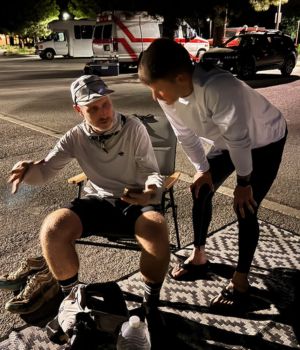
Ongoing pacer Samberg (right) received handoff from Geyer at Tahoe City Aid Station while Hannemann slept in the crew vehicle. Much like a clinical sign-out, the conversation focused on Hannemann’s condition, nutrition, pace, mindset and potential challenges for the upcoming overnight section, helping ensure continuity of support as the race entered its second night.
“Reading textbooks and studying physiology are essential parts of medical education,” Samberg said. “But there is no substitute for seeing the human body and mind pushed to their limits in real time.”
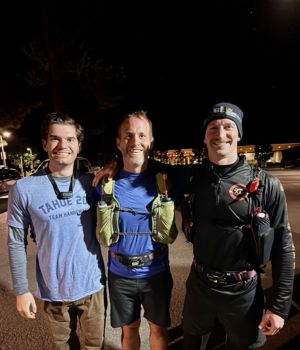
Refreshed after a two-hour sleep break at Tahoe City Aid Station, Hannemann (center) prepared to begin another overnight section of the Tahoe 200. Joining him are Smith (left), a member of the support crew, and Samberg (right), who would pace Hannemann through the next 20-mile segment. Like all runners and pacers in the event, Hannemann and Samberg carried mandatory safety equipment, including navigation tools, lighting, emergency gear, and extra clothing for the overnight mountain conditions.
“I am incredibly grateful to Dr. Westhoff for trusting us to participate in such an important and logistically complex event,” Samberg explained. “It was a privilege and an honor to support Dr. Hannemann in whatever small way I could during such an extraordinary race.”
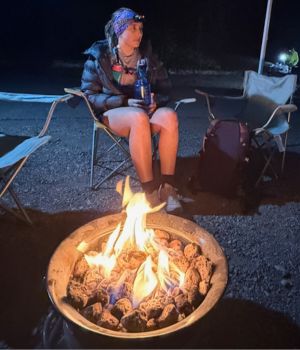
Medical student Annika McBride waited at Brockway Summit Aid Station while Hannemann and pacer Samberg make their way through the night from Tahoe City. McBride and fellow medical student Abby Hayes traveled ahead to the next crew-access aid station, where McBride would assume pacing duties for the following segment. Multi-day ultramarathons require careful coordination among runners, pacers and support crews, with team members often moving hours in advance to prepare for the next exchange.
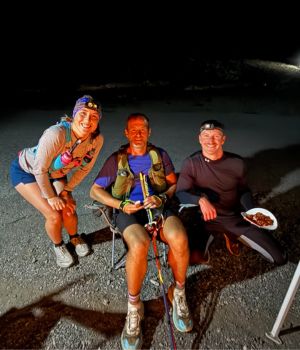
At Brockway Summit Aid Station, Hannemann (center) paused with outgoing pacer Samberg (right) and incoming pacer McBride (left). By this point, Hannemann had covered nearly 147 miles and was running well ahead of his projected pace. He later remarked that the energy and enthusiasm of UNR Med’s medical student pacing team provided a much-needed morale boost during one of the most difficult parts of the race.
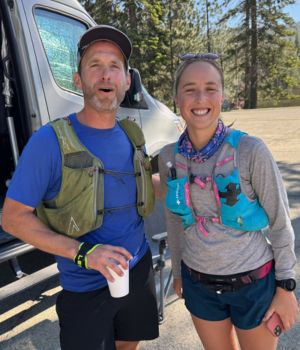
After running through a second night and into the morning, Hannemann arrived at Village Green Aid Station having covered 161.1 miles in 50 hours and 28 minutes. Despite more than two days on the course, Hannemann remained in remarkably good spirits. Joining him McBride, who had just completed a demanding overnight pacing segment that included technical descents and rugged terrain. By this point, the team knew a successful finish was increasingly within reach.
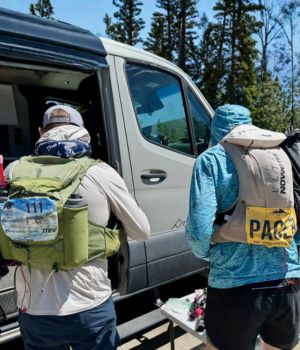
After a brief stop at Village Green Aid Station, Hannemann (left) prepared to depart for the final segment of the Tahoe 200 with longtime friend and pacer Geyer (right). Pacers are required to wear official race bibs identifying them to aid-station volunteers and race officials. With fewer than 40 miles remaining, the pair set out on the final push toward the finish line after more than two days on the course.
“It was an exquisite adventure and unlike anything I had experienced before,” Samberg said. “I feel genuinely honored that I was able to share even a small part of such a monumental journey with Dr. Hannemann.”
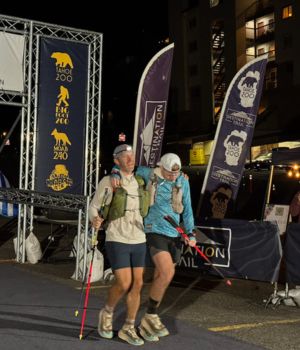
Hannemann crossed the finish line of the Tahoe 200 at Heavenly Ski Resort with Geyer after 2 days, 13 hours, and 18 minutes on the course. Hannemann completed the 200-mile ultramarathon in 10th place overall out of approximately 280 starters, overcoming two nights of sleep deprivation, challenging mountain terrain, and more than 30,000 feet of elevation change.
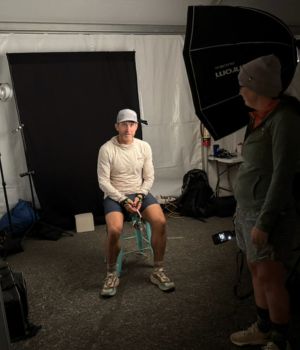
Minutes after completing the Tahoe 200, Hannemann sat for a traditional post-race portrait. Many ultramarathons photograph runners before and after the event to document the effects of extreme endurance efforts. Despite covering 200 miles in just over 61 hours, Hannemann appeared remarkably composed, a testament to his preparation, pacing strategy, and experience in multi-day ultramarathon.


