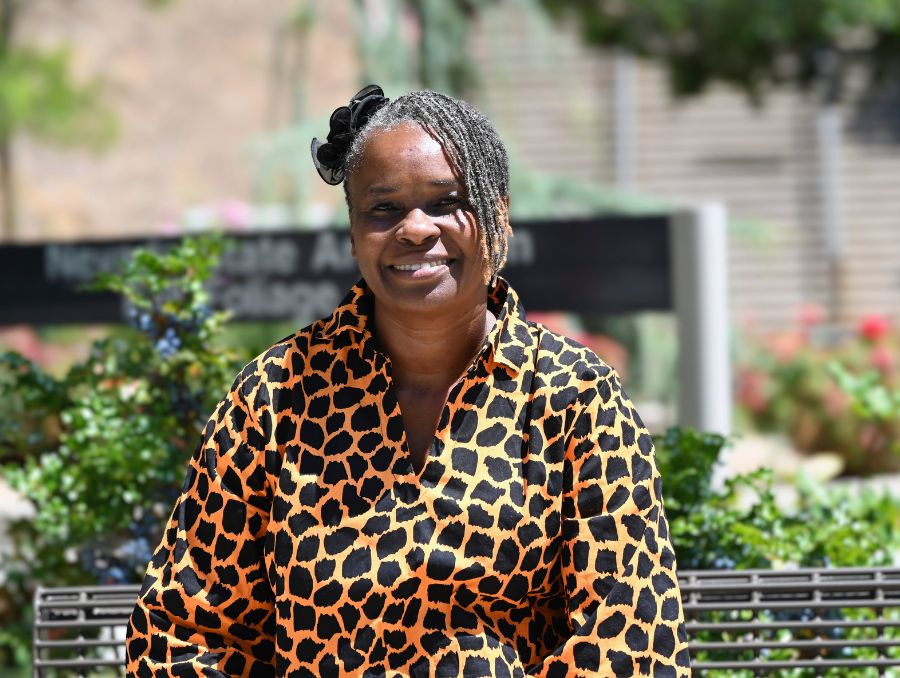
Stella Nyagwencha has run three therapy sessions of her own in the University of Nevada, Reno's psychology clinic, a small number that represents something the Kalel Program has been working toward for four years.
Nyagwencha is an assistant professor of psychology at the United States International University-Africa in Nairobi and the first faculty member to train in Reno through the Kalel Program, the partnership between USIU-Africa and the University's Global Institute for Behavior Analysis. Launched in 2022, it is the first applied behavior analysis training program on the African continent. Four cohorts have completed it, and enrollment has grown from 16 students to 31, with a fifth cohort beginning in September.
Nyagwencha had studied for her Master of Science in Behavioral Analysis through Nevada Online for three years while teaching full time in Nairobi. When she reached the practicum requirement, there was nowhere in Kenya to complete it.
The next hurdle was supervisors. Kenya has about four Board Certified Behavior Analysts (BCBAs), according to data from the Kenya Association for Behavior Analysis (KABA), and graduates need certified supervision to practice. Nyagwencha came to Reno to become among the first.
"I had absolutely no idea what Applied Behavior Analysis (ABA) truly was about before I came," Nyagwencha said. “Not in practice.”
Learning by watching
Nyagwencha had studied for her Master of Science in Behavioral Analysis through Nevada Online for three years while teaching full time in Nairobi. When she reached the practicum requirement, there was nowhere in Kenya to complete it.
The Kalel Program built her a path. Because Nyagwencha is not certified to practice in the U.S., she could not take clients whose sessions are billed to insurance, so staff secured permission from parents for her to observe, then paired her with volunteer families.
"By sitting in sessions with different clients, I was able to see this is how you handle small children, this is how you work with adolescents ... And at the same time, they were talking to me and teaching me what exactly I needed to do."
"By sitting in sessions with different clients, I was able to see this is how you handle small children, this is how you work with adolescents," she said. "And at the same time, they were talking to me and teaching me what exactly I needed to do."
Her supervisor is Matisse Lovett, a graduate student and instructor in the department. She worked in the clinic directed by Bethany Contreras, assistant professor of psychology. Laura Barcelos, director of the Global Institute for Behavior Analysis, organized supervision and the collaboration with partners at the University and the community.
"Experiential learning is a critical aspect of the success for the Kalel Program and the future of evidence-based autism treatment in Africa," Barcelos said. "The Global Institute for Behavior Analysis is committed to helping to create a self-sustaining educational system in Kenya through collaboration with dedicated individuals like Dr. Nyagwencha. The time Dr. Nyagwencha spent here this summer is a major step towards that goal."
What changed
What Nyagwencha describes learning is not a technique. It is an assumption she had to give up.
When I came to the University of Nevada, Reno, I thought that communication is just speaking. My world is turning upside down.
"When I came to the University of Nevada, Reno, I thought that communication is speaking," she said. Communication, she learned, can be a gesture, a point, a look. "That if I have no words, I can actually tell you what I want. That has been profound for me."
Clinical psychology, her own field, is two people sitting and talking. In Applied Behavior Analysis, a learner may not sit, may not speak, may be aggressive. "I have to put aside what I knew, literally," Nyagwencha said. "My world is turning upside down."
She watched how the team worked, too. Kenyan clinicians tend to work alone. Here, two or three behavior analysts shared a session and staff met weekly to go over it. "They chip in, they're supporting."
The department also connected her with High Sierra Industries, a Reno organization serving autistic and disabled adults, giving her a look at care that continues into adulthood, something Kenya has barely begun to offer.
"Dr. Stella brought a willingness to truly experience how we support autistic learners using the science of behavior and was willing to push through the intense process that is learning to see the world in a new way," said Mark Malady, MS, BCBA, of High Sierra Industries. "She brings us hope to see how Kenya builds a system of empowerment for autistics, and we can't wait to see what she builds!"
Going home
Nyagwencha has been the only person in Kenya taking the coursework, with no classmates and a large time difference from her instructors. "It has not been a walk in the park," she said.
Ending that isolation is the point. Once she is certified to supervise, Kalel Program graduates will have someone at home to turn to, and Nyagwencha hopes to be the first of several USIU-Africa faculty to train in Reno. She would like to see the partnership grow into a master's degree in ABA at USIU-Africa, a clinic in Nairobi, and joint research with University of Nevada, Reno faculty.
The Stella who came to the University is not the same Stella
"The Stella who came to the University is not the same Stella," she said. "It can never be 100%, but I know that I am going to make a difference."
What she wants readers to remember is smaller. "That the Kalel Program touched one life," she said.


