Thank you to the team at the University Libraries @One Center for producing and editing this episode.
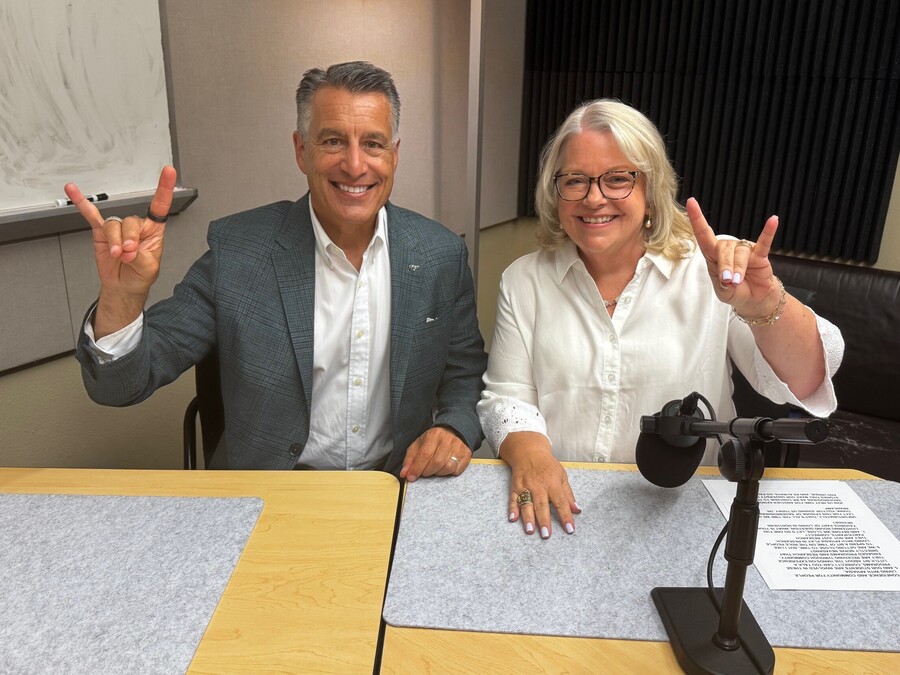
In this episode of Sagebrushers, University of Nevada, Reno President Brian Sandoval sits down with Tami Brancamp, Ph.D., founder of the Aphasia Center of Nevada and an associate professor in the Department of Speech Pathology and Audiology at the University of Nevada School of Medicine.
Brancamp explains the language disorder aphasia, which can happen after a stroke, a brain injury, a tumor or a neurological disease, and can severely inhibit the ability to speak or understand language. She explains how people with aphasia are historically excluded from and underrepresented in research, leading to reduced understanding of the condition and its impacts on daily life.
The two also discuss the University's aphasia camp, hosted annually in collaboration with Sierra Nevada Journeys. The weekend getaway provides opportunities for people with aphasia, their care partners and volunteers to build community, develop skills and spend time in the beautiful Sierra Nevada.
Brancamp also elaborates on her research regarding aphasia's impact on math skills, often impacting daily tasks such as grocery shopping or managing a checkbook. Brancamp collaborates with her husband, Dave Brancamp, who is an adjunct faculty in the College of Education and Human Development, to understand the correlation of aphasia and math and to develop rehabilitation procedures. She explains services offered for individuals with aphasia and how they can be accessed through the School of Medicine at little to no cost.
Sagebrushers is available on Spotify, Apple Podcasts and other major podcast platforms, with new episodes every month.

Sagebrushers season 5 episode 6: Aphasia Awareness with Dr. Tami Brancamp
In this episode of Sagebrushers, University of Nevada, Reno President Brian Sandoval speaks with Tami Brancamp, founder of the Aphasia Center of Nevada and associate professor of speech pathology and audiology.
President Brian Sandoval: Welcome back, Wolf Pack family. I'm your host, Brian Sandoval, a proud graduate and the president of the University of Nevada. Today's episode is focused on research and community outreach related to a disorder that affects millions of people worldwide called aphasia. Aphasia, which causes an inability to understand or produce speech, often affects people after stroke. Here on campus, we're extremely proud to have a center that supports individuals with aphasia with statewide resources. Joining us is Dr. Tami Brancamp, the founder of the Aphasia Center of Nevada and an associate professor in the Department of Speech Pathology and Audiology at the University of Nevada School of Medicine. Her research focuses on helping people with aphasia rebuild meaningful, fulfilling lives after stroke through innovative rehabilitation, community engagement and stakeholder-driven research. Dr. Brancamp's work spans post-traumatic growth in aphasia, exploring how individuals adapt, find resilience, and experience positive life changes after stroke as well as the development of novel interventions such as aphasia plus math that addresses everyday challenges including numeracy, scheduling and independence. That's a lot.
Today's episode is being recorded in the @One Podcast Studio of the Matthewson-IGT Knowledge Center. Thank you for being here today, Dr. Brancamp. We're really excited about this conversation.
Dr. Brancamp: Thank you for inviting me. I'm excited to have this conversation.
Sandoval: Yeah, no, after everything we've talked about, now we'll provide our audience with some of the details. So, we'll dive right into it. Before we dive into the important work happening related to this disorder on campus, can you share what aphasia is and why more people don't know about it?
Brancamp: Yeah. Aphasia is a language disorder, so that means people have difficulty understanding and producing speech, and it's due to an injury to the brain, most often from a stroke, but it can also be due to a brain tumor, a traumatic brain injury and even forms of dementia. So, over time, that ability even to have a conversation like you and I are having is impaired. In addition to having the language difficulty, they might also have difficulty with cognition, so thinking skills or mathematics, being able to calculate time or pay their bills. So, aphasia is a language disorder. It happens in older adults, but it also happens in young adults. One of my youngest patients was a 10-year-old who had a stroke. Yeah, so it can happen in all ages and different areas of development.
Sandoval: So, we kind of touched on it, and for me, I've heard of it, but I don't know about it. And so how common is it? Do you have an overwhelming number of patients?
Brancamp: So, you know about Parkinson's disease, right?
Sandoval: Yes.
Brancamp: More people have aphasia than have Parkinson's disease. It's like two million people in the United States have it. So, for every person who has a stroke, about one-third of those individuals will have stroke with aphasia, so they'll have the language disorder. I think part of the fact that people don't always know what it is, is that the person who has it may have a hard time advocating and sharing the information because it's a communication. We tell people about a disease or a disorder or a change after the stroke. It's also not visible. You won't notice it when you walk by somebody, but you might notice physical difficulties after a stroke, but not the language until you start to talk with them.
Sandoval: So, does it get confused with dementia?
Brancamp: It can, yeah. It can sometimes get confused with dementia. It can also get confused with, like, if someone's drunk, because if they get pulled over, physically they're fine to drive, but they can't speak. They can't tell the officer or somebody what's going on. So, it can get confused, but it is a separate condition from dementia.
Sandoval: And do you find that we have sufficient resources in this community to be able to take care of all of the individuals that are affected by aphasia?
Brancamp: No, I would say no. I think we have therapy centers, so there's the stroke, we have great hospitals, you have that urgent care and the immediate care and rehabilitation. Then we have private practice outpatient centers. Also, our partnership with Renown, we have a clinic here on campus. So those early zero to six months, pretty good coverage, but aphasia most often is lifelong. It doesn't disappear. It can get better, but it doesn't go away. So partly where we got extra interested was: how do you help an individual who has aphasia get back to living a life that's different than it was the moment before the stroke? So that's why we have the work that we're doing at the University is because our community needed –and still needs– more resources to help individuals get back to that, the highest level of independence and autonomy that we can support.
Sandoval: So just as an aside, you mentioned the relationship with Renown and what that is, is the affiliation agreement between the School of Medicine and Renown Health, which has been absolutely groundbreaking. And we just celebrated our fifth anniversary, so it really has opened a lot of care opportunities for people in the community. So, I'll go to our next question. So, tell us what led you to study this disorder and talk about some of your research related to growth and resilience after a stroke.
Brancamp: Yeah. So, I've had the opportunity to be a speech-language pathologist for a few decades now. And in those first 7-10 years, I would notice individuals who had the stroke, had aphasia, and who over time would start to thrive a little bit. I'm like, "Okay, that's fabulous." But then I would also notice individuals who didn't, who might stay in a state of depression or isolation. I'm like, "So what's the difference? What's the secret ingredient? Why are some people thriving or getting to a little bit of that and others are not?" So, I started to look into positive psychology and that led me to applying for a sabbatical, being awarded a sabbatical, which was wonderful. And I started looking into post-traumatic growth. I'm like, "What is that?" So, in the fact that a person has a traumatic event, and in this case, we're looking at stroke with aphasia, how do people–or do they–find a way to get more resilient, find some positives from it, at the same time not negating that this was a traumatic event and it has life-altering implications? So, learning about that.
As I started diving into it, I found that people with aphasia were often excluded from the stroke research because of the language difference, because the survey instruments weren't aphasia-friendly or weren't accessible to them. So, I thought, "Not on my watch, this is my opportunity." So, in that point, I gathered a group of people who have aphasia, their partners, and I said, "Okay guys, let's take a look at this if you're interested. One, you're being excluded from research, which I understand the why, but I don't like it. What are we going to do about it? And then what do you care?" So that lived experience, the people who are living with aphasia and those around them who love them and care for them, could be spouses, adult children, family, friend, we came together to, one, we got permission to take a tool and revise it into aphasia-friendly method.
We took that, went out and validated with about 70 people who have aphasia to show yes, we can participate in research and then: what does this post-traumatic growth thing look like? What it's also evolved into is identity. If you think about life-altering events, our personal identity has changed. Who I was the moment before is slightly different. So, the work we do really is about person-centered. Well, for example, normal therapy that we do is important, but there is this lifelong experience a person has after all the insurance therapy is allocated and gone. What do we do? So that's really where we started with the research was post-traumatic growth, resilience and then learning more and more about how do we do what's called co-production or co-directed research. So, taking the individuals who are living with the condition, they are the center and they're the ones who are telling us what is important and meaningful to them.
So that's where we started evolving a little bit over time to some of the other work with aphasia and mathematics.
Sandoval: That's incredible. So, let's go to another subject, which is aphasia camp.
Brancamp: Yeah.
Sandoval: Talk a little bit about the aphasia camp that happens on our campus.
Brancamp: Okay. So, we have a small center, the Aphasia Center of Nevada. It's a community hub in a way. It isn't the formal aphasia therapy. It's a place for people to come together, conversations, activities and involving students. So, aphasia camp, we have completed three years of it, and it came about because we have two people on who I call my advisory team. They're like, "Tami, let's go do a camp." I'm like, "Dudes, I don't camp in tents. I'm a glamper. So, if we can find a compromise... we did. Because the individuals who wanted it, being out in nature was super important to them, coming together in community. So, year three we've completed, we're getting ready for year four. We partner with Sierra Nevada Journeys in Portola, which is fabulous. So, we have an ADA accessible camp. It has really good cabins, so I'm happy.
And we include our graduate students and undergraduate students as part of the camp, so it's multi-generational. It's a place for community, conversation, outdoor education, relaxation. And we also follow it up with about four weeks of online groups as you transition back into real life after a great long weekend like that.
Sandoval: So, who are the campers?
Brancamp: So, the campers are people with aphasia. They're also a partner if a person needs any assistance, so it could be a spouse. First year, we had an adult son come with his dad; it was really life-altering for them. The other campers are some volunteers and our students. So, the students get a chance to take their learning outside the classroom and have those experiences of, yes, they've learned about the clinical term of aphasia and what it looks like and here they get to experience; these are people living with it who are just like the rest of us, but happen to have aphasia. They look able to look at the whole person and their family circles and dynamics and really expands their perspective so that when the students become professionals and professional clinicians, they are looking beyond the disease or the disorder and they're looking at the whole person and how a stroke with aphasia can really impact an individual.
Sandoval: And how many campers do you have and where do they come from?
Brancamp: Well, the first year we had only from Nevada, but we've opened it up. We also have people from Arizona, California. I have some New York people who are interested in coming, so they can come from all over. There are a few camps in the United States. We were the newest. The oldest is about 23 years. They've been doing it and each one is unique. We're doing it Nevada-style, even though it takes place in California, but it's Nevada-style camp.
Sandoval: Yes, we'll take that.
Brancamp: Yes.
Sandoval: So, talk a little bit more about the students that get engaged and what they learn and how they take that with them in their future careers.
Brancamp: Yeah. The students, I start recruiting right away, first class that we have. What I find is they get a chance to work with adults because I will only take people 18 and older, and the students get a chance to take some of the skills that they learned in the classroom and in the clinic and also get accustomed to working with adults. They can be more accustomed to working with kids, but how do you talk to an older adult and be comfortable? So, they learn to apply the academics, the psychosocial skills and engage with individuals. They also learn how to be the leader, because to me, they're not volunteers; they are my student leaders, so they get that responsibility and I can step back and watch them blossom and transform from student to professional, even in these couple of days that we're together.
Sandoval: How many of them are there that participate?
Brandcamp: Ranges from about 8-10. So last year we had speech pathology students, and we had our first medical student who's going to be a neurologist, so that opened and expanded perspectives. I'm also looking to – I know we're getting a new physical therapy program – so maybe in the future we'll get some PTs in there, OTs. I have past students who are now professional speech pathologists who come back to volunteer because it was so wonderful for their experience. They want to come back and give back to the community.
Sandoval: That's incredible. So, we're getting close to time, but I'd like to spend a bit of the time we have left on the role people living with aphasia play in research. They're not just research participants, correct?
Brandcamp: Right. I've sort of been a reluctant researcher. I'm a clinician first, right, and then I became a teacher and I am a researcher, but what made research real to me and enjoyable was utilizing and working with the people who are living with the condition; what is important and meaningful to them? And then is that something that's within my power to look at and explore? Because then we can hopefully have a different or a greater impact on the lived condition. So that's where we started with the math. Nobody was researching that math, just even being able to manage your checkbook, do your grocery shopping, follow a recipe, tell time, calculate time, all of those can get impacted because of a language disorder and damage to the brain.
So, we started looking at that and partnering with my partner and husband, Dave Brancamp, who is in the College of Education as an adjunct faculty, but he's a math educator. I'm like, "We need to borrow your knowledge and then combine it with my knowledge of aphasia, bringing math and language together to hopefully create some rehabilitation procedures that help people get those skills back."
Sandoval: So, for the listeners out there, if our family has been struck by a tragedy, a traumatic brain injury or stroke or the other things that you've talked about, who do they call? Do they go to a website? How can they reach out to you?
Brancamp: They can reach out to us on the School of Medicine website; they could probably Google "Aphasia Center" or Google "Aphasia" within the University website, and you should be able to find us.
Sandoval: That's great.
Brancamp: Yeah.
Sandoval: So, I know you're a Carson City kid.
Brancamp: I am.
Sandoval: And you are a local. And before we went live, we talked about the fact that you got your master's degree and your Ph.D. from the University of Nevada. So, you know all about Northern Nevada, but I'd love to hear from people that have grown up here: what's your favorite part about living here?
Brancamp: I think my favorite part about living here, one of them is that we get four seasons. When you're just getting bored with the temperature, it's going to change. I love that Lake Tahoe's in our backyard. I love that Vegas is what, 6-8 hour drive depending on how fast you go. So, there's such diverse environment and I like the people. And we were talking too, earlier, it's great to leave for just a bit so you can come back and know how wonderful Nevada really is. This is my home. I don't have any plans to move. I just enjoy it and love it.
Sandoval: No, we all love it. And we were having a conversation with another couple and we said, "Are you going anywhere this summer?" And they're like, "Why would we leave Northern Nevada during the summer?" But in any event, is there anything else that you wanted to bring to the attention of our listeners?
Brancamp: Well, I think aphasia is just under-recognized. We just finished the month of June, which was Aphasia Awareness Month. So, if you have never heard of the term, look it up. If you know someone who has a stroke and their language is off, but you don't know what it's called, there are resources. Please reach out, website, give us a call. And the work that we do at the Aphasia Center of Nevada currently is either no cost or low-cost, and that's due to donors who give. I just don't want anybody who has aphasia to be isolated. I want them to be able to participate to the level that they want. So, we don't want to let money be a barrier, but reach out, ask, speak up. Anything you need, I'll be here to help when it comes to aphasia.
Sandoval: Well, thank you. And unfortunately, that's all the time we have left for this episode of Sagebrushers. Thank you for joining us today, Dr. Brancamp.
Brancamp: My pleasure.
Sandoval: Phenomenal episode. So, join us next time for another episode of Sagebrushers as we continue to tell the stories that make our University special and unique, and as always, Go Pack.
Brancamp: Go Pack.


