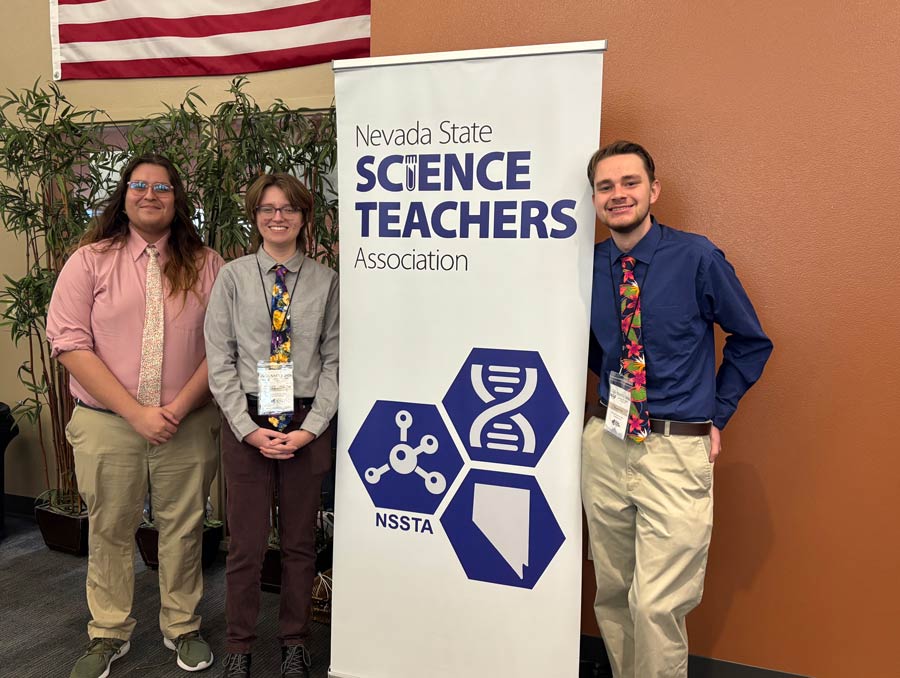
Four undergraduate students traveled to Las Vegas to present at the Nevada State Science Teachers Conference on Jan. 31. The students submitted proposals to present their work at the conference in December and presented to science teachers from across the Silver State at the conference. Over 230 teachers attended the conference.
NevadaTeach is an interdisciplinary program based in the College of Education and Human Development and provides undergraduate students with the opportunity to earn a degree in secondary education and a STEM degree in just four years to address the need for more well-prepared science teachers. Megan Beckam, a teaching associate professor and Master Teacher for NevadaTeach, is the chair of the planning committee for the conference and helped the students develop their presentation proposals.
“I love conferences because they give us a chance to pause the fast-paced teaching schedules we have and give us time to fill our buckets as teachers and as learners so that we are reinvigorated and inspired for our students,” Beckam said.
Three NevadaTeach students worked together on a session titled “Supporting practicum students in STEM: Perspectives from three pre-service secondary teachers.” The students identified three areas of improvement for observation days for pre-service teachers, an opportunity for future teachers to view a classroom and learn from teachers.
The presentation was developed by Franklin Alcala, a junior, Lily Pierce, a sophomore, and Daniel Gee, a junior. All three students are majoring in secondary education and biology.
The session was divided into three parts. The first part covered how to help encourage pre-service teachers to be involved in a STEM classroom.
“During a pre-service teacher’s first trip to the classroom, they don’t know much about the environment they are in. These uncertainties about the environment make it so a pre-service teacher doesn’t know what to do during an observation and makes it easy for them to sort of just shut down and sit in the back of the class watching,” Alcala said.
Alcala added that encouragement from teachers for pre-service teachers to be involved by passing out materials, providing definitions or even walking around the classroom is helpful for making pre-service teachers feel more comfortable in a classroom.
The second part of the session addressed the importance of making sure that pre-service teacher observances are taking place on days that involve teaching meaningful science content, like content found in the curriculum based on Next Generation Science Standards (NGSS), adopted by the Nevada Department of Education.
“These concepts could be reviews of information they know, or the application of these science concepts to answer problems,” Gee explained.
The last part of the session discussed how to provide productive feedback to pre-service teachers. Pierce noted that sometimes, mentors will praise a pre-service teacher’s successful lesson by saying that they don’t have feedback, and while students are glad to hear the teachers are happy with their work, feedback is crucial.
“The most memorable feedback I’ve received isn’t based on whether the comment was pleasant or constructive, but if it pointed out a specific event or action I took during the lesson,” Pierce explained. “Knowing what the mentor teacher is directly referencing is extremely helpful in being able to apply feedback in the future, whether it's an action I want to repeat or change.”
NevadaTeach requires its students to complete classroom visits in the form of both observation and teaching lessons of their own. Pierce said practicum hours are required to obtain a teaching license in Nevada.
“For most practicum classes, we go into the same classroom for the whole semester,” Alcala explained. “Usually, there are 3-5 classroom visits (“observations”) before we teach in a classroom. These classroom visits are meant to be spent getting to know the student and teacher, seeing how the teacher goes about teaching the students, and learning about the class norms in order to incorporate that information into our lessons.”
“These observations allow us to see how the skills we learned in our lectures can be applied,” Gee added. “It can sometimes be hard to understand how to utilize the tactics we learn as pre-service teachers, but by watching veteran teachers use them effectively, the way to use these techniques click.”
Alcala, Pierce and Gee each applied for funding to travel with Undergraduate Research and were successful in their applications.
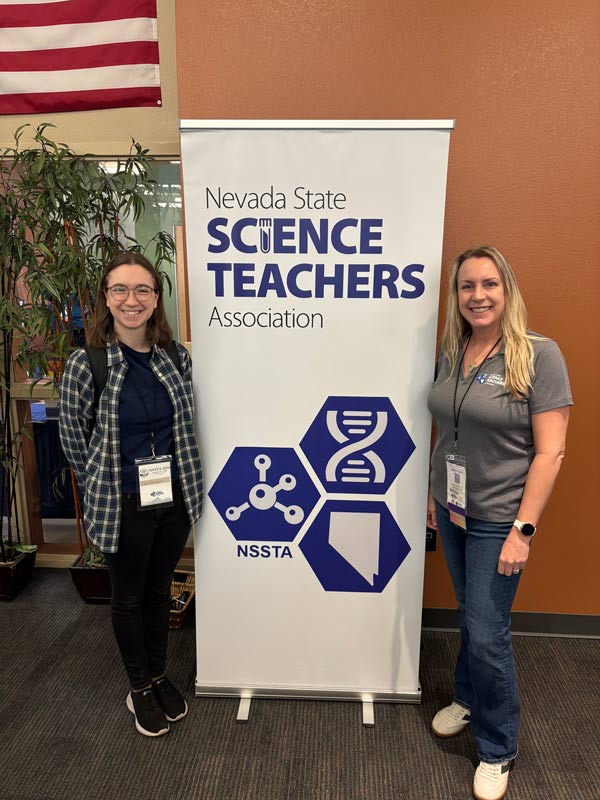
Beckam also presented a session alongside a geology undergraduate student, Trista McLaughlin. The session was an interactive workshop presenting a series of middle school earth science lessons based on NGSS. The session was titled, “Bringing Earth Science to Life: NGSS Aligned Lessons Using Local Phenomena” and the lessons explore natural phenomena like debris flows, wildfire, river velocity, weathering and plate tectonics, as well as mining of natural resources. Each lesson was developed, peer-reviewed and tested in middle school classrooms with funding from several National Science Foundation grants and is designed to provide relatable content to the students. For example, mining is a significant part of Nevada’s economy and employs many parents of students in Nevada, particularly in rural areas. The lessons were made available to science teachers in Nevada for use in their own classrooms.
McLauglin had previously participated in STEM education outreach with Joel Scheingross, an associate professor in geology. Beckam and Scheingross hosted a workshop funded by the National Science Foundation focused on middle school earth sciences. McLaughlin became involved in that workshop, attending geoscience mini-lectures related to middle school science standards and working in pairs to design and implement middle school earth science lessons.
“I was partnered with an in-service teacher, Fallon Arlin, and we worked together to create a lesson on Copper Porphyry deposits,” McLaughlin said.
Participating in these educational outreach opportunities blended two of McLauglin’s passions.
“I decided to get involved in these programs because I was originally an education major when I began studying at the University,” McLaughlin, a senior in geology, said. “I am passionate about learning and have always wanted to help spark curiosity and a love for learning in others. So, it was a hard decision to switch my major - but I fell in love with geology! These programs were an incredible opportunity for me to utilize both my education background and earth science knowledge.”


