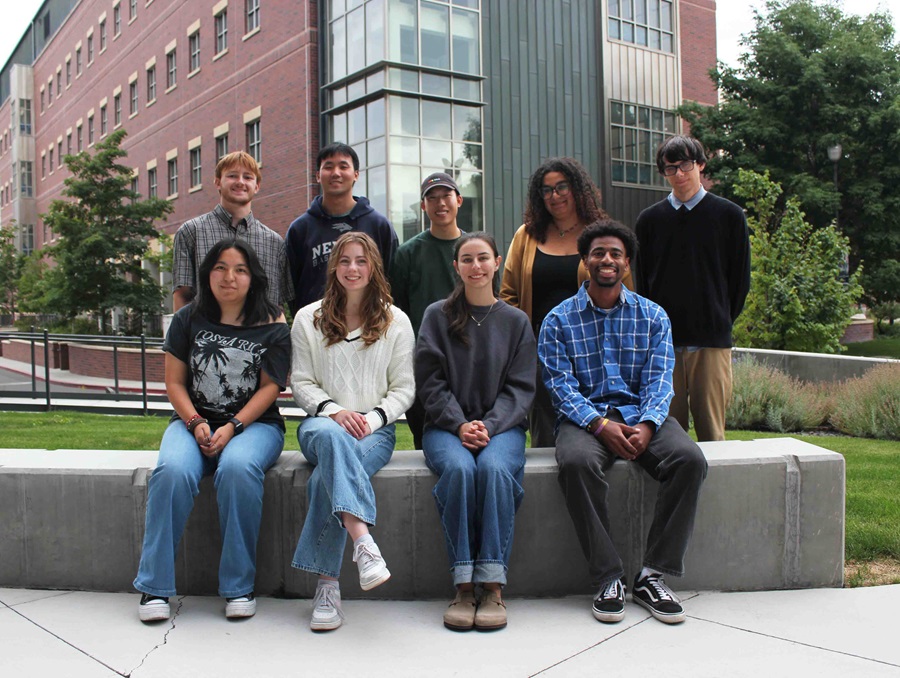
Twelve undergraduate and graduate students in engineering and science will begin research projects this fall on topics ranging from AI wildfire detection to insect adipose tissue signaling, funded through an engineering-led EPSCoR program.
Harnessing the Data Revolution for Fire Science (HDRFS) is a statewide research, education and workforce development program funded by the National Science Foundation (NSF) Established Program to Stimulate Competitive Research (EPSCoR). HDRFS is designed to strengthen Nevada’s research capacity and competitiveness in wildfire science and related fields.
The five-year program, which also involves the University of Nevada, Las Vegas and the Desert Research Institute, was established in 2022 with a $20 million NSF ESPCoR grant. Engineering Associate Dean Fred Harris is the project’s statewide director, and computer science Professor Alireza Tavakkoli leads the project at the University of Nevada, Reno.
“One of the most important outcomes of HDRFS is building the next generation of researchers and innovators,” Tavakkoli said. “These students are tackling complex challenges that span wildfire science, artificial intelligence, engineering and biology, while gaining hands-on experience with cutting-edge research.”
From wildfire detection networks to insect fat regulation
HDRFS is primarily a research grant focused on wildfire science, but part of the funding supports student research and training. Twelve graduate and undergraduate students from the University are supported in 2026: Jalen Banks, Saharat Buntha, Carter Burns, Carter Eads, Kaiden Farthing, Caden Feller, Mia Fisher, John Henkel, Branden Hough, Andrew Hsu, Brianna Rea and Audrey Schillinger.
Descriptions of the students’ projects are provided below. Information on Carter Burns’ project was not available at press time.
- Jalen Banks, a senior majoring in electrical engineering, is working with mentors Keane Flynn, NSHE research engineer, and Jehren Boehm, NSHE field science networks graduate assistant from the Department of Geography. Banks’ project, “LoRaWAN Sensor Distance Testing & Modification,” explores the capabilities of Long Range Wide Area Network (LoRaWAN) through various topography types across the Northern Nevada region. LoRa is a low power protocol that can transmit data across long distances with minimal signal degradation. This research is meant to expand the current existing network and assist the HDRFS campaign by enabling reliable telemetry across the state for wildfire detection.
- Saharat Buntha, a senior majoring in physics, is working with mentors Prakash Gautam and Hans Moosmuller from the Desert Research Institute on the project, “Experimental Investigation of Angular Light Scattering from Laboratory-Generated Soot.” Soot particles, commonly generated by wildfires, go through constant changes as they interact with particles in the atmosphere. Because soot particles are very light absorbent, it’s challenging to study their optical properties (how it interacts with light). Buntha’s study aims to improve our understanding of how soot size and structure affect its optical properties, which in turn will give us a more accurate interpretation of wildfire observations.
- Carter Eads, a senior majoring in electrical engineering, is working with mentor Professor Jeongwon Park. Her project, "Oxidation-Resistant MoS₂ Gas Sensors for High-Temperature Environmental Monitoring," develops heat-resistant gas sensors using two-dimensional materials to detect carbon monoxide from wildfires. The research could improve early wildfire detection by enabling sensors to operate reliably in extreme temperatures.
- Kaiden Farthing, a junior majoring in electrical engineering, is working with mentors Scotty Strachan, director of Nevada Climate-ecohydrological Assessment Network (NevCAN); and Keane Flynn, NSHE research engineer. Farthing’s project, “Low-Power Distributed Sensor Network for Early Wildfire Detection,” investigates a low-power distributed sensor network using LoRa for early wildfire detection across Nevada. Multiple sensor nodes collect temperature, humidity and smoke or gas data to identify potential fires while reducing false alarms. The research aims to improve wildfire monitoring and provide practical experience with embedded systems, wireless communication and data analysis.
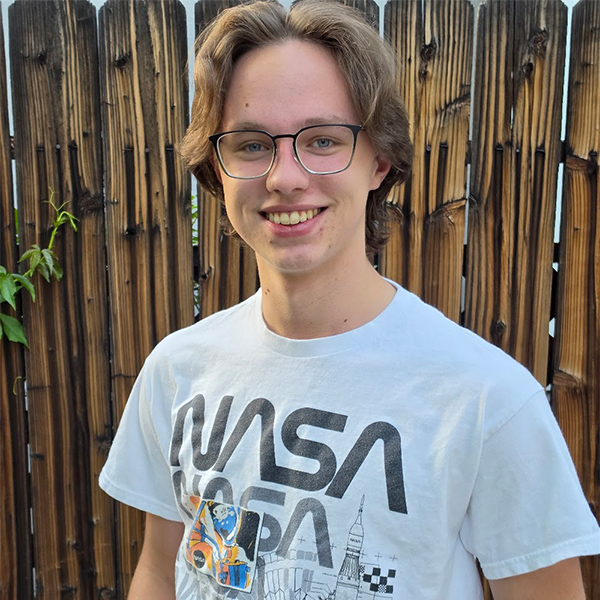
- Caden Feller, a sophomore majoring in computer science and engineering, is working with Scotty Strachan, an NSHE research engineer. Their project, “OpenPTZ”, is a free and open-source software solution that turns any generic PTZ security camera or otherwise into a research-ready field camera. The system will provide a universal camera control interface, a store-and-forward middleware to make it robust against unpredictable network drops, and backend integration with the existing camera image archive managed by SCS.
- Mia Fisher, a senior majoring in computer science and engineering, is working with mentor Assistant Professor Rui Hu, on the project, “Evaluation of Reliability and Robustness of LLM-Based Fire Detection and Data Analysis Systems Against Prompt Injection.” Large Language Model (LLM)-based agent systems support wildfire classification and decision-making by integrating external information. However, indirect prompt injection (IPI) attacks can manipulate retrieved content, causing inaccurate risk assessments or unsafe evacuation recommendations. This project evaluates the robustness and reliability of LLM-based wildfire response systems against IPI attacks.
- John G. Henkel, a senior majoring in computer science and engineering, is working with mentor Professor Monica Nicolescu. Henkel’s project, “Establishing Tightly Coupled Coordination Between People and Robots,” aims to facilitate synchronization in timing and speed during shared tasks in human-robot interactions. This project will enable a robot to identify and communicate discrepancies in human and robot execution, recover from errors, effectively coordinate timing with a human, and process human commands. This research builds on an existing framework in which teams of robots could communicate directly via broadcasting.
- Branden Hough, a junior majoring in computer science, is working with mentor Professor Alireza Tavakkoli and doctoral candidate Ayesh Meepaganithage. His project, “Machine Learning Model for Wildfire Detection,” uses computer vision technology to detect fires and smoke in aerial imagery from satellites and drones. Ecological data on sagebrush ecosystems will be implemented to study fire behavior and fuel availability, and results will be available through a web-based dashboard that visualizes predictions and environmental data.
- Andrew Hsu, a junior majoring in computer science, is working with mentor Professor David Alvarez-Ponce on the project “Gene Duplication’s Effect on Tissue Expression Divergence.” Gene duplication is widely recognized as a primary driver of evolutionary innovation and genome complexity. Hsu’s proposed study aims to investigate whether gene duplication events are often followed by accelerated evolution of gene expression patterns.
- Brianna Rea, a sophomore majoring in mechanical engineering, is mentored by Professor Pradeep Menezes and his graduate student, Lincoln Pinoski. Her project, “Mechanical Characterization of Stainless-Steel Welds: Comparing GMAW, HLAW, and LW Techniques,” focuses on mechanical characterization of stainless-steel weld joints produced using gas metal arc welding, hybrid laser-arc welding and laser welding. Hardness, toughness and microstructural characteristics across the fusion zone, heat-affected zone and base metal are investigated. Results will support the development of storage canisters for spent nuclear fuel in challenging environments.
- Audrey Shillinger, a junior majoring in biology, is working with mentor and biology Professor Thomas Kidd. Her project is “Identifying Signaling Components that Regulate Insect Adipose Tissue Structure.” Insect larvae increase their body mass 1,000-fold in a few days. If faced with starvation or other stresses, they have to activate molecular mechanisms to ensure their survival. The Kidd Laboratory has identified a key signaling pathway and Schillinger will identify components that are active in this process using a genetic approach.


