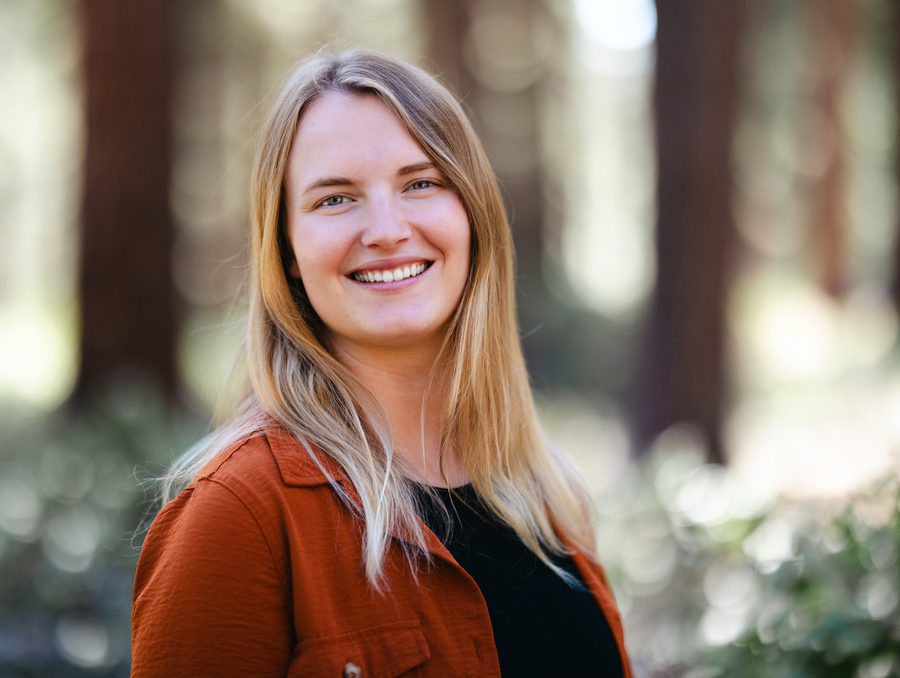
Kylie Papson has spent nearly seven years at the University of Nevada, Reno: as a student, a marketing professional and a graduate researcher. Across every role, she said, one thing has stayed the same.
"Faculty members' passion for education and research that defines the heart of this University."
"The overarching theme throughout all of my different times here is the incredible faculty who have guided my work along the way," Papson said. "For me, it is their passion for education and research that defines the heart of this University."
A Reno start
Papson was born and raised in Reno and chose to study at the University to stay close to family.
"The University offered scholarships and made higher education affordable," she said.
That affordability opened doors. Papson graduated in 2020 with three bachelor's degrees in French, anthropology and art. While a student, she studied abroad for a semester in Pau, France, where she nearly completed her French degree, taking the final class after returning to Reno.
An unexpected path
Graduating in the middle of the COVID-19 pandemic changed her plans quickly.
"It's been quite the unexpected ride," Papson said. "All of the opportunities I had lined up suddenly dissolved, as they did for many people."
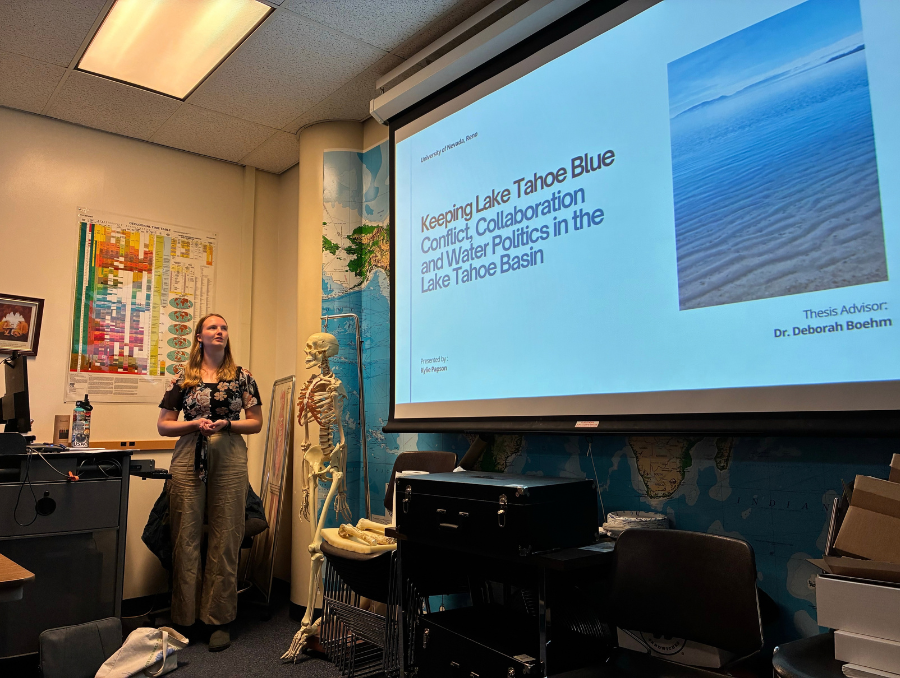
Papson worked odd jobs to build experience, but her heart was set on working in sustainability or environmental protection. In 2024, Papson began a master's degree in anthropology. Her research examined the political dynamics of water policy at Lake Tahoe, including how people interact with and talk about water policy in the region and how those conversations shape governance decisions. The project began that fall, with most interviews held in fall 2025 and spring 2026. Participants included local scientists, journalists, tribal members, leaders of nonprofit organizations, governing authorities, retired environmental lawyers, policymakers and full-time and part-time residents. She also drew on a historical analysis of resource exploitation and environmental governance at Lake Tahoe, participant observation at events, an analysis of social media posts and a review of local news coverage.
"The University offered scholarships and made higher education affordable."
"I absolutely loved the program, the faculty and the research," she said.
Papson has presented her findings at several conferences, including a panel at the American Anthropological Association conference in November 2025, a poster at the Nevada Water Resources Association conference in February 2026 and a poster at the Society of Ethnobiology conference in May 2025, which was hosted at the Lake Tahoe campus. During her studies, she also began working in 2025 with Sudeep Chandra, professor of limnology and director of the Tahoe Institute for Global Sustainability. Inspired by his passion for Tahoe and for global sustainability research, she joined the team at the Institute. Through the Institute, Papson met stakeholders in the Tahoe community who would later participate in her study.
"Their interviews transformed the direction of my research and brought up new and important questions that I addressed in the project," she said.
Connecting science and community
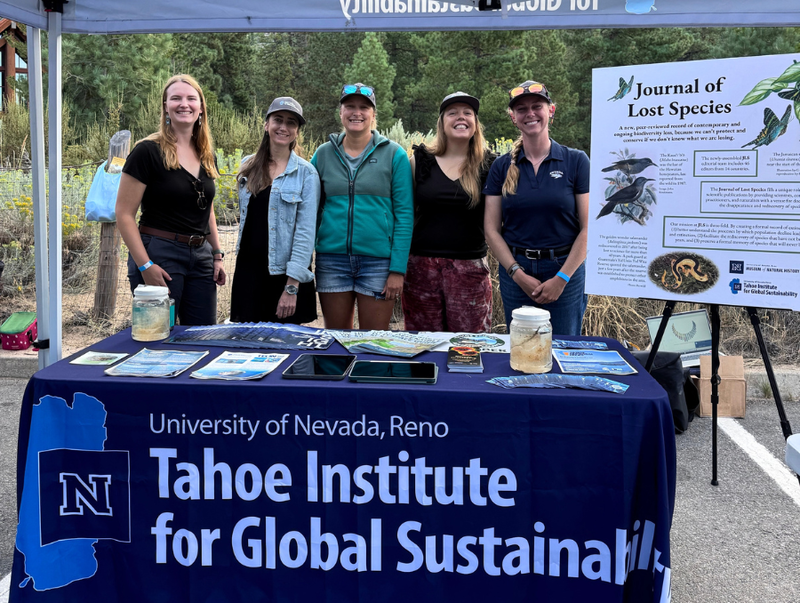
As communications and education outreach coordinator for the Tahoe Institute for Global Sustainability, Papson said her day-to-day work varies, but the goal stays consistent.
"My goal is to help connect our researchers to the Tahoe community as an expert resource to solve the most pressing issues facing Lake Tahoe," she said.
"We are capturing a broader view of how changes in the climate are affecting the watershed and ecosystem."
One of her favorite projects is the Tahoe Environmental Observatory Network, known as TEON.
"Through it, we are getting a better understanding of the interactions between land, streams and Lake Tahoe, capturing a broader view of how changes in the climate are affecting the watershed and ecosystem as a whole. Getting to listen to colleagues at the Institute explain their work in public presentations has also helped me learn more about the lake," Papson said.
Building relationships outside the University is another highlight.
"It's inspiring to see how many people care about the protection of Lake Tahoe, and interesting to see how we are working toward that goal while also protecting people and the economy," she said.
Telling the story
Papson helped launch Tahoe Insight magazine in 2025, its first year of publication. The magazine offers an in-depth look at work coming from the Lake Tahoe Campus and its faculty. In 2026, designers Alex Mounde and Mikey Muños took over the magazine's design so she could focus on writing stories for the issue.
"I'm happy that we've been able to create such an impactful piece, and that some of the work being done by our incredible university faculty is being highlighted," she said.
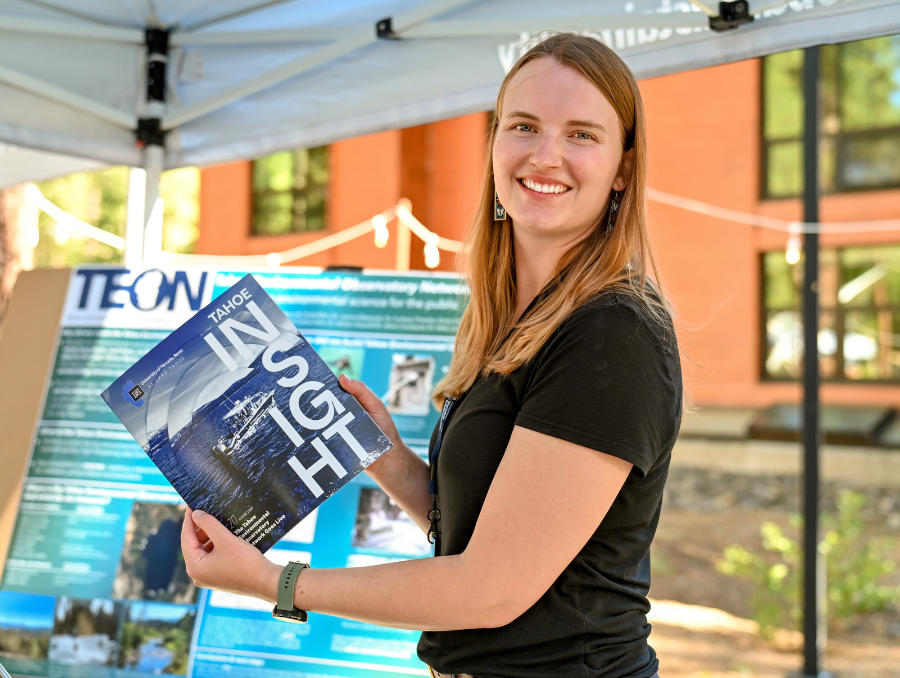 Photo by Yasmin Barbosa.
She also creates video content for social media. She credits Jennifer Kent, her former manager and current director of the Hitchcock Project for Visualizing Science, as a mentor.
"Jennifer Kent has been an incredible mentor in learning video editing and content design, among other communications skills," Papson said.
Beneath the surface
Many of those threads came together this fall in "What Lies Below Tahoe," a new exhibit at the Lake Tahoe Campus developed by the Tahoe Institute for Global Sustainability. Papson curated the exhibit and conceived it as a dive, guiding visitors from the shoreline down to the lakebed and back out again. Alex Mounde, a graduate student in the Reynolds School of Journalism, helped guide the design of the exhibit.
Along the way, visitors encounter the work of the colleagues Papson learns from every day, including the research on particles and clarity led by Carina Seitz, a research assistant professor in the Department of Biology; the year-round underwater sensor work of Emily Carlson, a limnology specialist in the Department of Biology; and the basin-wide monitoring of TEON.
"It's always exciting to connect the public, regional agencies and other researchers to our faculty to share their work more broadly and get the community excited about sustainability research happening at the lake," Papson said.
"What Lies Below Tahoe" is free and open to the public through the fall semester. Read more about the exhibit in the Nevada Today article.
Rooted in the region
Papson said she could talk at length about the region's landscape, from the desert to the high Sierra. But what moves her most, she said, is the people.
"What I think is most incredible are the communities here."
"I constantly marvel at the interactions between the geology, hydrology and biology of this stunning, impressive place," she said. "But what I think is most incredible are the communities here."
She noted that the region's history has shaped its landscape as much as natural processes have, sometimes with grave consequences, and that the work is far from finished.
"There is still work to be done, especially in uplifting the Indigenous communities whose land we are on and whose voices must be included throughout present and future decision-making processes," she said. "I am most impressed by the resilience of communities throughout the Reno, Truckee and Tahoe area, and believe that our strength comes from the empathy and care that we can provide each other while we navigate the future."


