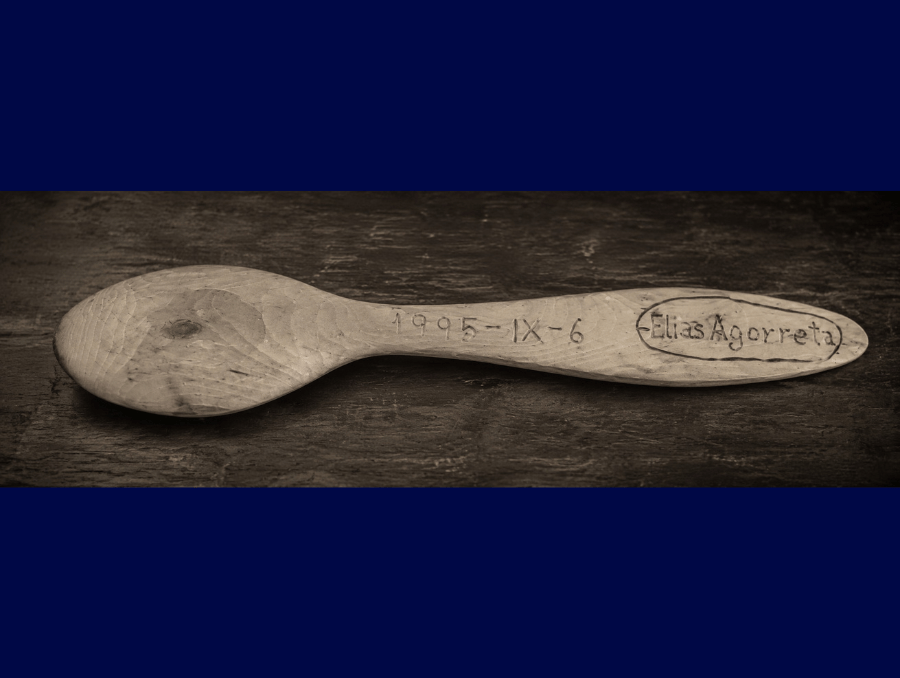
In this first-person narrative, Xabier Irujo, professor at the Center for Basque Studies, reflects on the memory of his late friend and teacher, Elias Agorreta, and how learning to make a traditional Basque shepherd’s meal became a lesson in friendship, memory and the traditions passed from one generation to the next.
One day, Elías Agorreta called me. He had been my teacher for years and from him I learned my first lessons about Basque culture. He always wore an imposing black txapela, the traditional Basque beret, and spoke slowly and warmly, usually with a large Cuban cigar between his fingers.
He reminded me that he had once been my teacher, but that now we were good friends. And because we were friends, he wanted to teach me something he had never taught me in the classroom.
“We are going to make two boxwood spoons,” he said.
Elías was from Ureta, in the Erro Valley — Erroibar in Basque — in Navarre. His childhood had been closely tied to Erro, Mezkiritz and Olondritz, among forests, mountain pastures and the ancient trails of shepherds.
“Boxwood — ezpela in Basque — has always been a special wood in our valleys,” he explained. Dense, hard, fine-grained and resistant to heat, it was particularly well suited to making small kitchen utensils. Spoons, ladles and forks were carved from boxwood, as were combs and other everyday objects.
They were not luxury articles. They were the simple things that accompanied us through everyday life.
There were specialized spoon makers in Mezkiritz, Lintzoain, Aurizberri and Aintzioa. Elias told me that even in the 1920s, wooden spoons and forks, kaikus — traditional Basque vessels used for milk — and other household utensils were still being made in the town of Aintzioa. From one of the last masters of that craft, he himself had learned how to carve boxwood.
He also told me, with a certain pride, a story from 1816. Thirteen spoon makers from Zilbeti and Mezkiritz came upon craftsmen from Baigorri who had entered the forests of Erroibar to cut boxwood. The local men confiscated their tools and drove them away.
Elías paused and smiled.
“It was our boxwood!”
There were different kinds of spoons. The kuxeta was the ordinary spoon, ending in a distinctive point; the kutxarona was the ladle.
“Here in Erroibar,” he told me, “we call them ezpelezko kuxetak — boxwood spoons.”
The spoon makers might spend weeks in the mountains, living in small etxolak, stone huts they built themselves. They cut the boxwood and prepared pieces about eight inches long, then carried the wood home on donkeys. During the winter, they carved those rough pieces into tools.
Shepherds also made their own while tending their flocks. Some had broad handles decorated with symbols cut with the point of a pocketknife, a way of filling the long winter hours beside the sheep.
The spoon was an elementary object, yet almost mythical: a small hollow made by the human hand to receive food.
For two weeks, Elías and I worked together. When we finished, we had made two spoons and a ladle.
I thought our work was done.
Elías said it was not.
That had only been the prologue.
We made the spoons so that we could eat atapurrak together, sheepherder's breadcrumbs. For, as Elias explained, there was an old shepherding tradition: for two people to become friends, they had to share a cauldron of breadcrumbs at least once in their lives.
I realized then that he had not simply taught me how to carve two spoons.
For generations, shepherds from the Pyrenean valleys drove their sheep southward to the warmer lands of Navarre for the winter. This was transhumance: men and animals walking for days along ancient trails, carrying only what was truly necessary.
No food expressed the old Basque shepherd’s way of life more completely than atapurrak. During those long journeys, bread hardened. But dry bread lasted and what seemed spent could become food again. With a little water and salt, garlic and animal fat, stale bread came back to life over glowing embers. All that was needed was a low fire, a cauldron and a boxwood spoon.
Breadcrumbs were food for dawn. Shepherds ate them before moving the flock, when the cold still lingered in the ravines. They gathered around the fire and ate together from the same cauldron.
There was no need for a table.
The fire was the center.
“My father used to make this recipe,” Elías told me. “We all learned it from our fathers.”
The atapurrak prepared by his aita — his father — tasted of tradition and affection. The bread contained water, salt, garlic and fat, but it also contained the memory of a house, family, cold winter mornings and people gathered around the fire.
Austerity was part of the recipe: stale bread, water, salt, animal fat and garlic. A fire, a cauldron and the boxwood spoon that had accompanied the shepherds of Erroibar for generations.
Nothing more.
And yet a community could be built around those few things.
Elías explained to me how to cook them. The bread, already dry from several days, is broken by hand into small pieces: atapurrak, literally breadcrumbs. A little salt is dissolved in warm water and a cloth is moistened with it. The crumbs are spread over the cloth, taking care to dampen rather than soak them. They are then covered with the same cloth and left to rest.
Meanwhile, the fire is prepared.
Into the shepherd’s cauldron — a pertza in Basque — goes the sheep tallow — ardi-bilgorra — , cut into small pieces. The sheep tallow is the fresh fat attached to and intertwined around the intestines, in the mesenteric area. It is neither meat nor rendered tallow. If it is unavailable, store-bought tallow can be used instead.
The cauldron is brought close to the fire and the pieces are pressed and stirred with the boxwood spoon. Slowly, the tallow renders, releasing the fat in which the bread will cook. The small solid pieces gradually brown until toasted and crisp.
Once enough fat has rendered, the cauldron is moved slightly away from the flames and the moistened bread is added.
Then begins the true secret of atapurrak: Stir and stir.
With the ladle, the bread is continually lifted from the bottom of the cauldron, turned and separated so that every crumb absorbs the fat without clumping or sticking. Finely chopped garlic is added and the mixture continues to cook slowly over a low fire.
Depending on the shepherd’s taste — and on what happened to be available — a little dried pepper or even a few black grapes might be added. They were small variations on a dish whose essence lay precisely in its simplicity.
There is no clock. There is no exact cooking time.
The crumbs themselves tell you when they are ready.
They should be loose, light and separate, never reduced to a paste.
That is all: stale bread, water, salt, fat and garlic. Fire, cauldron and boxwood spoon.
The atapurrak were eaten hot, gathered around the fire and at times directly from the cauldron. Red wine might accompany them, drunk from the traditional wineskin — zatoa — , a wineskin made from sewn goatskin.
Carried over the shoulder on the trail, it allowed the shepherd to raise it and send a thin stream of wine directly into his mouth.
No plates were needed. No separate silverware. No table.
The fire was the table; the cauldron was the plate.
And atapurrak, shared among those gathered around it, were far more than food. They were a way of giving stale bread a second life, they were warmth and companionship on the road.
In Erroibar, this humble shepherd’s meal has outlived the world that created it. Even today, parents, children, grandchildren and friends still gather to prepare atapurrak.
Because some recipes have one ingredient that is never written down.
Elías made me work for two weeks to understand it.
First, we made the spoons.
Then, we lit the fire.
And only then, around the cauldron, did we cook friendship.
About the author
Born in exile in Caracas, Venezuela, Xabier Irujo is a professor at the Center for Basque Studies and a leading scholar of Basque history, memory and genocide studies. He holds three master’s degrees and two doctoral degrees in history and philosophy. He has lectured at universities and cultural institutions across Europe and the United States and has authored more than fifteen books. His work explores how history and memory are preserved through words, landscapes and generations. His notable works include "Gernika 1937: The Market Day Massacre," "Gernika: Genealogy of a Lie" and "Charlemagne’s Defeat in the Pyrenees."
Of sharing this piece, Irujo said, "Elías died ten years ago. I wanted to tell this story to honor his memory, but also that of the many Basque sheepherders who, for centuries, greeted the day around a fire, sharing a pot of crumbs at daybreak. There was a certain shepherd’s pride in atapurrak. It was the humblest and cheapest of meals, made from almost nothing—stale bread, water, salt, fat, and garlic. And yet, around that simple pot, they shared something immeasurably richer—warmth, companionship, and friendship. That is the heart of this recipe. Elías had been my teacher and master for many years, but only then, around that cauldron, did we cook friendship."


