
In this first-person narrative, Rachel Schell, College of Liberal Arts graduate student in the Department of Philosophy, tells Nevada Today about her experience working with Southern Nevada and Washoe County schools to familiarize students with the concept of philosophy prior to college.
Education and learning have always played a crucial role in my upbringing. I was raised by a family of educators from elementary through high school teachers. Because of this, I thought my path was destined to be a K–12 teacher, but upon an internship where I student-taught a 6th grade math class, I realized that maybe I wasn’t cut out for that kind of job. Upon that discovery, I began my undergraduate studies at the University of Nevada, Las Vegas with an open mind as an undeclared major.
As I was planning my schedule, I enrolled in a Philosophy 101 course and quickly found myself diving into philosophical readings and lectures with genuine enthusiasm. After just a few sessions, I decided to declare philosophy as my major, especially after recognizing that many of the questions we explored were ones my peers and I had already been asking throughout high school, which sparked my interest in bringing philosophy into younger classrooms.
Building on that interest, my Philosophy 101 professor, Bill Ramsey, Ph.D., later introduced me to Amy Reed-Sandoval, Ph.D., another UNLV faculty member involved in Philosophy for Children (P4C), an international educational movement. Discovering that I wasn’t alone in believing that philosophical inquiry has a place in K–12 education further strengthened my motivation to help bring philosophy into schools.
While an undergraduate at the University of Nevada, Las Vegas, I learned about the Philosophy Learning and Teaching Organization (PLATO), celebrating its 30th anniversary this year. I was trained under their model of bringing philosophy into schools called “community of inquiry.” It places the child at the center of philosophical inquiry and encourages students to engage with one another to practice democratic participation by voting on which philosophical question they want to answer collectively. I helped bring philosophy to the schools of Southern Nevada with the Las Vegas Philosophy for Children Initiative (LVP4CI) under Dr. Reed-Sandoval’s guidance.
Now, as a graduate student in the Master of Arts in Philosophy program at the University of Nevada, Reno, I’ve taken the lessons from LVP4CI with aspirations of bringing a program to Washoe County. When I arrived in August of 2025, I contacted the Philosophy Department Chair, David Rondel, Ph.D. and our Graduate Director, Ben Young, Ph.D., about the possibility bringing philosophy into local schools. I was met with great enthusiasm and learned that Reno High School already had a philosophy club interested in working with University of Nevada, Reno professors. This felt like the ideal place to begin my outreach.
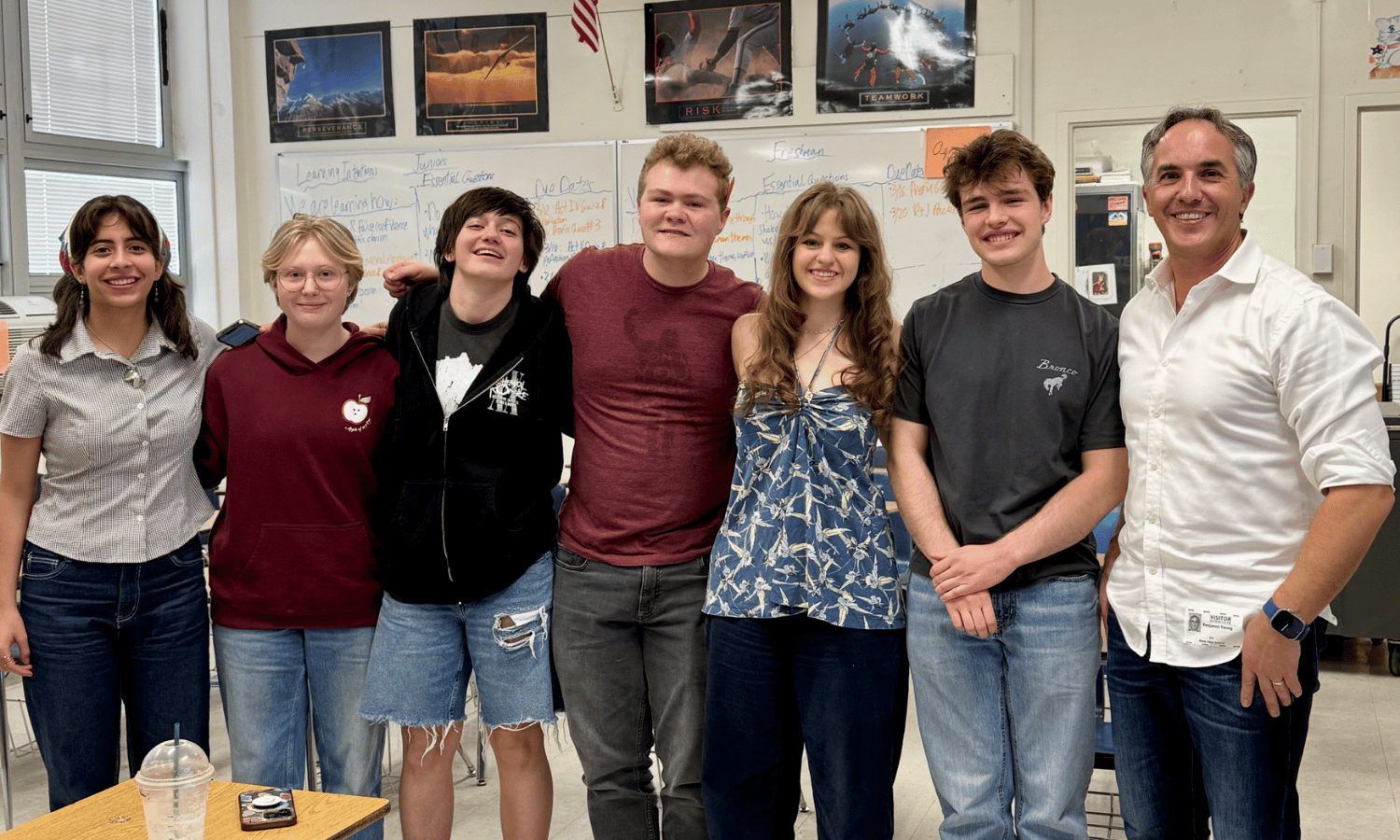 Reno High School's Philosophy club student with University of Nevada, Reno Philosophy Associate Professor, Ben Young, Ph.D. (right).
Students were thrilled to learn that professional philosophers would be sharing their knowledge at their high school. This group of students, in particular, are already invested in philosophical literature from Hobbes to Nietzsche; they wanted to talk about anything and everything related to philosophy. Young presented on the kinds of consciousness we distinguish in philosophy of mind and cognitive neuroscience. One student shared after the presentation that they feel philosophy applies to their life because they were able to “learn more about how our brains work” and that “philosophy is in my life even though I don’t always see it.”
By introducing young minds to philosophical topics and questions, we are able to expand not only how they position themselves in the world, but also how their relationships to others, our environment and our obligations to them are deeply interwoven. By taking philosophy outside of the halls of academia, we engage young minds in seeing themselves as capable of doing philosophical work, traditionally viewed as an elitist study.
Because philosophy is traditionally done at a university, it can be hard for students to know what it means to study it, let alone to be a philosophy major or minor. By exposing the discipline to those outside of academia — especially those approaching university age or questioning whether they should even go to college — we empower them to believe they, too, can do philosophy. More importantly, we get to show why philosophy matters.


