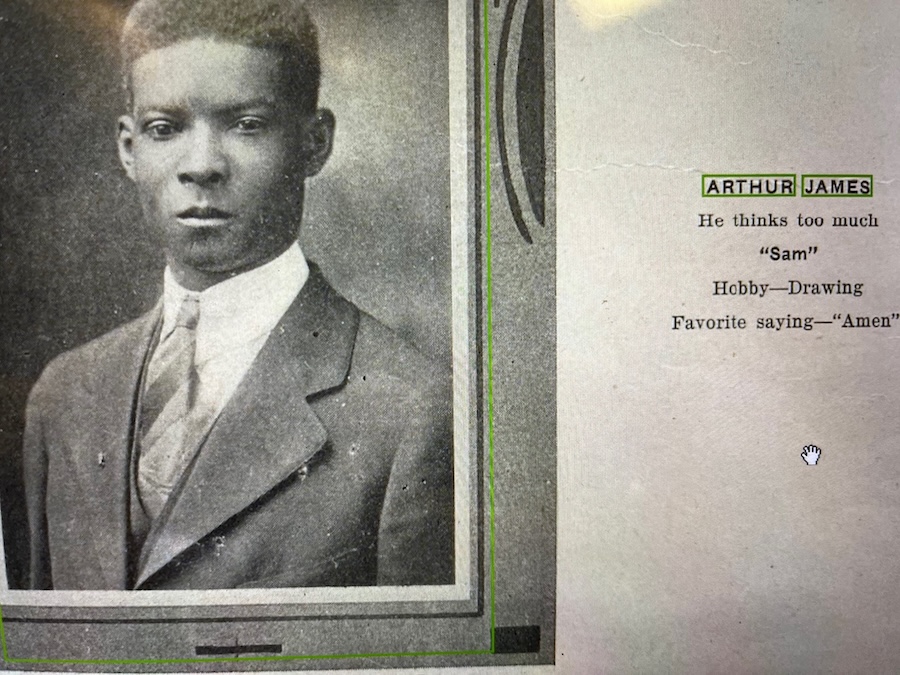
Perhaps part of the allure of the life of Arthur James is how that among the many notable figures in the history of the University of Nevada, Reno, he is part of a much smaller group who can say they were among the first to achieve something lasting – and were the first of more firsts to come.
James, who grew up in Elko and attended the University for three years, 1919-1922, is the earliest documented African American to play football at Nevada. A 6-foot-1, 195-pound tackle, James was a key contributor on some of the Wolf Pack’s earliest and most well-known teams that featured All-American back James “Rabbit” Bradshaw.
In 1919, as the “Corky” Courtright-coached “Sagebrush 11” demolished the University of the Pacific, 132-0, James’ hometown newspaper, the Elko Daily Free Press, reported that, “It was one of the best games ever held in Reno … Arthur James represented Elko on the winning team during the third quarter.”
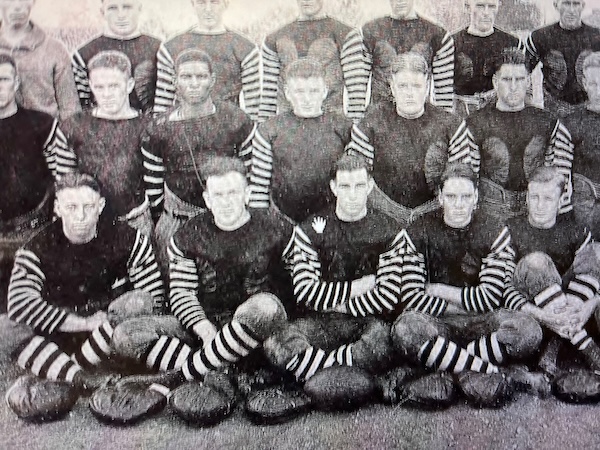
During the 1921 football season, Bradshaw, the senior quarterback in Courtright’s single-wing offense, led the nation in rushing with 1,534 yards. And James, along with several others that included future Wolf Pack Hall of Fame member Chester Scranton, was credited for helping Bradshaw make such an unforgettable imprint on the nation.
Wrote the 1922 Artemisia about James, who was known around campus by the nickname “Sam” and his role during the ’21 season: “Sam has worked conscientiously for three years for the betterment of Nevada’s athletics. No end of credit is due James for the manner in which he has held down the tackle position. James has been a great factor in the determination of the yardage gained by Nevada.”
James was the forerunner for numerous African American sports figures at the University, including future NFL Hall of Famer Marion Motley, who along with Kenny Washington, Woody Strode and Bill Willis broke professional football’s color barrier in 1946, as well as Wolf Pack quarterback Colin Kaepernick, who after starring for the 49ers has become one of the leading figures for social justice throughout the nation and the world.
The life of Arthur James is about all of this, and a lot more. He was part of a notable African American family that settled in Elko hoping to find a better life as one of the family members battled illness. He was an award-winning story writer during his days as a student at Elko High School. He helped Jim “Jackrabbit” Bradshaw become the University’s first great, nationally recognized football player. His legacy today is one that reminds us that he was more than just a barrier-breaking football player.
Growing up in Nevada
SILAS JAMES WAS A RESPECTED FIGURE in Elko, and for good reason. For the final 22 years of his life, Silas, who had moved his young family from Schulenberg, Texas to the eastern Nevada town of Elko in 1907, was the janitor at Elko High School. He had worked as a carpenter for a time at the sprawling 1,280-acre Carville Ranch, located near Jiggs, Nevada in the Mound Valley. The Carville Ranch was one of the oldest ranches in all of Nevada, possessing water rights dating back to 1869. It was a home to E.P. Carville, the future Nevada governor and United States senator, and it was said that Silas knew E.P. Carville as Carville was growing up.
Eventually, Silas moved to Elko, where he became a janitor at the Western Pacific Depot. Then he moved on to custodial work, first at Elko’s grammar school, and then, in 1917, Silas began his career at Elko High School. Silas James was widely known as “a kindly man, who never drank or smoked. He was trustworthy and honest …. He was well-liked by the children who attended school.”
Perhaps this was why James’ family flourished the way it did. They had moved to Elko partly because of the health condition of Silas’ wife, Lola, or often referred to as Lulu, who had long suffered from lung problems with symptoms resembling tuberculosis. Silas believed that moving from the clinging humidity of southern Fayette County in Texas – about 95 miles west of Houston – to the higher, drier elevations out West, to Elko, Lola’s difficulties breathing would be lessened. The move did just that. And for the next 10 years Lola, who had married Silas in 1897 at age 18, enjoyed improved health. The couple brought three children with them to Elko: the oldest, Arthur Malcolm, was born on Christmas Day in 1898; daughter Annie Juanita, who was born in 1899, and son Alaric, who was born in 1903. The baby of the family, Vivian “Nevada” James, was born on Nov. 28, 1908 in Elko.
Vivian was called “Nevada” by her family because they believed her to be the “first Black child born in the state of Nevada,” which was not true. The Nevada Independent wrote in 2024 of the state’s early Black population that, “Virginia City was home to the first sizable Black population in Nevada. The 1859 discovery of the Comstock Lode — the largest silver strike in U.S. history — led to a population boom in Nevada, which up until then only had a few thousand inhabitants. Like other demographic groups, Black immigrants flocked from the north and south. By 1860, all of the 44 Black Americans in Nevada resided in the region, and by the 1870s, about 100 lived there, according to U.S. Census data.”
However, Vivian was among only a handful of Black children born in Elko during that time period. The Nevada connection was always important to the James family, with the family firmly believing that little Vivian was indeed special, so much so that they wrote of her, “She was deemed by citizens of the state as their little princess.”
The James children were notably talented. They were among the highest achievers of all of the school-going families of Elko. All four were church-going, musical, enjoyed reading, writing and drawing, and were all well on their way to seeking higher education. All four James children would attend either college or trade school following their time in Elko, with both Juanita and Vivian both becoming teachers who influenced countless lives in their classrooms.
Their home on 756 River Street was notable, too, in that Silas, first a renter, was able to purchase it and was its sole owner. Their home was located near a church, and as Elko, a railroad and ranching town, began to move into the 20th century with electricity coming to the town in 1913, the James family found themselves to be a well-known part of an otherwise almost all-white community.
Young Arthur excelled at school. As one of 10 seniors at Elko High School in 1916-1917, he was involved in numerous activities, including being part of the staff of the school newspaper, “The Senyer,” which was created by the senior English class.
Arthur, who was also a sports correspondent for the Elko Independent newspaper, delivering writeups of Elko track meets, handled the sporting section of “The Senyer,” along with classmate Billy Maye. He wrote many of the funny stories that were in the “Jokes” section of the publication, and supplied cartoons, which the Elko Daily Free Press noted, demonstrated the young man “has talent and throws a good pen.” “The paper,” The Daily Free Press concluded, “is a very creditable production and reflects great credit by its producers.”
Arthur’s writing earned him well-deserved kudos. His “Dead Man’s Grotto” story was entered in a statewide story contest, the Brown Memorial, and earned positive reviews: “One very interesting story deserving of special mention was ‘Dead Man’s Grotto,’ written by Arthur James of the Elko High School,” the Elko Independent reported in June 1917. “This story was the most artistic in description of them all. Its characters stood out most vividly. There was a charm in the grotesqueness of the plot, that makes its young author as a talented aspirant to literary fame.”
In the 1917 Elko High School yearbook, the Pohob, Arthur’s story, “The Man of Dreams,” was featured on Page 9. In it, Arthur wrote of adventure in Alaska and San Francisco, and how a group of fishermen come to some hard-earned wisdom through their experiences. Near the end of the story, a sightless man regains his sight, realizing that for all the great adventures a person might have in far-off, exotic locales like Alaska and San Francisco, perhaps the greatest adventure of them all is realizing that at the end of one’s travels, it is the familiar, and not the fantastical, that truly lend a life meaning.
“Suddenly his dim eyes rested on a mirror,” Arthur wrote in the story, “and with the agility of an athlete he dashed abruptly to the clear, crystal glass, shouting, ‘I am happy forever! There he is! There he is! That’s my Man of Dreams.’”
Within about a month in 1917, the family would celebrate and grieve, with Arthur’s graduation from Elko High on June 14, along with nine other members of the Class of 1917 (Class motto: “Not on the Heights, But Climbing”) at the Bradley Opera House, followed by Lulu’s passing at age 38 on July 16, 1917 from complications from her lung condition. It was a time that would see even more changes in 1918, as the United States was now fully involved in World War I. Arthur enlisted in the United States Army that fall and served as a private until the war’s conclusion.
By the fall of 1919, Arthur was among 22 students from Elko who were beginning their studies at the University of Nevada. It was the largest group of first-year students from any Nevada town outside of Reno. Not long after, Silas married again, to Mamie, or “Mayme,” L. Green, who had lived with her brother, Isham, a Western Union Telegraph messenger who was known to be “well-educated,” in Elko since 1915.
Football
THE FOOTBALL TEAMS OF COACH CORKY COURTRIGHT featured some of the most notable figures in Nevada history. The most well-known was “Jackrabbit” Bradshaw, a 5-foot-9, 135-pounder, who was, as his nickname suggested, as quick as a jackrabbit. Until the advent of Marion Motley nearly two decades later, Jimmy Bradshaw was the greatest football player to ever play for Nevada. Later, Bradshaw would become a great college coach at Fresno State.
Nevada was in a period of its most sustained football success to this point, with Courtright’s first team in 1919 finishing 8-1-1, and outscoring its opponents 450-32. The team’s single wing offense required good blocking, as well as ball awareness, with snaps often going to the quarterback of the formation, who might then feint handoffs or take the ball on a run himself. This was why players like the hard-hitting, heady Chester Scranton, who, like Arthur James, was from Elko, were so critical to the team’s success. Given how quickly the offense operated, it wasn’t surprising that a player like Arthur James would contribute.
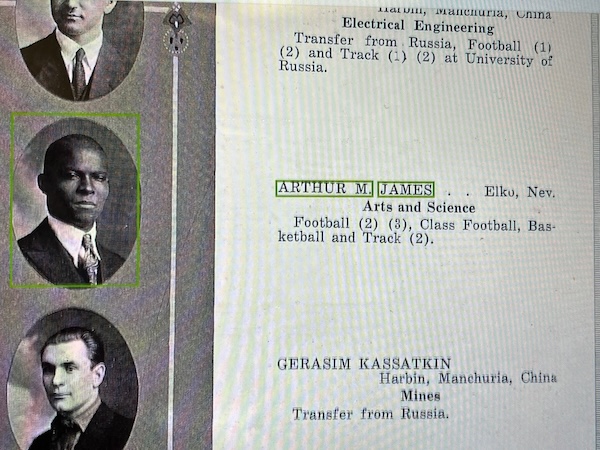
“Sam” James fit right in. He had run track at Elko and was the possessor of a championship-level broad jumping ability. He played tackle on both offense and defense in 1920 and 1921, and the team continued to win – the 1920 squad finished 7-3-1 and went 4-3-1 in 1921 as Bradshaw valiantly played through a senior season filled with injury. Arthur’s appearance in the 1922 Artemisia, listed among the members of Junior Class, noted that he was majoring in Arts and Science, that he had participated in football, as well as basketball and track. The Junior Class, in its introduction to that section noted that, “Entering in the Fall of 1919, our class was largely composed of men just out of service, men who whose trials and experiences had demonstrated the need for a better education.”
Family history
Over the next several years, the James children began to fan out throughout the country, mirroring the crest of the “great migration” that earlier in the 20th century saw hundreds of thousands of African Americans relocate from the South to cities in the West, Midwest, and East.
Alaric earned a degree in engineering from a Booker T. Washington School, with a focus on electricity, and moved to New York. He became a maintenance control supervisor for the U.S. Post Office. He passed away in June 1982 at age 79.
Vivian, “Nevada’s princess,” passed away on New Year’s Eve, 1999, at the age of 91. She was a teacher for more than four decades, working at schools in Texas, Kansas and Oklahoma City. Annie “Juanita” Keith Meeks passed away on June 28, 1997, at age 97 in Oklahoma City. Both sisters were pillars of their community in Oklahoma City. Juanita, long after she had retired from teaching, remained an active organizer in the Oklahoma City area of the Delta Sigma Theta sorority of Black female graduates of the University of Oklahoma.
All three children, along with Arthur, wrote a letter to Elko following the death of their stepmother, Mayme Lee James, in November 1943. Silas had passed away four years earlier, on Aug. 12, 1939. The home on River Street had caught fire in 1936, suffering major damage. Silas, with some great difficulty, had managed to extricate the family car, which was brand new, from the garage following the blaze. He was still serving as janitor at Elko High in spring 1939. But in late June, he suffered a fractured hip from a fall. He never fully recovered. The man who started out working on a ranch in Mound Valley and then roamed the halls of Elko High for more than two decades, always cleaning and engaging those he knew with good words and actions, was praised by those he worked with for his kind, gentle and reliable nature.
When Mayme died at age 63 in 1943, her stepchildren shared a “Card of Thanks” in the Elko Daily Free Press that appeared on Nov. 19, 1943. Although it was signed by all four of the James children, it’s difficult not to conjecture that Arthur played a prominent role in writing it. The language is very similar to the writing of a quarter century earlier, when the author of “The Man of Dreams” excelled in spinning stories that were well-written and was able to connect with the reader through a shared sense of humanity.
The “Card of Thanks” read in part:
“We extend our unadulterated thanks for the various deeds, comforting and sympathetic expressions and heed with propriety all courtesies afforded and extended. … Words are inadequate to convey and extend our sincere gratitude and appreciation … (for) your unusual kindness and genuine hospitality and services rendered … (You) leave an indelible impression that time itself cannot efface. May God bless you. Do remember us in your prayers.”
The James children’s coda to Elko noted that Arthur was living in San Francisco, which, not entirely uncoincidentally, was one of the exotic, foreign locales that he’d featured in “The Man of Dreams” in the Elko High yearbook in 1917. By the late 1920s, Arthur, who never graduated from the University and appears to have left Reno sometime following the completion of his junior year in 1922, had begun work as a longshoreman for the F.C. Gregory Waterfront Employers Association. Eventually, Arthur moved to Oakland, where he lived until his retirement in 1959. He then moved to Oklahoma City to be closer to his sisters. He lived his final years in a rest home in Oklahoma City. He died on July 6, 1968.
Three of the James children – Arthur, Juanita and the Nevada Princess, Vivian – are buried at Trice Hill Cemetery in Oklahoma City, Oklahoma.
Arthur Malcolm James’ headstone carries only a few words, each one somewhat solitary and carrying a solemn finality for a life that had many parts. His was a life that included a talented, accomplished family that was always there for one another; fanciful young writing dreams of what far-flung lives in places far, far away must be like; sturdy athletic play that was historically significant for the first university ever founded in Nevada as football’s first true star was introduced to the nation; and a wistful reminder that often when we have history within our midst, we often don’t realize it until it is too late.
“Jackrabbit” Bradshaw returned to his campus on many occasions throughout a long and storied and Hall of Fame life that saw him pass away in 1987 at age 89. “If there had ever been an all-time (Wolf Pack) team picked, (Bradshaw) would have been in the starting backfield,” the legendary Nevada State Journal managing editor and sports editor Ty Cobb said at the time. It would have been nice to know that at least at some point, one of the men who blocked for Bradshaw, Arthur M. James, could have made a similar return to the campus, where he could have been welcomed and congratulated for all he’d done.
Nevada's Man of Dreams
On Arthur’s headstone, followed by a cascade of veteran’s service wording – PRIVATE, ARMY – plus his birth and death, there is one word that actually leads off the entire retelling of his life. The single word that begins the headstone story of Arthur James reads, simply, proudly: NEVADA.
Arthur Malcolm James was much more than a first footnote in the University’s early history.
He was more than the first documented African-American to letter on a Nevada football team.
He was a Man of Dreams.
Nevada’s Man of Dreams.
(Author’s Note: All information including quotes contained in this story were taken from newspaper accounts in the Elko newspapers of the time, along with the Oklahoma City Daily Oklahoman, The Black Dispatch of Oklahoma, San Francisco Chronicle, Oakland Tribune, Mount Vernon (N.Y.) Argus, the Nevada State Journal, as well as Elko High School Yearbook Pohob, the University of Nevada Yearbook Artemisia and the Nevada Independent.)


