Thank you to the team at the University Libraries @One Center for producing and editing this episode.
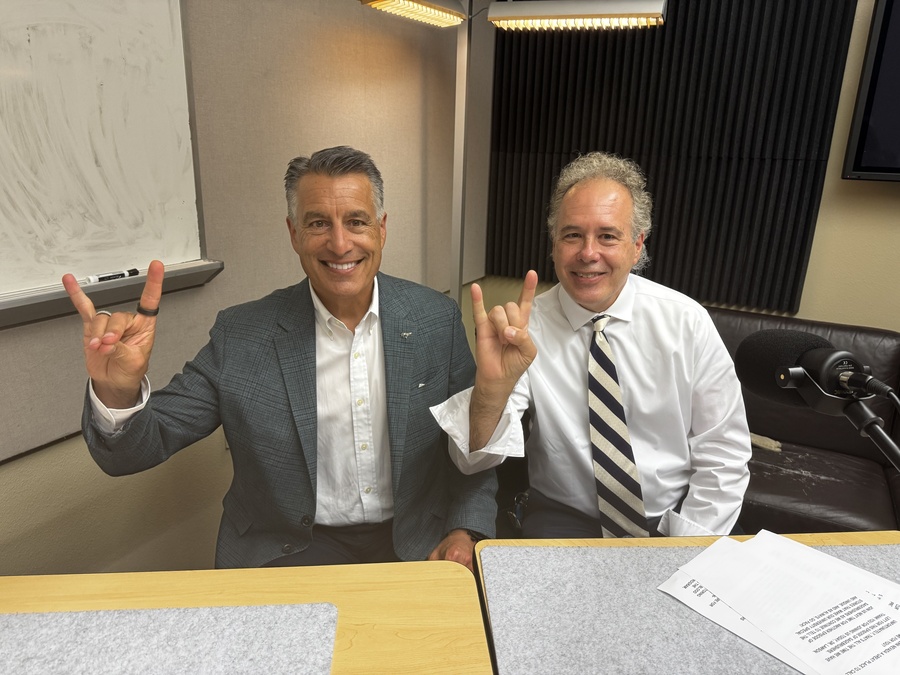
In this episode of Sagebrushers, University of Nevada, Reno President Brian Sandoval sits down with Daryl Lawson, professor and director of the School of Public Health’s new Doctor of Physical Therapy Program (DPT), which is now accepting applications for its launch in the fall of 2027.
Prior to his position at the University, Lawson practiced physical therapy at Renown for 12 years. He explains what physical therapists do and how the field extends into wound care, injury prevention and diabetic care. The versatility of the field allows DPT students to specialize in their interests and prepare for a career in a specific area.
Sandoval and Lawson explore how the development of an in-state DPT program will not only help more Nevada residents access higher education but also mitigate the state’s current shortage of physical therapists. Combined with the University’s R1 research departments, the DPT program will develop Nevada’s education, technology and public health, creating opportunities for Nevadans to learn and receive care right at home in the Silver State.
The two also discuss unique program opportunities, what makes a successful applicant and the state-of-the-art facilities that await students and staff.
Sagebrushers is available on Spotify, Apple Podcasts and other major podcast platforms, with new episodes every month.

Sagebrushers season 5 episode 5: Director of the Doctor of Physical Therapy Program Daryl Lawson
In this episode of Sagebrushers, University of Nevada, Reno President Brian Sandoval speaks with Daryl Lawson, director of the new Doctor of Physical Therapy program.
Brian Sandoval: Welcome back, Wolf Pack Family. I'm your host, Brian Sandoval, a proud graduate and the President of the University of Nevada. The University of Nevada School of Public Health's Doctor of Physical Therapy program is designed to address Nevada's critical healthcare workforce shortage, improve patient outcomes, and position the University as a leader in health sciences education and research. Here with us today is Daryl Lawson, professor and director of the Doctorate of Physical Therapy program, a physical therapist with clinical expertise in orthopedics and wound management. Lawson previously practiced for 12 years at Renown Medical Center and has held faculty positions at Western Michigan University and Elon University in North Carolina. His research focuses on improving care for people with diabetes and chronic non-healing wounds, including the use of electrical stimulation, remote monitoring, and other technologies to improve blood flow and healing. He's now leading the development of Nevada's new DPT program with an emphasis on preparing practice-ready physical therapists to serve communities throughout the great state of Nevada.
Today's episode is being recorded in the @One Podcast Studio of the Matthewson IGT Knowledge Center. Thank you for being here, Dr. Lawson.
Daryl Lawson: This is an honor, President Sandoval.
Sandoval: Yeah, no, I'm really excited, and I know our listeners will be excited to learn about what we're about to talk about. So, let's dive right in. And for our listeners who may not be familiar with the profession, what does a physical therapist do and how does physical therapy connect to public health in our communities?
Lawson: A physical therapist is a movement expert. A movement expert evaluates one's movement, especially if there's an injury. What's interesting about a movement expert is it can span from orthopedics, which a lot of people know of, but it then can go in pediatrics, or neurology where someone might have cerebral palsy or MS, but then it also can go to wound care or wound management, which a lot of people don't know. So, it has to do with being a movement specialist and analyzing that movement, then using interventions to improve that movement. We're really blessed to be in the School of Public Health because now we have the opportunity to prevent injuries. A lot of times we're focused on improving or helping these injuries, but now if we step back, we can look at people who may fall and have fall clinics and go to areas to help prevent these falls.
And if you can help prevent that, you'll help prevent a lot of orthopedic injuries and hospitalizations.
Sandoval: So very briefly, because I was surprised to learn that physical therapy has to do with wound care and diabetes. So, can you talk a little bit about that and the history of it?
Lawson: Yes. It started back at World War II, believe it or not, and we were having a lot of people recruited for the war. And at that time there were a lot of injuries, especially wounds. And so, the Department of Defense were looking for someone to take care of the wounds, and they said, "Hey, physical therapists might be a great profession." So honestly, that's how it started. And then since then, that is one of the pillars. So, if you're going for accreditation through an accreditation agency called CAPTI, which accredits our PT program here at University of Nevada, you will have to have wounds or integumentary still in there back from the 40s. So that still is a staple of what we do as physical therapists.
Sandoval: That's an incredible story. So, I love these podcasts because I learn something every time. So, Nevada has a significant shortage of physical therapists, particularly outside the Reno-Sparks and Las Vegas metro areas. What led the School of Public Health to develop a Doctor of Physical Therapy program and why is it so important for our state?
Lawson: Right now, there are about up to 500 vacancies for people, hospitals and clinics needing physical therapists.
Sandoval: In Nevada?
Lawson: In Nevada, in Nevada. And also, not only being the fastest — one of the fastest —growing states in the union, we also land third from the bottom of the number of PTs per 100,000 people. So, we need this great, great amount of PTs. And married with an R1 institution, we can not only have physical therapists in that need, but we also need research to create the best evidence-based treatment for our citizens here in Nevada.
Sandoval: So, part of this shortage means if one of us has an injury or needs a physical therapist, we likely have to wait to get an appointment, I would imagine.
Lawson: Yes, waiting times.
Sandoval: And then off the air, we were talking about rural Nevada; talk a little bit about that.
Lawson: Yes. Rural Nevada unfortunately has even been hit more than Reno, Sparks, and even down in Vegas. And it's so hard for them to recruit. And now, you may have heard of the Rural Health Transformation Grant. And the Rural Health Transformation Grant is an innovative grant to try to get more workforce out to the rural areas, especially physical therapists and all medical staff. Within the UNR DPT program, we're going to have a specific clinical rotation that leads people out to the rural area.
Sandoval: No, that's fantastic. So obviously building a new program also means building a new team. So, what expertise will faculty and staff bring to the program and what additional roles do you expect to fill before welcoming the first cohort of students?
Lawson: Well, I already have four people right now. I have one person, and that person is a great neuro expert, Dr. Nash, and she's going to immediately bring to our program the neurological expertise, content expertise we need here and for our students. Dr. Yuri Yoshida is from New Mexico. She's here now, a great researcher and orthopedic person. And we also have a person that was at the Sanford Center, and she's our director of clinical education.
And I view this program as not only a DPT program, but a program that has a value. What kind of value can we bring to it? What extra things can we bring to this more than that. And one value we're going to bring that we talk briefly about is we're going to have a dual program for those that are really interested in orthopedics and sports medicine. And so, we have a DPT program, but kind of parallel, we're going to have an athletic training program. So, we're one of the only four schools in the nation where you could get a DPT plus an athletic training program combined. So that's huge value.
Sandoval: Yeah, that's incredible. So, Brian is an entering freshman at the University of Nevada and he's interested in this program. What kind of curriculum— what can he study? What should he do? Or if it was Brianna, what should she do?
Lawson: Well, Brian wouldn't have to worry about his undergraduate degree. Let's say he loved— or she loved — business or was in English. All those are acceptable to get into a DPT program; you have to have an undergraduate, but then you have to look at the specific prerequisites. And as we were talking off-air, some of my best students in Carolina were dance majors, were English majors. They just went back and did the prerequisites such as biology, chemistry, anatomy and physics, getting those along with their degree to apply to the program.
Sandoval: And I guess, intuitively, many of our students who aspire to get a DPT are having to leave the state.
Lawson: Yes. And as we all know, tuition burden is huge, especially in any medical area. And unfortunately with only two schools, the one in the South and University of Nevada, many, many, many students have had to go out of state to get their physical therapy degree and then come back. And that really increased their student debt. And the other problem is once you go out of state, you may not come back. And that is a disservice to what we're trying to do here at the University of Nevada; is not only have graduates, but keep them here.
Sandoval: So, what can prospective students expect from the program and when will it start? I'm sure everybody's wondering that. And where does the program currently stand in the accreditation process?
Lawson: So, we expect our first class in the fall of 2027, and you have to go through something called CAPTI, an accreditation agency. So, we're doing well there. And then we are going to admit our first class in the fall of 2027, which will be exciting. And we also didn't initially know we were going to have the particular program, but we got this amazing building from this amazing person, Sonnia Iliescu. And this building is, for those that know Wells and Ryland and that area, it's not too far from the hospital, from Renown, but it's perfect. And so, when students come to see this, they're going to see a beautiful building that's going to house this program really, really well. And we plan to have, as I did in North Carolina, a pro bono clinic. So, we'll be around a lot of areas where the first year you come in, Brian comes in, first week he's going to take a history of a patient, pro bono patient.
So we're really excited of its location, it's 12,000 square feet, its size, and with minimum renovations, what we can do with that.
Sandoval: And for the locals, it's immediately next to where the old Juicy's was. And for the really old locals like me, it was once the Oakman’s building. But I do want to publicly thank Sonnia Iliescu and Dr. Iliescu for this generous gift of this building, and it will be state-of-the-art. And there was an additional monetary donation to be able to get all the best equipment and everything you need to start up a program, so we're just thrilled. So another question on how many applications do you expect and how many slots will there be?
Lawson: Yes, 40 slots and about 400 applications. So, I want to tell everyone listening to this: it's not all about grade point. Think of your application as we look at you as a whole person. What are your experiences? What are your leadership? Have you had anything in research? Doesn't mean you had to publish a paper, but have you had any experience in that? Grade point, of course, does play a big role. What have you done in the community? Have you done any observations in a few different clinics? All of that goes together on a big sheet to look at you as a whole. And so, a lot of students say, "I have a 3.2 or I have a 3.5 or a 3.6 or a 3.0." We're not as focused on that as looking at the whole person.
Sandoval: And when does Brian get to apply?
Lawson: Brian can apply right now.
Sandoval: Oh.
Lawson: Yes, right now. So, as you're listening to this, go to the DPT website and you'll see a link right there, and you can apply.
Sandoval: That's incredible. Exciting. So, your own research has explored ways to monitor and treat people with diabetes and chronic wounds from home. What have you learned through that work and how will you focus on technology, prevention, and access to care to help shape the education Nevada's DPT students receive?
Lawson: Yes. Anybody listening will know compliance to just about any intervention is the key. And so unfortunately, what I was doing here in Renown is I was seeing people who had diabetes and had these diabetic wounds, and a few passed away through something called osteomyelitis. They would get an infection in the bone and pass away, and it's because they couldn't make their appointment. So, I thought there had to be a better way. And so, we've continued to do research on what we call digital health. Digital health is a kind of a hybrid way where I'll see the patient, then they can go home, and we can monitor that patient to see how, in this particular case, the wound's doing. And we can monitor the blood flow to make sure it's not ischemic. We can monitor other things. So, we're in constant communication and I would like to create the Center for Digital Health here at the University of Nevada with my PT students and others to collaborate with a rural area and do more of this, this hybrid. We see them, but yet we can monitor them in areas where they may not be able to get to a place two, three times a week.
Sandoval: So, you anticipated my next question, which is artificial intelligence and technology, how can that assist our patients out there?
Lawson: Right. This is where it's great to be at an R1 University because we have a great engineering department, we're going to have a great PT department, and we can work together developing platforms in which we can help monitor people that are at home — in my case is the diabetic foot ulcer — but you can create these insoles, but you can create other sensors, and then they can not only physiologically, but they can communicate back to you with text and all this, how they're feeling and how they're doing. So, this digital health, doing it right, can, I think, save limbs, but also keep in communication with those that just don't have access and get to a clinic or a hospital quickly. I think you're going to see more and more and more of this in the country.
Sandoval: As I was thinking, we talked about rural Nevada, but if I live in Tonopah or Battle Mountain or Austin or Winnemucca, Lovelock— you can go down the list — and that could be really helpful if you can't get into Reno or Sparks or Southern Nevada.
Lawson: And next year I'd like to begin with the Rural Health Transformation Grant and start some pilot projects doing this.
Sandoval: So, I forgot to ask this when we were talking about students: how long is the program?
Lawson: Three years.
Sandoval: Three years, okay.
Lawson: And another value, I gotta add another value; the last clinical is one that you have found a great passion in. So, let's say its people have vestibular imbalance, people have pelvic health, people have pediatrics. There's so many. And let's say your last year say, "I just love pediatrics." Well, we're going to put you in a special spot for pediatrics, give you more coursework beyond the entry level so you can become more of an expert. So, when you graduate, you're ready to go in pediatrics.
Sandoval: That's incredible. And I would imagine, and you can never say 100%, but with a shortage of 500 PTs statewide in a class of 50, you're almost guaranteed of getting a job when you graduate.
Lawson: Yeah, the statewide unemployment rate I think is zero.
Sandoval: Yeah. So, one last question that I always love to ask is, you've obviously spent a lot of time in Northern Nevada. What is your favorite part about living in Northern Nevada?
Lawson: Oh, that's so easy. For me, it's the biodiversity of this area. And I don't know if a lot of people know, but I love to fly fish. I fish. And so, people do not know the great streams, the great fishing, the beautiful area just around us. And it's just remarkable to hike. And it's just this great peace you get up there, and you're fishing, and then you can come down here to Reno, which is just this growing city and all the great things. But within ten minutes or fifteen minutes, I can get up to a good stream and be by myself.
Sandoval: That's great. So, is there anything else that you wanted to talk about and bring to the attention of our listeners?
Lawson: For anybody interested in this program, please look at the website. And if you have more questions, please email me or text me. Don't think that you can't get in just because of one or two things. Talk to us because we want Nevadans to stay here — that's my job — and to become physical therapists within our area. So please follow up on that.
Sandoval: And then just to be specific, when you say go to the website, where should somebody go?
Lawson: The website was just launched. So, if you could Google UNR DPT program, it will bring it right up.
Sandoval: All right. Fabulous. Well, unfortunately, that's all the time we have left for this episode of Sagebrushers. Thank you for joining us today, Dr. Lawson. This was fabulous. So, join us next time for another episode of Sagebrushers as we continue to tell the stories that make our university special and unique. And, as always, Go Pack!


