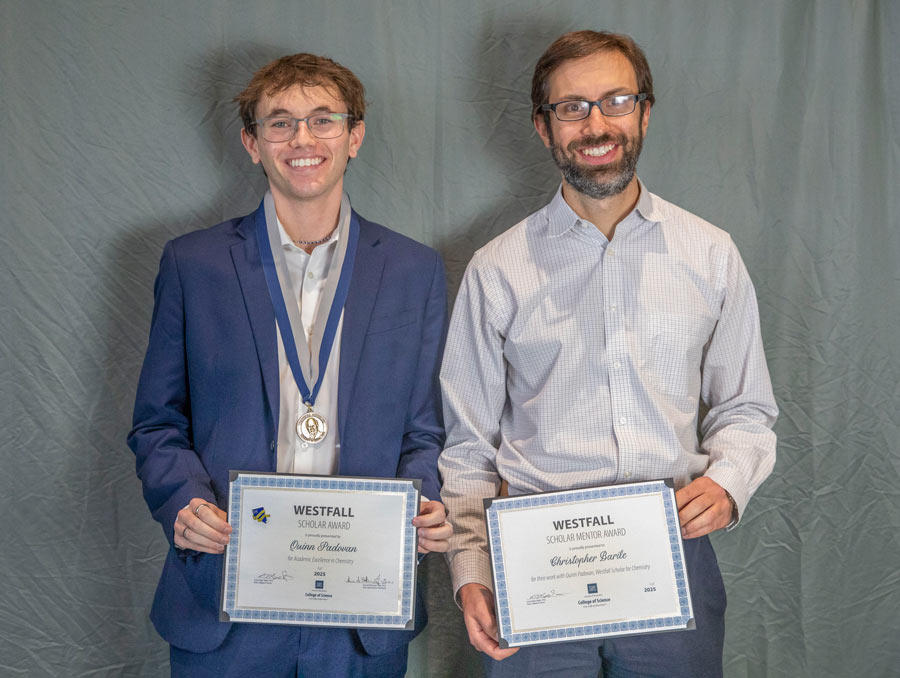
A student eager to participate in undergraduate research since before he started college reaped the rewards for his hard work when he was offered a prestigious research award.
Quinn Padovan ’25 (chemistry) said he came to the University of Nevada, Reno knowing he wanted to participate in research and joined Professor Christopher Barile’s lab group the summer before starting his freshman year. His experiences in the lab sealed the deal.
“I quickly fell in love with electrochemistry,” Padovan said. “By the second semester of my freshman year I decided to pursue a Ph.D. in chemistry with the eventual goal of becoming a research professor.”
For Padovan, the National Science Foundation Graduate Research Fellowship Program was the way to funding for a Ph.D.
“I knew early on that I would be applying for this award,” Padovan said. “It gives extra freedom to graduate students and is very good practice for scientific writing as well as developing a novel research idea to address a gap in current literature.”
The NSF GRFP is a competitive award: this year, nearly 14,000 students from across the country applied, and just under 2,600 awards were offered. The NSF GRFP program describes its awardees as “outstanding students with exceptional potential for leadership in STEM.”
“The NSF GRFP is exceptionally competitive, and earning the fellowship as an undergraduate is not just about GPA,” Barile said. “It requires an extraordinary level of research productivity, independence, and initiative. Quinn's research productivity and dedication was simply phenomenal over a four-year period, so I knew he would be an excellent candidate for becoming a Fellow.”
Padovan’s undergraduate experience was rife with chemistry education and research, preparing him well for his GRFP application. With guidance from Barile, he developed research projects for the Nevada Undergraduate Research Award and the Nevada NASA Space Grant program. Padovan was the first author of a research article about electrodeposition published in the Journal of The Electrochemical Society. He served as a PASS leader for an organic chemistry course and as the director of external recruitment for the Honors College. Padovan, who graduated a semester early, was also a Westfall Scholar, which recognizes students who have the highest GPAs in their department in the College of Science (Padovan earned a 4.0 GPA), and he graduated summa cum laude.
Padovan was also interested in integrating what he found in the lab into everyday use. He was one of the first employees at a startup company that brings zero-gap flow cells to industry for the reduction of carbon dioxide emissions.
But it wasn’t all chemistry, all the time. Padovan also took advantage of the outdoor activities available in the Sierra Nevada: skiing, backcountry skiing and hiking across the greater Tahoe area.
“Late night group study sessions, university events, as well as the skiing and hiking access that Tahoe provides have all been highlights,” Padovan said.
He did spend significant time working on his NSF GRFP application, which requires a two-page proposal to investigate a novel research question and a personal statement.
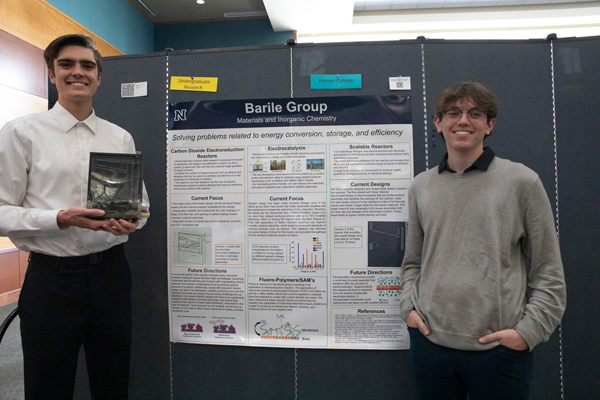
“Fortunately, due to the great programs that we have in the state, I had experience writing research proposals and received a lot of feedback on my writing,” Padovan said.
Ultimately, his application was successful.
“I was incredibly happy and grateful when I saw the email,” Padovan said.
Padovan started his Ph.D. in chemistry last week at Stanford University. He will continue his research in electrochemistry and plans to expand into research related to carbon capture and sequestration.
“I also hope to take a deeper dive into device manufacturing and design,” Padovan said.
For Padovan, the mentorship he received from Barile was indispensable.
“Dr. Christopher Barile has been an amazing mentor who I have worked with for the past four years guiding me through research and chemistry as a whole,” Padovan said. “His help has been instrumental throughout the whole of my undergraduate and his passion for chemistry is what initially inspired me to major in chemistry. I am fortunate to have had many amazing relationships with mentors within the chemistry department and within the Honors College.”
“Working with students like Quinn, both in the classroom and in the research laboratory, is among the most gratifying experiences of my career,” Barile said. “I will always think fondly of the many hours Quinn and I spent hashing out scientific ideas and principles at the whiteboard or the excitement of examining unexpected experimental results at the bench. The epiphany moments working together to arrive at a new understanding that neither of us could have reached alone are the ones that make scientific research so rewarding. As a mentor, the hard part is that all great students must one day graduate, but now I have the opportunity to learn about all of Quinn's future accomplishments.”


