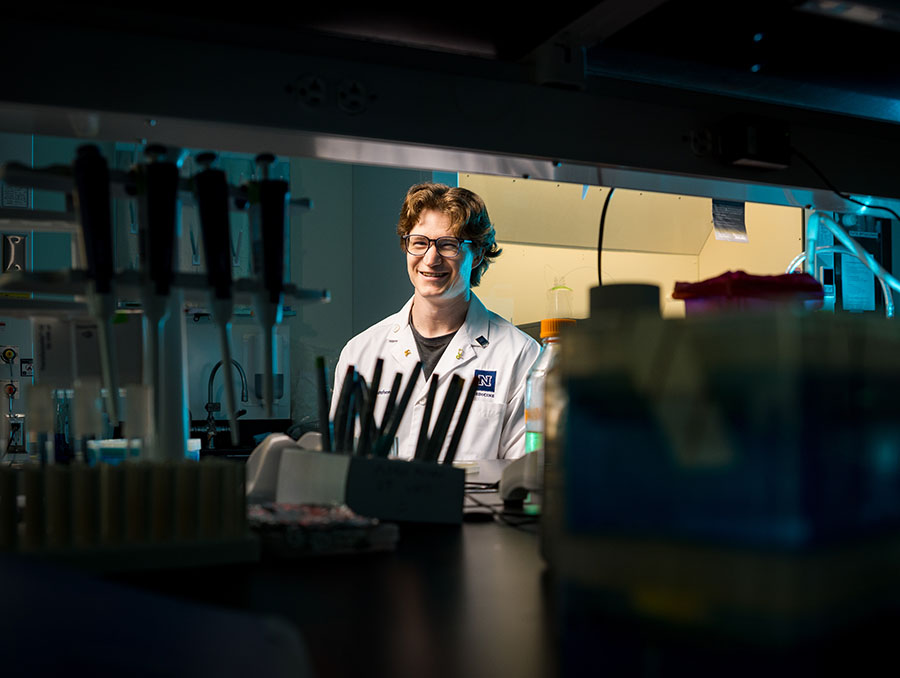
At the University of Nevada, Reno School of Medicine (UNR Med), a select group of students is pursuing a unique path that combines scientific discovery with patient care. Through the school's M.D./Ph.D. program, the only prospective dual-degree program of its kind in Nevada, future physician-scientists are gaining the skills to investigate some of medicine's most complex challenges while preparing to care for patients.
Over the course of seven to eight years, students complete the first two years of medical school, transition into doctoral research training and then return to finish their clinical education. The program equips graduates with expertise in both biomedical research and clinical medicine, preparing them to translate scientific discoveries into improved patient care.
Small by design, the program offers students close mentorship and a strong sense of community. UNR Med currently has 10 students enrolled and accepts two direct admits each year.
"Our smaller size allows us to provide students with more individualized mentorship while creating a close-knit community where they feel supported throughout their training," said Mary Burtnick, Ph.D., who co-leads the program with Kovi Bessoff, M.D., Ph.D.
One of the program's greatest strengths is its ability to train physician-scientists who can identify challenges in the clinical setting and help develop research-based solutions.
"As research and clinical care become more complex, the physician-scientist serves as a bridge between those worlds," Bessoff said. "The M.D./Ph.D. program trains physicians to work and exist in both spheres and bring together top talent from both sides to create meaningful collaborations."
A passion for discovery and patient care
For Ryan Gustafson, entering his fourth year in the M.D./Ph.D. program, the physician-scientist pathway was the natural choice.
"What first sparked my interest in medicine was gaining an appreciation for just how complex the human body really is, paired with the realization that, at the end of the day, it's a biochemical system built of matter that can be understood and adjusted," Gustafson said. "Seeing the body through that lens made a career blending patient care and scientific inquiry feel like the natural path."
After completing two years of medical school and passing Step 1, Gustafson recently transitioned into the Ph.D. phase of his training. His research focuses on proteins and how they can be engineered to influence biological processes, particularly in the fight against glioblastoma multiforme, an aggressive form of brain cancer.
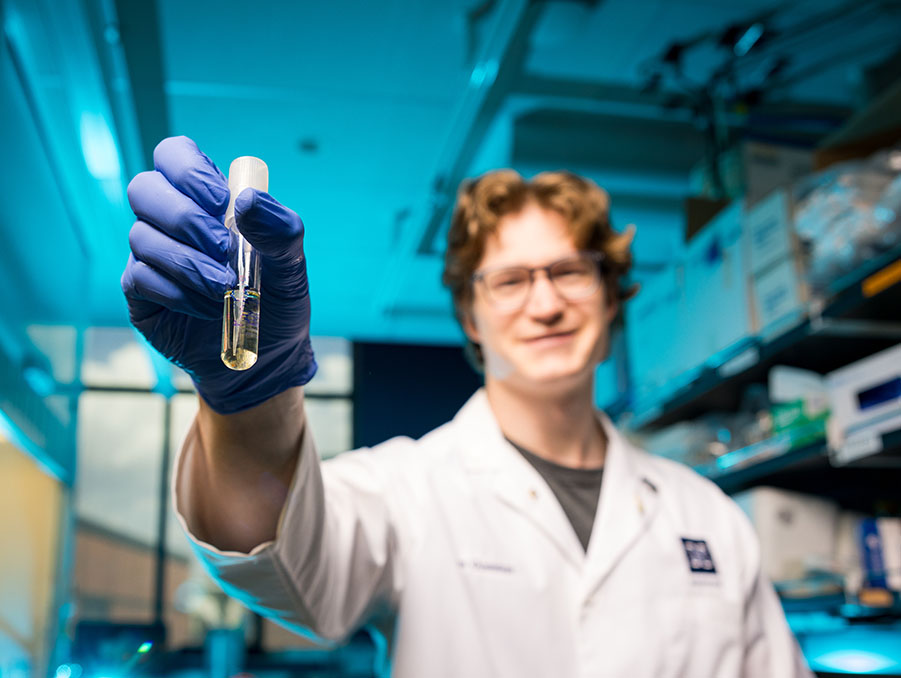
"My research looks at the basic functional units of life, proteins, and how we can use biology, chemistry and new computational tools to design them, so they change and improve the way the body functions," he said.
"My career as a physician will allow me to see patients and provide treatments that directly improve their health outcomes," Gustafson said. "My training as a scientist lets me ask the questions behind those treatments and go looking for the answers."
By combining computational approaches, laboratory experiments and advanced screening technologies, Gustafson hopes to improve the precision of future therapies while minimizing unwanted side effects.
"If we can reliably design proteins that interact only with their intended targets, it gives us a method for designing pharmaceuticals with the best possible outcomes for patients and the fewest side effects," he said.
For Gustafson, whose goal is to pursue a career in neurosurgery, the dual degree provides a unique opportunity to connect discoveries made at the bench with the realities of patient care in the operating room.
Finding solutions through research
For Shaun Suranowitz, the M.D./Ph.D. pathway provides an opportunity to combine his lifelong interest in neurosurgery with research that could one day improve outcomes for patients facing some of the most challenging neurological diseases.
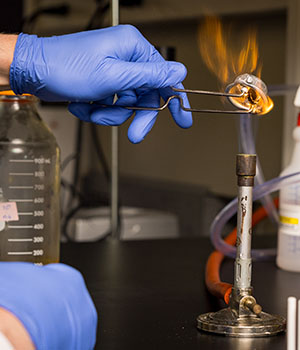
Suranowitz has been interested in medicine since he was nine years old. As he learned more about the anatomy, physiology and diseases of the central nervous system, that interest evolved into a commitment to neurosurgery and a desire to contribute to advances in patient care through research.
Working under the mentorship of Albert Gonzales, Ph.D., professor of physiology and cell biology, Suranowitz studies glioblastoma multiforme (GBM), the most common primary malignant brain cancer. His research examines how glioblastoma tumors may manipulate the brain's blood vessels to increase blood flow and deliver the oxygen and nutrients needed to support tumor growth.
"Glioblastoma remains a highly aggressive cancer with poor outcomes for patients," he said. "By better understanding the mechanisms tumors use to survive and grow, we may be able to identify new therapeutic targets and develop strategies that limit their access to the resources they need."
His work draws on advanced experimental techniques and collaborations with researchers across the University, experiences he says have reinforced the importance of teamwork in science.
"Collaboration is essential to the scientific process," Suranowitz said. "The mentorship I've received and the willingness of faculty and fellow researchers to share their expertise have been invaluable to my development as a scientist."
For Suranowitz, the dual-degree training provides a unique perspective that will shape both his future research and clinical practice.
"The M.D./Ph.D. program allows me to think like a scientist in the clinic and like a physician in the lab," he said. "Those perspectives inform one another and help ensure that the research questions I pursue are focused on improving care for patients."
Following graduation, Suranowitz plans to pursue a neurosurgery residency and continue a career as a surgeon-scientist in academic medicine, balancing patient care, research and mentorship of future trainees.
Building a community of scholars
While the academic rigor of the M.D./Ph.D. pathway is well known, program leaders also emphasize the importance of creating a strong support system.
Students begin their journey alongside a cohort of medical students before transitioning into doctoral research and eventually returning to complete their clinical training. That unique structure can sometimes feel isolating, making community-building a priority.
"Both graduate school and medical school are extremely demanding," Bessoff said. "One of the things we're really interested in doing is building a community around this program, both for the academic benefit and for the psychosocial support."
The program's intentionally small size helps foster close connections among students and faculty mentors. Students are encouraged to identify research mentors early and pursue projects that align with their interests and career goals.
"Our goal is to encourage students to identify potential labs and mentors they want to work with," Bessoff said. "Many students are attracted to programs where they can work in the labs of leading researchers, gaining mentorship from experts at the forefront of scientific discovery."
Shaping the future of medicine in Nevada and beyond
As UNR Med and its clinical and research partners continue to expand research opportunities throughout Northern Nevada, the M.D./Ph.D. program plays a vital role in the region's future.
"We're excited to build this program from the ground up," Bessoff said. "This really shows the importance that the institutions place on translational research, finding an idea, collaborating with scientists to find a solution and bringing it back to the clinical setting."
For students, the opportunity to work at the intersection of science and medicine is exactly what makes the journey worthwhile.
"This program has let me connect nearly all of my interests at once," Gustafson said. "I get to do computational research, work with large datasets, be hands-on in the lab and continue pursuing medicine. It's been a great way to dive deeper into a wide range of things I care about, and it keeps me curious."
As UNR Med's physician-scientist community continues to grow, students like Gustafson and Suranowitz represent the future of medical innovation in Nevada, one where discoveries made in the laboratory can quickly find their way to the patients who need them most.
“The people you meet along the way in the M.D./Ph.D. program teach you to think outside the box, like a scientist, to answer novel questions and become an expert in your field," Suranowitz said. "This training will challenge you, but the experience will make you both a better researcher and physician for your future patients."


