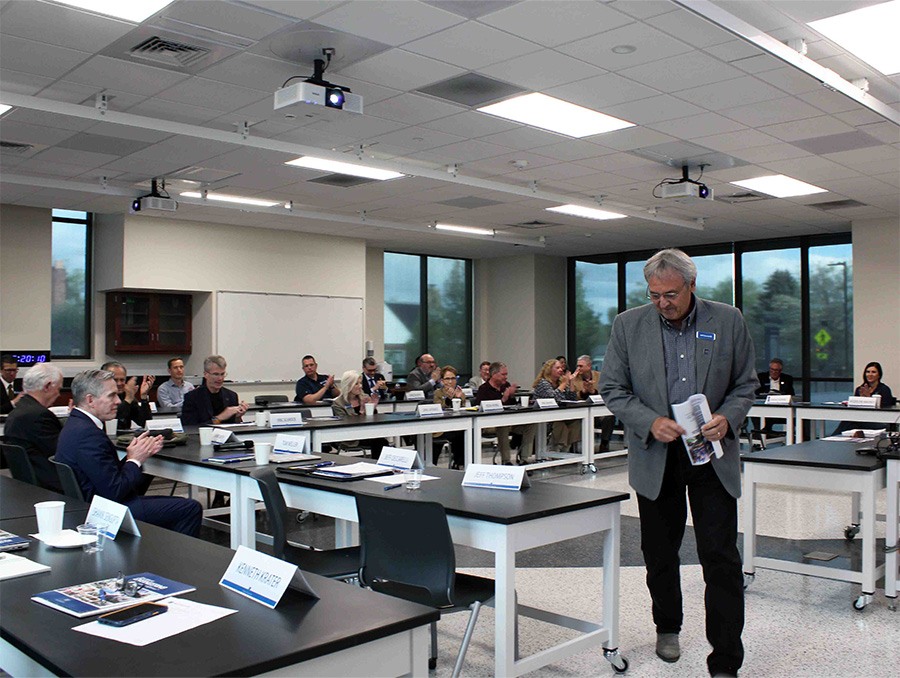
An experienced sailor like engineering alumnus Jeff Ceccarelli ’76 knows to tack his boat in the flat spot between the waves.
Basically, he explained, sailors will choose the smoothest moment between waves to change direction. That’s exactly what Ceccarelli did earlier this year, when he stepped down from a 15-year run as chair of the College of Engineering Advisory Board.
“The board is strong, the membership is excellent, the corporate partners are as good as they’ve ever been, and we’ve got an energetic new leader with an exciting vision on where he’d like to take the college,” he said during an interview this fall. “It’s a good time for new leadership.”
But that doesn’t mean he’s jumping ship entirely. Ceccarelli remains on the Nevada Engineering Advisory Board, still committed to the University that he says gave him a great education. Former colleagues, including two from NV Energy, where he worked from 1972 to 2012, describe him as a steady, team-oriented leader who strengthened the College and helped create a model for the next generation of Wolf Pack leaders.
“Skate to where the puck is headed”
Jesse Murray ’02, ’07 MBA, the new chair of the Nevada Engineering Advisory Board, first met Cecarelli in 2000. At the time, Murray was an intern at Sierra Pacific Power, which would later become known as NV Energy, and Ceccarelli was the company’s president.
“I remember thinking, ‘this is pretty cool that the president of the company is willing to come and have breakfast with the interns,’” Murray said.
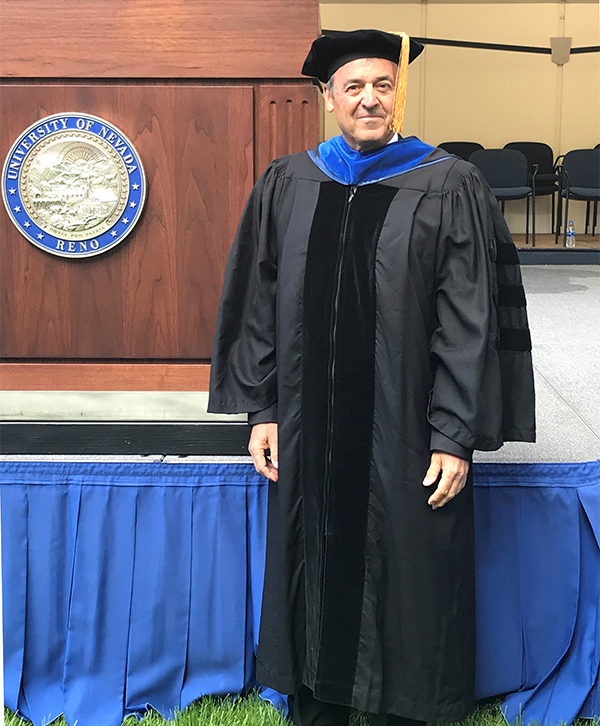
Now a senior vice president at NV Energy, Murray recalls lessons learned watching Ceccarelli over the years: value your team, put family first and remain steady when challenges arise.
That last lesson Murray would learn early on, when Ceccarelli was leading the utility through the 2000-2001 Western energy crisis. Soaring wholesale electricity prices and turmoil across Western power markets threatened utilities throughout the region.
“Having a leader like Jeff in those times was comforting,” Murray said. “You felt good that you had a guy like Jeff in the driver’s seat making decisions.”
He also learned that Ceccarelli — who played basketball for the Wolf Pack in the 1970s — appreciates a good sports metaphor.
“One of his favorite phrases was, ‘Skate to where the puck is headed, not where it is right now,’” Murray said. “Don’t go to where things are now. Anticipate where the puck is going to go — and go there. Be ahead of it.”
Provide the assist
Former Engineering Dean Manos Maragakis bonded with Ceccarelli in 2008. Maragakis had just been named dean and Cecarelli was a relatively new member of the Engineering Advisory Board.
Times were tough: Nevada and the nation were struggling with the Great Recession of 2007-2009, spurred by the collapse of the subprime mortgage market, creating challenges for universities and businesses alike.
“At that time, in the middle of a crisis, to have someone encouraging (me), that was very important,” Maragakis recalled.
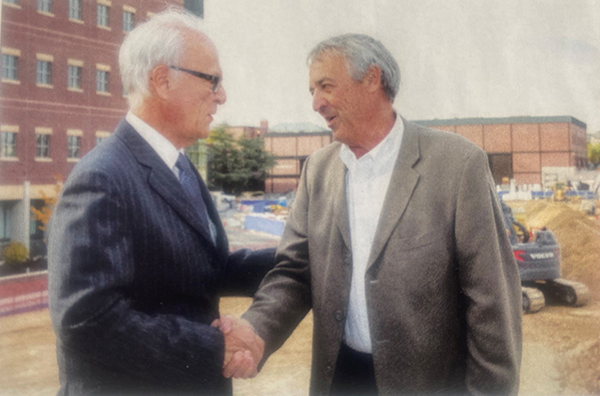
The two went on to drive major initiatives for the College: financial support for Engineering’s renewable energy minor; the establishment of Engineering’s differential fees; and the opening of the William N. Pennington Engineering Building in 2020.
Securing support and funding for the building was a multi-year effort that Maragakis described as ambiguous and complex. Throughout the process, Ceccarelli was there to provide a valuable assist.
“Jeff was always next to my side while we were trying to make the building happen,” he said. “So, in all of this major effort, I had Jeff by my side.”
Those shared experiences have cemented their friendship, even after Maragakis retired in 2022 and moved back to his native Greece.
“When I come to (visit) Reno, I always like to have a breakfast with Jeff for the sake of old times,” he said.
Looking back on their shared legacy, Maragakis credits Ceccarelli with being a “major force in the college.”
“I know that advancement of the college is done through the work of the faculty and staff,” Maragakis added. “But you need people from the community to step up and back the major initiatives, and Jeff was one of the major players in that respect. I personally owe him a lot.”
Trust your team
Carolyn Barbash ’90, ’98 MBA, keeps a list of “Jeffisms” on a legal notepad.
“They were leadership values that he held,” she said. “And he lives them — they aren’t just buzzwords.”
The former NV Energy executive first met Ceccarelli in the late 1980s, when she applied for an internship at Sierra Pacific Power, later known as NV Energy. As she progressed in the company, she would see him demonstrate many of those values, especially the importance of building and trusting a strong team.
“He surrounded himself with people he trusted,” she said. “And he trusted his team.”
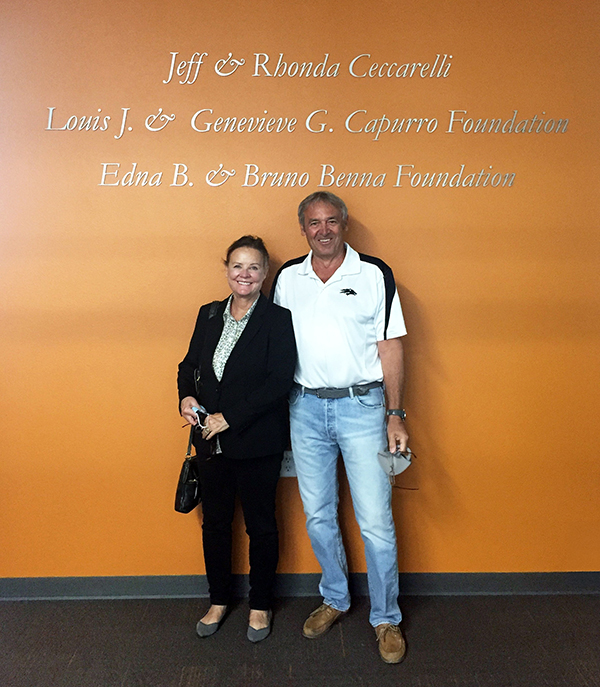
As she herself moved into leadership roles, Barbash passed that lesson along. During her keynote address to the University’s Society of Women Engineers chapter at its 2024 Evening with Industry event, she shared one of those “Jeffisms.”
“When you get into leadership,” she said, “pay more attention to managing your employees than reporting up to your boss. Your own team is what is going to make you successful. And you get the joy of seeing them advance. A true leader is marked by how successful their employees become.”
Future Wolf Pack leaders: consider taking a “reasonable risk”
Growing up in Sparks in the 1960s and ’70s, Ceccarelli was drawn to leadership. Whether it was at Sparks High School or on athletic teams or in his career, “I’ve always been interested in the leadership role,” he said.
But as a young civil engineer at Sierra Pacific Power, he made an unconventional decision for someone aspiring to the C-Suite. In 1979, he left the company so he and his wife, Rhonda “Ronny”, and another couple could sail to Hawaii.
It was a risk, but Ceccarelli said it was also a pivotal moment in his life: it taught him the value of stepping outside his comfort zone.
“My advice to a young person starting in their career is to take a reasonable risk,” he said. “I had a 40-year career, but I had 10 different assignments (during that time). I took the opportunity to have different roles and each one of those was slightly outside or (very) outside my comfort zone.
“But what I recognized is (that) if you're able to be successful in those different roles, it instills in you a level of confidence that ‘yeah, I can take on a risk and be successful,’” he added.
“And I think that's a really a good message to send to a young graduate.”


