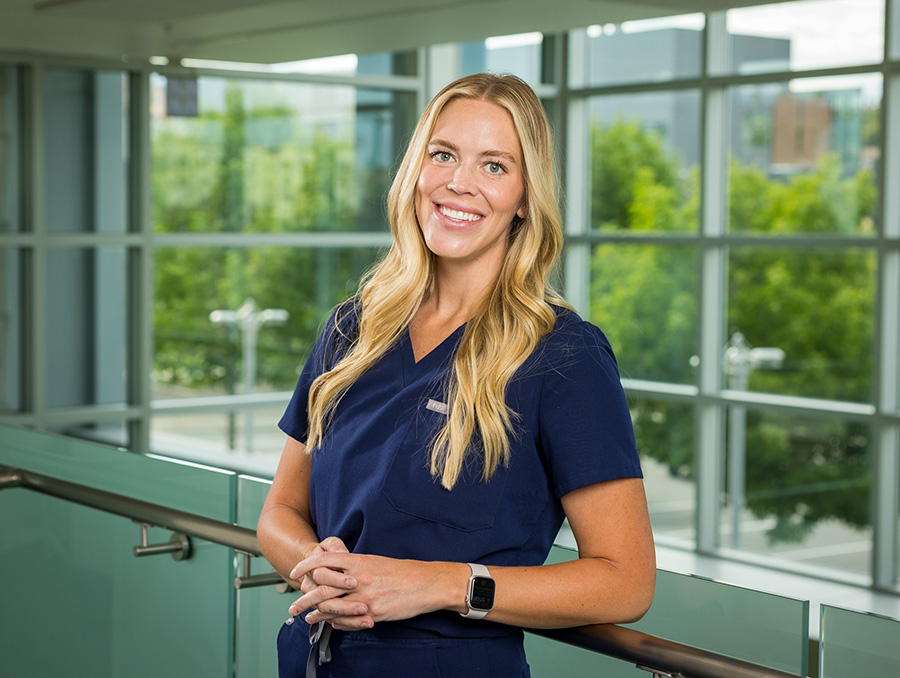
Jennifer Geddes’ journey into medicine was driven by a simple but powerful goal: to care of people and build meaningful connections with her patients. After graduating from the University of Nevada, Reno in 2015, she gained hands-on health care experience as an advanced emergency medical technician with the Regional Emergency Medical Services Authority (REMSA) while also serving as a medical assistant at a local family practice.
After spending several years living in different locations, Geddes ultimately found her way back to Nevada, drawn by the support of her family and the opportunities available to aspiring healthcare providers. She was especially inspired by the chance to serve rural communities as a physician assistant, where she could make a direct impact on patients’ lives. Working in rural healthcare will allow her not only to provide critical care but also to develop lasting relationships with the people and communities she serves.
As a recent graduate of the University of Nevada, Reno School of Medicine’s (UNR Med) Physician Assistant Studies Class of 2026, Geddes completed her training in one of the nation’s top PA programs. Her education and clinical experiences strengthened her commitment to providing compassionate, patient-centered care and prepared her to make a meaningful impact on patients and communities across Nevada.
Why did you pick this career?
“I always knew that I wanted a career where I could take care of people. When I came back, I started as an advanced EMT with REMSA, along with working as a medical assistant at a local family practice. And every experience just confirmed that medicine is where I belonged. And then becoming a PA felt like the perfect fit because it allows me to build relationships with my patients while continuing to learn every day and be a part of a team that’s really making a difference in people’s lives.”
How would you describe the learning environment?
“It was incredibly supportive. Our professors are exceptional and challenged us every day to become better clinicians while making sure we felt supported throughout the process. We also had the opportunity to work closely with our classmates, which prepared us well because health care is built on teamwork and collaboration. Having that environment as part of our training was invaluable, not only as we transitioned into our clinical year, but also in preparing us to provide the best possible patient care and work effectively within the broader healthcare team.”
What was the biggest challenge you faced while in the program?
“The biggest challenge was probably learning to trust myself. In the beginning, it’s so easy to doubt your knowledge because you’re constantly surrounded by incredibly smart people. Over time, though, with multiple, I mean, thousands of patient care hours, contacts, feedback from my preceptors, and just gaining experience. I learned to have confidence in my training. And I realized that you don’t have to know everything. You just have to be open and willing to keep on learning.”
What is one of your most memorable moments while in the PA program?
“I would say that my rural rotations in Winnemucca and Caliente stand out to me the most. They challenged me to become more adaptable and confident while showing me the importance of access to healthcare is in rural Nevada. I had incredible mentors, very inspiring people who trusted me to grow. And those experiences really shaped the kind of provider I hope to become.”
What do you wish you did differently while in the program?
“This one is kind of difficult, but I think all in all, I wish I had enjoyed the journey a little bit more. I spent so much time thinking about the next exam, the next rotation, or the next big assignment that I sometimes forgot to appreciate where I was and just be grateful for what I was experiencing. And then as time went on, I created a schedule to help find a little bit better balance in my life and enjoy the experience instead of always worrying about what was coming next.”
How would you describe your connection with your peers?
“I would say my classmates were one of the best parts of the program. Medicine is definitely a team sport, and everyone brings different strengths to the table. So, we studied together, practiced procedures together, and helped each other through difficult moments. Some of my best learning and some of the things that are most strongly ingrained in my brain happened while talking through different cases and scenarios with classmates.”
What specialty or area of PA are you most passionate about pursuing?
“Emergency medicine has always felt like home. My time working with REMSA sparked that interest many years ago, and my emergency medicine rotation only reinforced it. I love the variety, the teamwork and the opportunity to make a difference for patients during some of the most critical moments of their lives.”
What do you want to do with your degree once you graduate?
“I hope to continue growing as a clinician while staying involved in rural healthcare in some capacity. Research opportunities are also of high interest and then hopefully teaching, even if that’s part-time or just a few lectures for the classes. This program has just given me so much, and I’d love the opportunity to give back by mentoring future students one day.”
Is there any advice you would offer to students who are interested in the program?
“Say yes to all the opportunities. Just be a yes man. Every experience, even the ones that push you way outside your comfort zone, helps you grow. Another piece of advice would be to not compare your journey to anyone else’s. Everyone learns differently – trust the process. Be willing to ask questions and remember that you don’t have to be perfect. You just have to keep showing up and working hard and everything will fall into place.”


