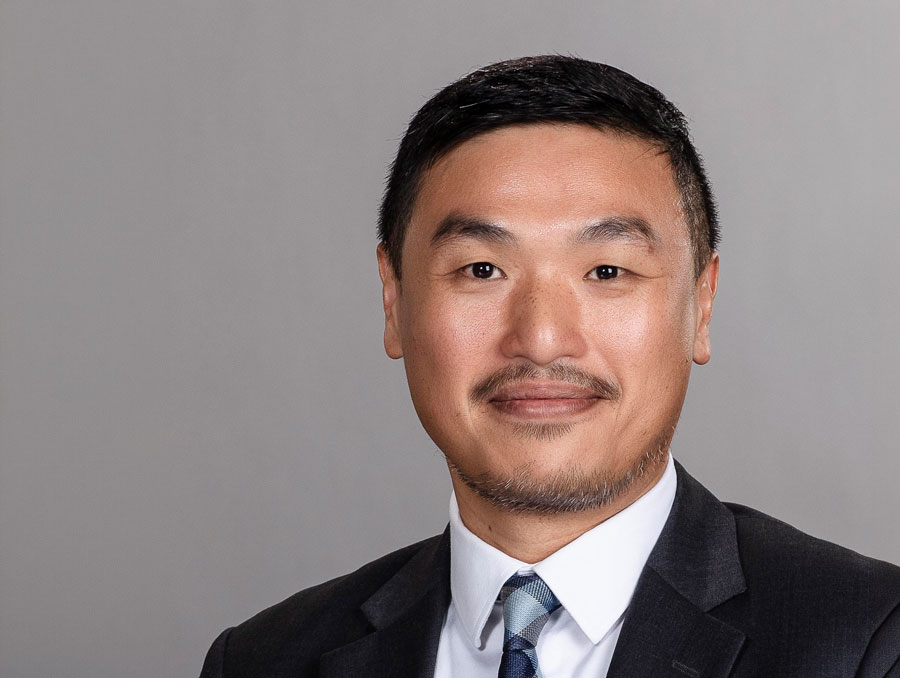
Smartphone users visiting Manhattan's Chinatown can add a soundscape to their sightseeing with an immersive app developed by University of Nevada music professor and composer George Tsz-Kwan Lam. The app, called Family Association, enables users to take a “soundwalk,” activating location-based music and interviews based on GPS location.
Lam’s experiences have inspired him to compose in a style known as “musical placemaking,” which is a form of contemporary classical music with a connection to the place the music is created or performed.
In one of his current projects, he takes interviews from a small oral history archive, summarizes them into short clips and reinterprets them into instrumental patterns. This shapes the way the audience hears his music.
“The audience gets prepped for that sort of resonance between what they hear and what they see,” Lam said. “I think that gives me a lot of room as a composer to do some things that are more out there.”
Lam, who began teaching at the University this fall, combines a passion for music that started when he was a child — he was born in Hong Kong in 1981, moving to Boston, Massachusetts in 1992. His experience as an east-west transplant informs his worldly view of music composition.
“I was just about to turn 12, and I was moving here because we got a green card,” Lam said. “That was also around the time when a lot of my friends in Hong Kong were leaving, partly because there was a lot of anxiety with the handover of Hong Kong back to China. I have an aunt who still lives in Massachusetts. She had been in the U.S. for a longer time, probably 10-15 years before I moved. So, we had someone to stay with and then to reestablish.”
Lam’s journey in music started during his elementary school years in Hong Kong, where he learned violin and piano. His focus was on the violin, but he experimented with and became adept with other instruments and took an interest in how they work together. In the U.S. he turned toward musical performance.
“The middle school I went to didn’t have an orchestra, so I was in the band,” Lam said. “I played percussion because that’s something that I can do, and later trombone because everyone could buzz a bigger mouthpiece. While I was in Boston, I started taking private lessons in violin, and in high school I just did band.”
He started arranging and creating original music in high school.
“(Me and my friends) played music from James Bond, Star Wars ... these arrangements that other people did, and then eventually, I also made arrangements,” Lam said. “I started an arrangement of Gershwin’s ‘Rhapsody in Blue,’ but for a solo clarinet instead of (solo piano). For my senior year, I put together a concert with another friend of mine from another school who was also a composer. “
That love for composition became a full-time career. He began his musical placemaking journey in 2011.
“The piece that I started doing that with was a documentary opera about the former cigarette warehouses in Durham, North Carolina,” Lam said. “I interviewed different people that were connected with the cigarette industry and cigarette warehouses and the people who worked there. I also worked with a playwright to put all of this material, these interviews, as inspiration for a story that talks about some of these things. We (eventually) performed the opera in a former cigarette warehouse.”
Lam enjoys the way composers, like Stephen Sondheim in A Little Night Music, try to change the status quo. This has inspired him to create similar music.
“I like restrictions when I’m writing,” Lam said. “Maybe writing for a specific person who has a specific set of skills and things that they’re interested in. And I would work with that and square that with what I, at the moment, would be interested in.”
When using musical placemaking, Lam typically uses speech and oral history interviews to create his pieces. These help shape the way that they come together.
“In some ways, I was thinking to myself, ‘How would a composer do documentary work? And what would that look like?’” Lam said. “‘And what does the record mean in terms of so-called authenticity? Or is it [accurate] in some ways?’ But then again, nothing is a facsimile of what the record is about. So the person who’s in the middle [the author] is always interpreting and picking things [or] not picking things.”
Lam later found his way to Reno in 2023, and to UNR two years later, coordinating music theory.
“I’m coordinating different faculty, teaching levels of music theory, oral skills, and (working with) graduate teaching assistants,” he said. “It has a lot of moving pieces, (but) it’s helpful because you also have a lot of people working together.”
Lam continues composition in his free time.
“I teach Mondays, Wednesdays, Fridays, and so my plan is basically focused on teaching on those days,” Lam said. “Then, Tuesday, Thursday, I can be a little bit more flexible. Generally, the 15-16 weeks of the semester, I’m prioritizing school, which means I will have the summer and a little bit of time in the winter just to work. But during the semester, though, I’m trying to also move things a little bit forward at a time every week.”
Being a part of the Nevada music community, Lam hopes to expand and inspire others with his work, creating more of a presence for classical music throughout the state.
“I think Nevada has a lot of need for humanities and the arts, especially because of how widespread everyone is,” Lam said. “[But] I think Nevada is great because whatever you do, it’s much needed, and people are really excited about it because there’s not a lot of it. I think in the same way, there are not a lot of Nevada composers, at least that I know who are working in contemporary classical music. It would be great to work with folks in Nevada.”


