Stefan Lovgren works with the University of Nevada, Reno’s Tahoe Institute for Global Sustainability. In this first-person narrative, Lovgren describes his ongoing reporting project on how mining is reshaping rivers around the world — work supported by an Alicia Patterson Journalism Fellowship and carried out under his Freshwater Frontlines journalism initiative. He reported for the project in Australia earlier this year.
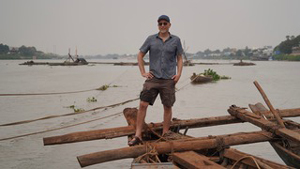
Mining is one of the oldest threats to rivers, and one of the least examined. Metal mines, sand dredges and rare earth operations contaminate waterways, destabilize riverbeds and poison the fish and communities that depend on them, often with little oversight.
My project asks what happens to a river long after the ore is gone, drawing on field reporting, satellite data and the scientific literature. It is one strand of Freshwater Frontlines, the independent initiative I am starting to cover the global freshwater crisis — from river economics and giant fish to sinking deltas and the freshwater demands of data centers.
Tasmania: a river that looks wild, and isn’t
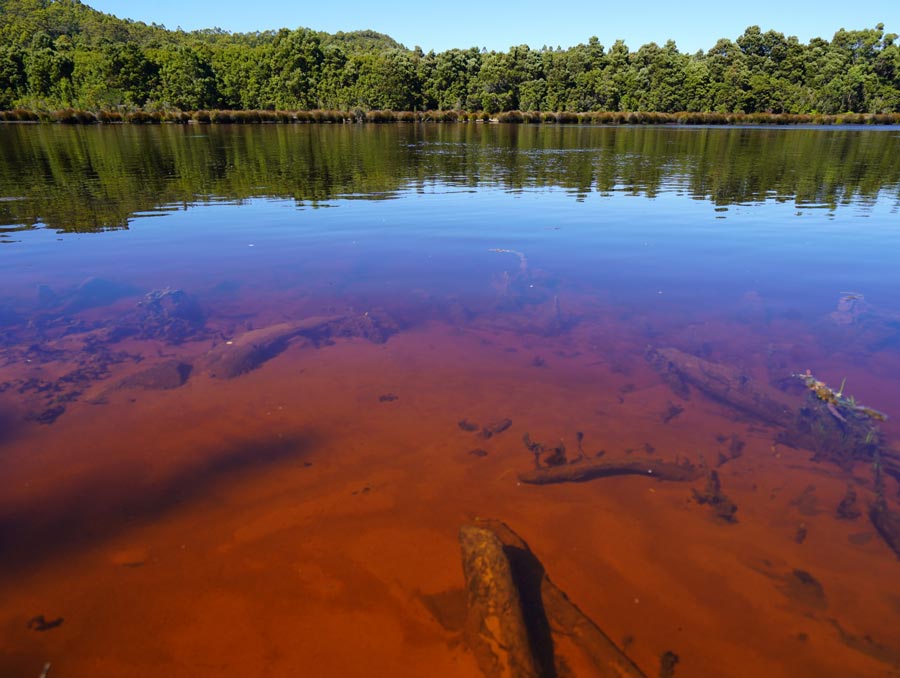
Earlier this year, I traveled to Australia to report for the project. In a story published by Mongabay in April, I wrote about the long afterlife of copper mining on Tasmania's rugged west coast, where the King River winds past rainforest and button grass plains before emptying into Macquarie Harbour near the fishing town of Strahan. To a visitor, the river looks as untouched as the country around it. Stand beside it on a February morning, though, and the silence is the tell: healthy Tasmanian streams hum with mayflies, stoneflies and caddisflies, the insects that anchor freshwater food webs. Along the lower King, they are largely gone.
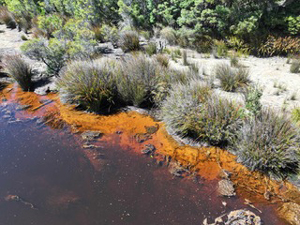
The cause sits upstream at Mount Lyell, one of Australia's largest historic copper mines, established in the early 1890s above Queenstown. For more than a century, sulfide-rich tailings were discharged into the Queen River, which flows into the King. Exposed to air and water, they generate acid mine drainage that dissolves copper, zinc and iron and carries the metals downstream into sediments, floodplains and a waste delta at the harbor's edge. Tasmania's Environment Protection Authority has described stretches of the lower King as biologically dead. Large-scale dumping ended long before the mine closed in 2014, but acid drainage still enters the Queen River today, and the catchment is one of more than 100 contaminated mining sites on the island.
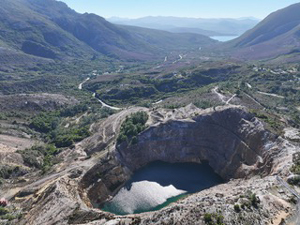
Tasmania matters beyond Tasmania. Recent research finds the most persistent river contamination worldwide comes from abandoned mines rather than active ones, and that more than 90% of mining-related metals travel in sediment, which floods can remobilize decades later.
"Rivers remember mining," says Mark Macklin, a University of Lincoln geomorphologist quoted in the Mongabay story.
As demand accelerates for the copper, lithium and rare earths behind electric vehicles and AI data centers, that memory is a warning.
Rare earths: Untested environmental impacts of processing
The same trip produced a very different story about the same problem — this one looking forward rather than back. Writing for Chemical & Engineering News in June, I reported from the Australian Nuclear Science and Technology Organization’s campus at Lucas Heights, near Sydney, where a building that hosted rare earth research in the 1990s is being refitted as a pilot plant. Its purpose is to let companies test how their particular ore behaves, as an integrated process rather than isolated lab steps, before committing to a full refinery.
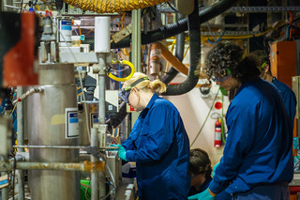
The stakes are geopolitical. Rare earths are not especially rare; concentrated deposits and the ability to process them are. Separating the 17 elements, which share nearly identical chemical properties, takes dozens or even hundreds of stages of solvent extraction using acids and organic solvents. China holds roughly 90% of global refining capacity, a position it built as the United States and other mining countries scaled back in the 1980s and 1990s and accepted that someone else would carry the environmental cost. Australia, the world's fourth-largest producer of rare earth ore, now wants some of that capacity back.
The freshwater question runs underneath all of it. Refining a single ton of separated material can generate tens to hundreds of tons of waste — acidic, metal-rich and sometimes carrying naturally occurring radioactive elements such as uranium — that must be contained and monitored for decades or longer to keep it out of soil, groundwater and rivers. Australia has strict environmental frameworks, and companies developing deposits such as clay-hosted Koppamurra, which sits beneath farmland, say they will not win approval without demonstrating containment. Skeptics counter that the regulation has never been tested at scale.
"It's not hard to be cleaner than China," Charles Roche, executive director of the Mineral Policy Institute, told me.
What is changing is not the chemistry but where it happens — and which rivers are downstream.
What comes next
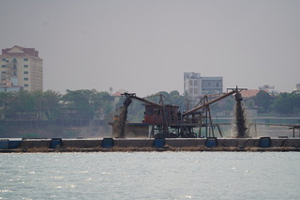
The project continues on several fronts. I plan to report on the river impacts of rare earth mining in Southeast Asia, where extraction in weakly regulated areas has already sent contamination across international borders, and on sand mining in Cambodia’s Mekong River, where dredging strips riverbeds and starves the delta of the sediment that sustains its fisheries and farmland. Further reporting will examine lithium mining in Africa as the energy transition drives demand into new watersheds, and the water pollution associated with data centers.