Imagine you sit down to play a card game, except you’ve never played the game before and you don’t know the rules. Fortunately, the stakes are low and so you can learn as you play without consequences. Each time you play a card, you make a decision that, according to the rules of the game, is either right or wrong. As you play, you start to pick up on the rules. How does this process play out in the brain?
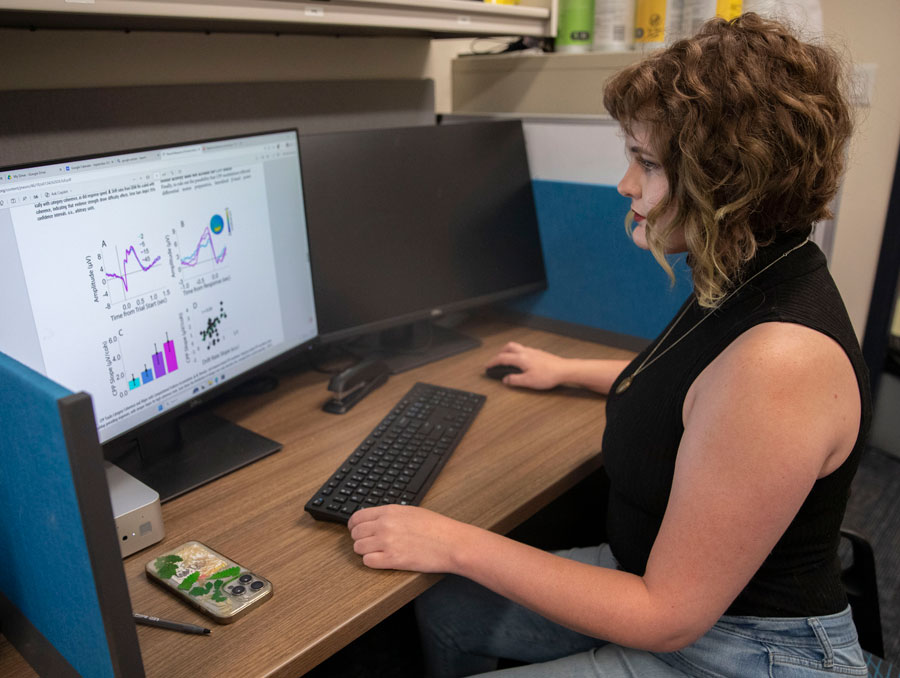
That was the driving question in research recently published by Edward Ester, an associate professor in the Department of Psychology, and his student. The research builds on previous findings which show that a signal in the brain’s parietal cortex called the central parietal positivity (CPP) ramps up over the course of the decision-making process in the brain, regardless of where the information came from. Right before a person makes a decision (like deciding which card to play) the CCP reaches a maximum, the decision-making threshold.
“[The CPP] has been described as essentially a marker or a measurement of the evidence accumulation process that's taking place in people's brains,” Ester said.
As the card player gains more insight into the rules of the game, they’re accumulating evidence or information that will guide their decisions. Ester wanted to know whether the CCP played a role in the decision-making process when evidence is actively being accumulated to guide the decision.
Ester’s lab group invited participants to categorize a series of tilted lies. The participants, wearing electroencephalography caps to monitor the CPP signal, began their task not knowing the boundaries or rules defining the categories. Each right or wrong categorization the participant selected was another piece of evidence the brain could use to build the rulebook for categorization. The researchers found that the CPP was present in this type of decision making, showing there is just one mechanism for evidence accumulation, regardless of the source of the evidence.
The research, led by Ester’s doctoral student Arianna Thoksakis, was published in the Journal of Neuroscience.
Ester and his colleagues then wondered to what degree a person’s decision might be apparent from outward physical behaviors, like a poker tell. The team exploited a challenge associated with EEG measurements to explore their question. EEG is a useful measurement in many neuroscience studies, but it can also be interspersed with noise from other electrical potentials, in particular eye movements. The researchers decided to monitor the eye movements study participants made while deciding on stimuli categories.
“The way that I kind of think about this is like a little behavioral tell, like you might see in like a poker room,” Ester said.
They found that there were differences between eye movements for each category of stimulus. The researchers explored further and collected data on eye movements for each kind of stimulus. Then, they used that data to predict which category a participant would choose for a given stimulus, based on their eye movements. The researchers were able to accurately predict a person’s decision based on their eye movements a little over half the time — modestly but reliably above chance, and in some participants closer to 60%.
“A coin flip would be 50-50, right?” Ester said. “If we really push it, we can get up to about 58, 60%.... But you know, if I could do 58, 60% detecting bluffs in a poker room, I wouldn't be applying for grants anymore because I could just self-fund my own lab.”
This research, led by another of Ester’s graduate students, Ali Caron, was published in the Journal of Cognitive Neuroscience. A paper published around the same time by researchers at the University of Chicago, working with primates, found a strikingly similar pattern in the superior colliculus — a brainstem structure long associated with eye movements — where neurons are responsible for both eye movements and categorization, and the two occasionally align. These findings build on one another to show that eye movement and decision-making processes are linked both in the brain and outside it.
One takeaway from the research: wear sunglasses when you’re playing poker, especially if you’re playing against Ester.


