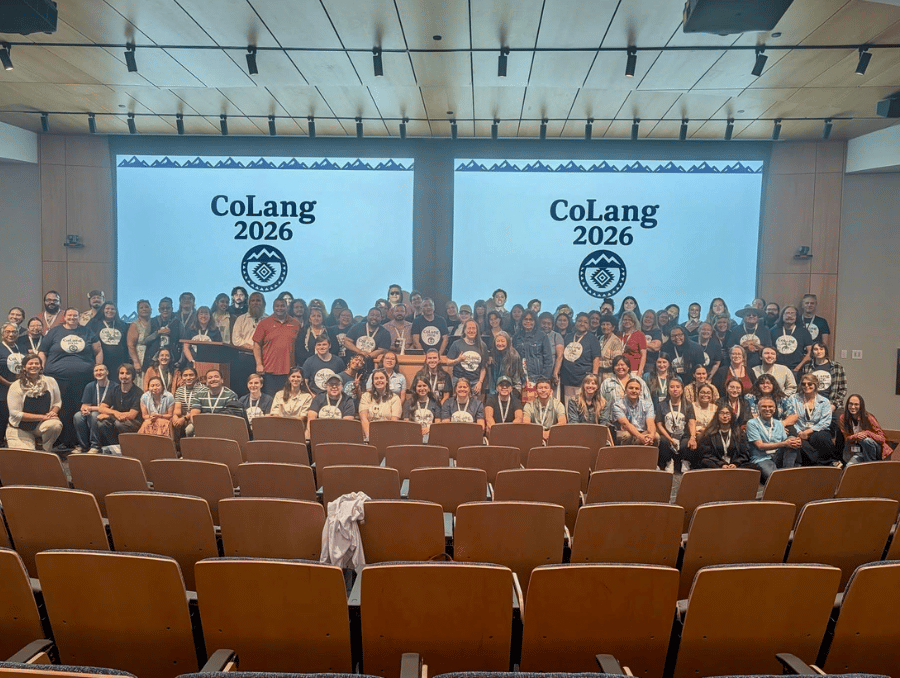
Over the summer, the University of Nevada, Reno became a gathering place for people committed to one of the most powerful acts of cultural continuity: keeping languages alive. Through the Institute on Collaborative Language Research (CoLang) 2026, language workers, community advocates, scholars, teachers and learners came together under the theme “Strengthening Solidarity, Overcoming Obstacles, Forging our Future.” More than a training institute, CoLang was a celebration of collaboration, community and the enduring strength of Indigenous languages.
Held in the heart of the Great Basin, on the traditional homelands of the Wasiw (Washoe) and Numu (Northern Paiute) peoples, CoLang 2026 was deeply rooted in place. With Nevada home to 20 federally recognized tribes and the region carrying generations of linguistic and cultural knowledge, the institute offered a meaningful opportunity to learn from and alongside the communities whose languages and traditions continue to shape the region. Participants traveled from Nevada, across the country and around the world, creating connections that reached far beyond the classroom.
The first two weeks featured more than 45 workshops addressing the practical, ethical, linguistic and technological dimensions of language documentation, revitalization and reclamation. Sessions such as “Tell Your Story: Integrating Indigenous Knowledge through Collaborative School and Community Projects,” led by Cláudio da Silva and Craig Volker and “Practical Approaches to Community Language Teaching While Bridging Linguistics and Revitalization Pedagogy,” led by Lisa Casarez, reflected the breadth and purpose of the institute: equipping participants with knowledge they can bring directly into their communities. Beyond those sessions, CoLang offered models talks, sharing nights and informal conversations that created additional spaces for participants to exchange experiences, ask difficult questions and imagine new possibilities together.
The final week brought those lessons to life through collaborative fieldwork practica focused on the three Indigenous languages of Northern Nevada: Wašiw (Washoe), Numu (Northern Paiute) and Newe (Western Shoshone). Guided by passionate language experts and community leaders, participants had the opportunity to apply the skills developed during the workshops in real-world settings. These practica demonstrated what CoLang does best: bringing academic knowledge and community expertise together in ways that honor lived experience, strengthen language work and build sustainable relationships.
Ignacio Montoya, College of Liberal Arts English professor and director of CoLang 2026, who has also been involved with two other CoLangs, reflects on what makes the institute such a special and valuable program in the field of language documentation and revitalization: “The spirit of CoLang is about making connections, which is exactly what we saw at this year’s institute – seasoned professors having lunch with new linguistics students, academics and Indigenous leaders exploring Reno together, and members of tribal communities from all over the country exchanging stories and gifts in between workshops. In addition, our close partnerships with local tribes allowed CoLang participants to connect with the rich traditions and customs of our local Indigenous communities.”
Perhaps the greatest accomplishment of CoLang 2026 was not simply the number of workshops offered, or skills learned, but the relationships strengthened and new partnerships forged. Participants left with new tools, new collaborators and renewed purpose. Community knowledge holders and language leaders shared expertise that cannot be learned from textbooks alone, while scholars and emerging language workers brought energy, technical knowledge and a commitment to listening and learning.
University of Nevada, Reno linguistics graduate student and CoLang participant, Caroline Scott, summarizes her meaningful experience: "I was extremely fortunate to experience CoLang as both a volunteer and participant. It was an honor and privilege to be able to witness and hear stories of the dedication, passion, and immense mental and emotional effort that comes with language revitalization and reclamation work. This experience is one that was beautifully shaped by the people, and I look forward to carrying what I’ve learned with me."
CoLang 2026 was made possible through the dedication of its local organizing team and the generous support of the National Science Foundation, West Regional Native American Language Resource Center, the Linguistic Society of America and the Endangered Language Fund. Directors Ignacio Montoya and Co-Director Daphne Emm-Hooper, Program Coordinator Katharine Donelson and intern Reese Donnelly worked together to create an institute grounded in respect, reciprocity and possibility.
College of Liberal Arts Dean Isabelli highlights CoLang’s impact and the collective effort behind its success: “Ignacio and Daphne’s team, together with the many people who contributed, created an experience that was both deeply meaningful and truly collaborative. I am thrilled to have events of this level of community impact hosted within the College and University.”
At its heart, CoLang 2026 reminded us that language revitalization is about far more than words. It is about people, identity, memory, relationships and the right of communities to carry their languages forward on their own terms. The work begun and strengthened at CoLang will continue in classrooms, archives, communities, families and future generations. In gathering, learning together and imagining the future together, CoLang 2026 did exactly what its theme called us to do: strengthen solidarity, overcome obstacles and forge a future in which Indigenous languages can continue to thrive.


