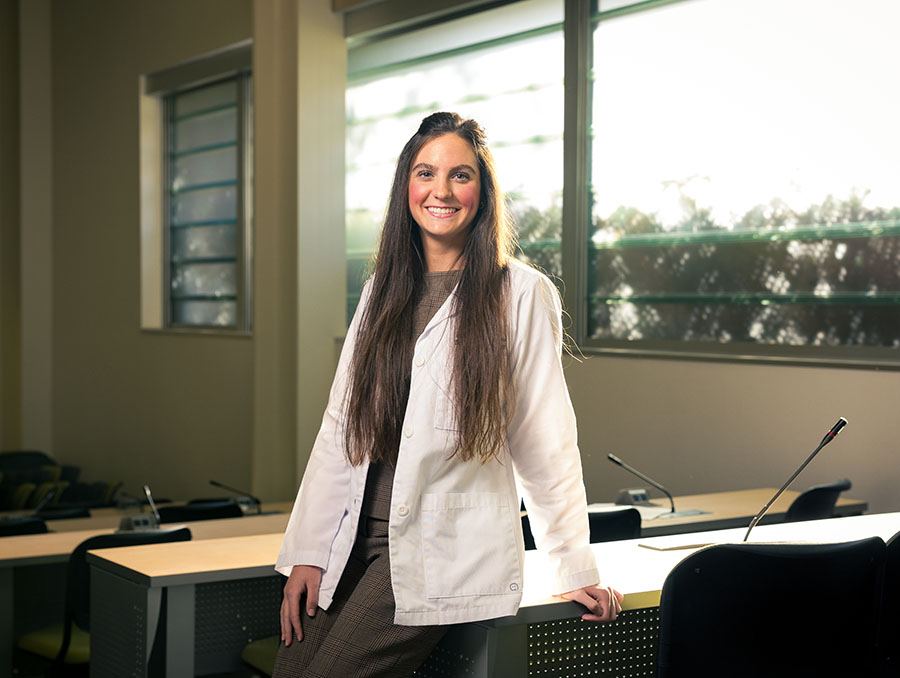

Britta Verhey has always been driven by a desire to connect with and help others.
A Reno local and second-generation Nevadan, she first discovered that passion through ballet, finding fulfillment in the moments when a performance truly resonated with an audience. But when her grandmother was diagnosed with Alzheimer's, Verhey saw firsthand the profound impact medical care can have on patients and their families. The experience inspired her to pursue a career in medicine, where she could provide support and make a difference in people's lives beyond the stage.
Now a medical student at the University of Nevada, Reno School of Medicine (UNR Med), Verhey is combining that passion for helping others with a longstanding commitment to research.
Her recent publication examining Medicaid reimbursement for Mohs micrographic surgery is drawing attention to an important question in healthcare: Does having insurance coverage actually translate into access to care?
A passion for discovery
Verhey's interest in research began during her undergraduate years studying biology at Stanford University. There, she worked in a clinic focused on Pediatric Acute-onset Neuropsychiatric Syndrome, a condition that causes sudden-onset movement and neuropsychiatric symptoms in children.
"Seeing those kids and their families made me want to help," Verhey said. "I loved using what I learned in class to work on real problems for patients."
Arriving at UNR Med with prior research experience and publications, Verhey was eager to continue pursuing projects that could have a meaningful impact on patient care. She was particularly drawn to questions surrounding healthcare access and disparities.
That interest ultimately led her to a national study exploring Medicaid reimbursement rates for Mohs micrographic surgery, a specialized procedure for many skin cancers.
Examining access beyond coverage
The project began with a simple but important question: What happens to patient access when insurance coverage expands, but physician reimbursement declines?
Working alongside collaborators from Stanford University, the Mayo Clinic Alix School of Medicine and the University of California, San Francisco, Verhey analyzed inflation-adjusted Medicaid claims data from 2016 to 2022. The team compared reimbursement trends in states that expanded Medicaid under the Affordable Care Act with those that did not.
Their findings challenged expectations.
"I expected Medicaid expansion to help payments," Verhey said. "But they actually fell more in expansion states."
The study found that Medicaid reimbursement for Mohs surgery declined substantially nationwide during the study period, with even steeper decreases in states that expanded Medicaid coverage. The findings raise concerns about whether declining reimbursement rates could discourage physicians from accepting Medicaid patients, potentially limiting access to care for individuals who already face significant barriers.
"Mohs surgery is the gold-standard treatment for many skin cancers, but fewer than half of Mohs surgeons accept Medicaid. Low payment is the most common reason they give," Verhey explained. "Having coverage only helps if patients can find a surgeon."
For Verhey, the project reinforced the importance of examining the policies and systems that influence what happens in the exam room.
Lessons beyond the data
While the findings were significant, the research process itself offered valuable lessons.
Verhey was surprised by how much work takes place before a study ever reaches the data analysis stage. Developing a strong research design, defining methods and ensuring the study can answer meaningful clinical questions all proved essential.
"You have to define your methods in advance because a poorly designed study can weaken your data and your conclusions," she said.
The experience also taught her the importance of remaining open to unexpected results.
"Your first hypothesis may not turn out to be true," Verhey said. "When that happens, you adjust and ask the questions that matter most clinically."
Conducting the project presented its own challenges. Collaborators were spread across multiple institutions and states, requiring careful coordination and communication. Verhey also learned to work with large national claims databases, building new analytical skills throughout the process.
She credits mentors such as Gordon Bae, M.D., clinical assistant professor of dermatology at Stanford University School of Medicine, for helping make the project possible.
“I'm so appreciative of the mentorship and support that got me here,” she said. “I also know there is a lot more work to do, and I hope I can keep advancing access to care."
Looking ahead
For Verhey, publishing as a medical student is both an honor and a motivation to continue exploring questions that can improve patient care.
"Research has taught me to ask good questions and look for real answers," she said. "It has given me an appreciation for developing solutions that make patient care better."
Her work is already continuing. Verhey is preparing to launch a national secret-shopper study examining how a patient's insurance type affects access to Mohs surgery, further building on the themes of access and equity that inspired her original project.
She hopes research will remain a central part of her career throughout medical school, residency and beyond. In addition to advancing knowledge, she hopes to one day mentor students just as her own mentors have guided her.
As she reflects on her journey, Verhey remains grateful for the support she has received at UNR Med and beyond.
For students interested in pursuing research, her advice is straightforward: Start with a topic you genuinely care about.
"Look at what's already out there, find the gaps or questions no one has answered yet, and turn them into a clear research proposal," she said. "Then be persistent. Many people never wrote back, and a few did but weren't interested. All you need is one yes."


