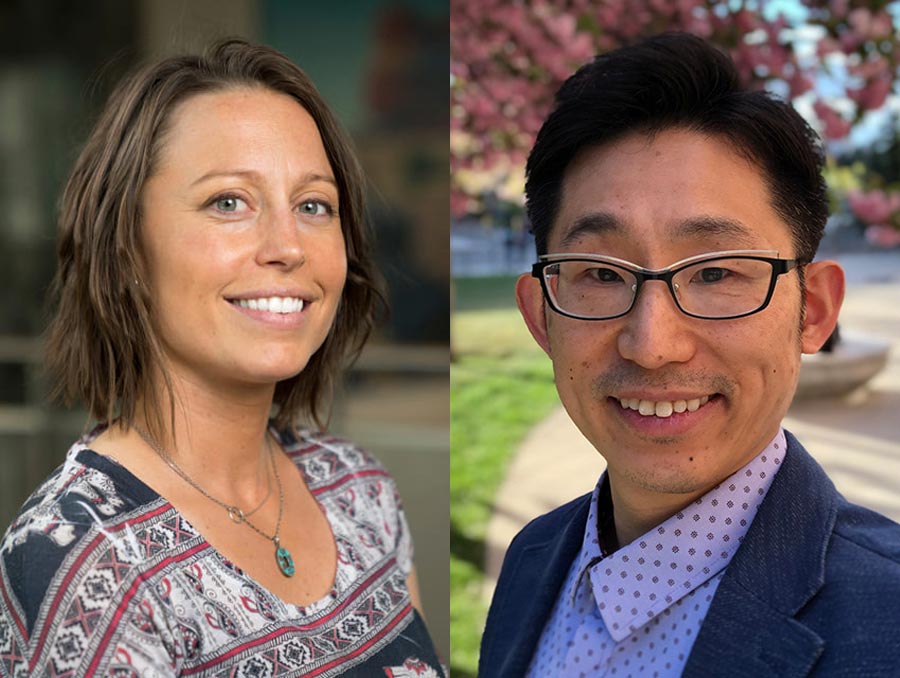
Two research projects at the University have received awards of nearly $1 million each from the U.S. Department of Energy (DOE). Both projects will receive funding over four years and will generate training opportunities for both undergraduate and graduate students at UNR, who will work with leading scientists in their discipline.
The awards are part of DOE's Established Program to Stimulate Competitive Research (DOE EPSCoR), which supports partnerships between universities in eligible states and DOE national laboratories to advance fundamental, early-stage energy research. The program aims to strengthen research capabilities in participating states while providing students with hands-on research and training opportunities alongside national laboratory scientists.
Krista Carlson, an associate professor in Materials Science and Engineering in the College of Engineering, has received a $1,000,000 award to improve mercury detection and capture. Mercury is released into an off-gas stream when radioactive and hazardous waste at the Hanford Site in Washington State is converted to glass for safe, permanent disposal. Carlson’s project will investigate sorbents which can capture mercury to reduce disposal toxicity. The team also includes co-investigators Professor Dev Chidambaram, from Materials Science and Engineering, and Professor Mae Gustin and Research Professor Sarrah Dunham-Cheatham from the College of Agriculture, Biotechnology & Natural Resources.
“The sorbent selected for Hanford’s off-gas system is no longer being manufactured by the supplier, so alternatives must be identified,” Carlson said. “Another challenge is effectively identifying and capturing all the different forms of mercury that could be present. Mercury detection and abatement from the off-gas directly supports DOE EM mission of waste remediation in a way that protects workers, the public, and the environment.”
Hiroshi Sawada, an associate professor in the Department of Physics in the College of Science, has received a $989,916 award to develop advanced diagnostic tools and establish a new experimental platform using an X-ray free-electron laser at the Matter in Extreme Conditions (MEC) instrument of the Linac Coherent Light Source (LCLS), located at SLAC National Accelerator Laboratory in California. Sawada uses powerful lasers to explore high-density plasmas, used in fusion experiments. The diagnostic tools developed by Sawada and his collaborators will improve understanding of these technologies.
“This new capability will allow us to explore the behavior of high-density plasmas under conditions that have been difficult to probe,” Sawada said. “Experiments combining long- and short-pulse lasers have been conducted at single-shot facilities, but measuring conditions inside dense plasmas remains challenging, particularly under high-intensity laser irradiation, which generates strong radiation backgrounds that can interfere with measurements.”
“DOE EPSCoR investments like these strengthen Nevada’s research capacity by connecting our faculty and students with the expertise and resources of the nation’s leading laboratories,” Senior Vice President for Research and Innovation, Mridul Gautam, said. “These awards give our researchers the opportunity to tackle complex energy challenges while building expertise and training the next generation of scientists and engineers here in Nevada.”


