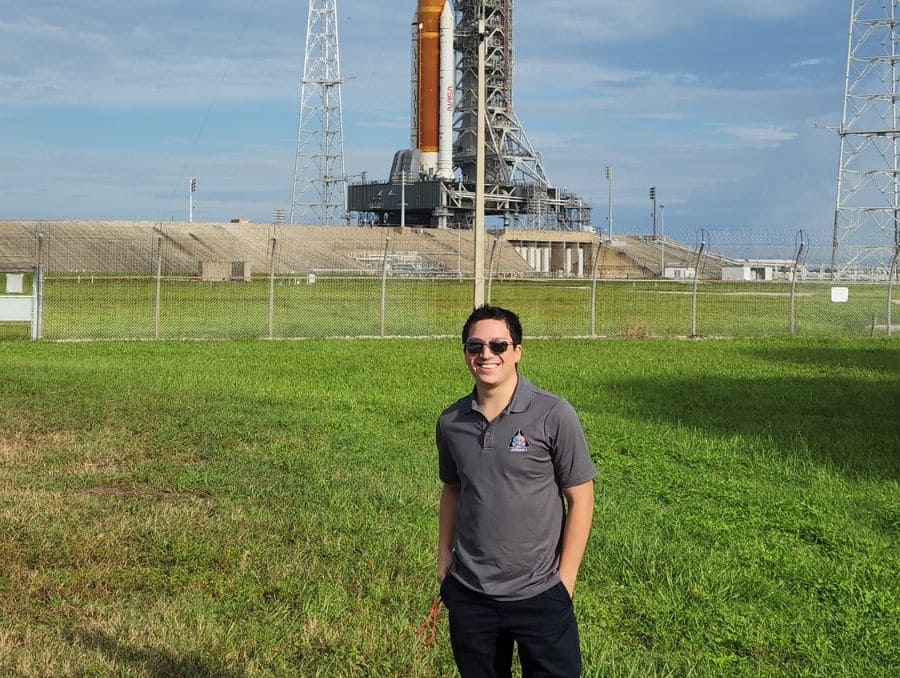
Manny Retana ’18 (mechanical engineering) was born in Texas to Mexican immigrants. During his childhood, his mother moved him and his four siblings back to Mexico, where she raised them on her own. By the time he reached high school, Manny had set his sights on pursuing a career in engineering and STEM. However, he realized that his mother would not be able to afford to send all of her children to universities in Mexico.
“Mom raised us all as a single parent,” Retana said. “She was a business owner, and things were difficult, but she didn’t expose the kids to it. She is an inspiration.”
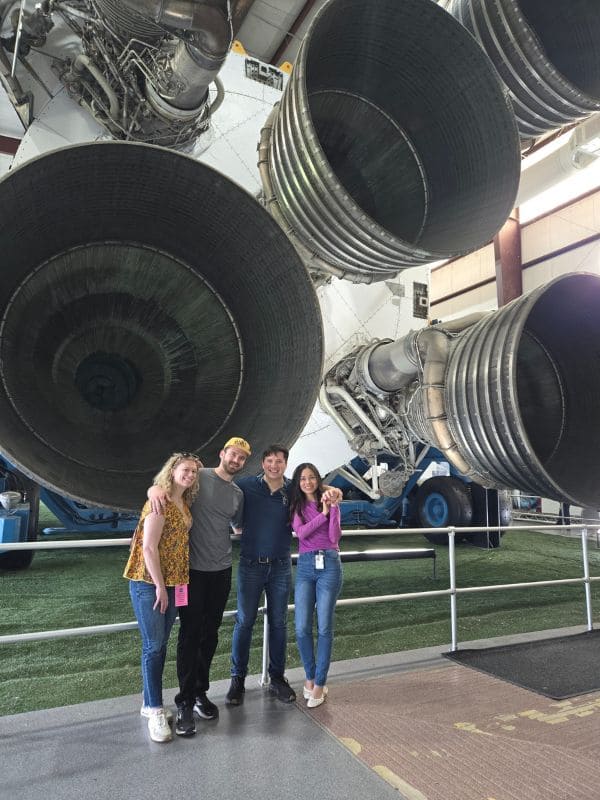
Taking a leap of faith, Retana made the difficult decision to move from Mexico to the United States, leaving behind his mother, his siblings, and the life he knew. He enrolled in high school in Las Vegas, living with his sister’s mother’s family while still learning English. Determined to continue his education, he secured $80,000 in scholarship funding during high school and applied to 15 universities. Despite his broad ambitions, staying in-state was the only financially feasible option.
Upward Bound provided him with the chance to visit the University of Nevada, Reno before making the decision between UNLV and Nevada. He ultimately chose the University—a decision he still considers the right one—joining the Wolf Pack with the intention of creating a college experience every bit as fulfilling as the one he once dreamed of having at Stanford.
Of the decision, Retana said, “Attending the University was the best decision in my life.”
Finding belonging at Nevada
Manny enrolled as a mechanical engineering major. Inspired by student groups he admired at Stanford, he went on to establish both the University’s Mariachi Club and the Taekwondo Club, believing he could build communities for himself—and he did. During his first year, he also served as president of the White Pine and Lincoln residence halls and joined the University of Nevada, Reno Honors Program.
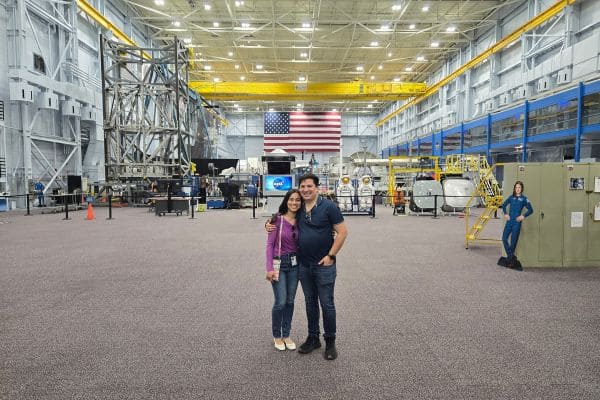
“For me, college was all new to me. I was the first engineer in my family. The first in my family to speak English, and the University was a huge jump in culture,” Retana said. “I thought I would be out of place, but I fit right in. The University welcomed me, and I’m very thankful.”
At the end of his freshman year, he applied for his first internship and moved to Washington to work in nuclear engineering with the National Nuclear Security Administration (NNSA). Through mentorship he found at the University, he applied to NASA internships 11 times during his second year, earning two interviews and ultimately securing the NASA internship that would lead to his current career with the agency. He also pursued study abroad opportunities, and in his third year he spent a semester in England through USAC—the only program offering his junior-year engineering coursework abroad.
Upon returning to the United States, Manny interned for two additional semesters at NASA in Houston and completed research at the University during the summer through the TRIO McNair Scholars Program. He graduated in five years, having amassed NASA experience, international study, and strong preparation for graduate school. Supported by the McNair Scholars Program, he was admitted to and funded by Stanford University.
Learning to push through rejection
Despite all of Retana’s success, he touched on a sentiment common among first-generation college students.
“I had impostor syndrome,” he said. “I had to work on my internal talk, and I had to come to terms with the fact that you’re going to get a lot of noes. You’re going to get 75% noes, and you just need that 25%.”
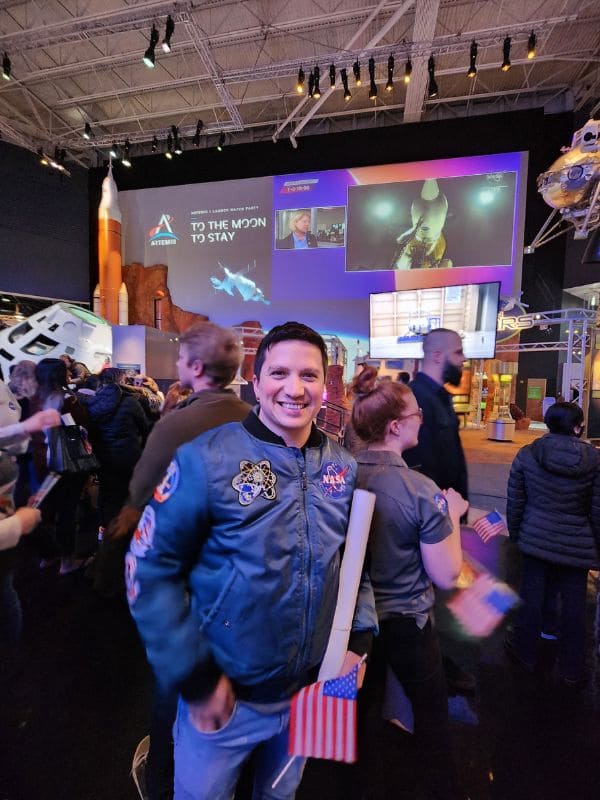
He added, “What separates people who achieve their dreams and those who don’t is not talent, money or your background. It’s not any of that. It’s about grit. It’s about how much you want it. I’m not the smartest guy. I didn’t get straight As. Some folks assume companies are going to come and get them. You have to go get it. You have to go get that first internship.”
Retana credits the TRIO McNair Scholars Program with connecting him with faculty members, like Professor Miles Greiner. Under his tutelage, Retana worked on nuclear research, published his first paper, presented at a conference for the first-time, and was introduced to the faculty members at Stanford, where he would eventually pursue his graduate studies.
“The opening door started at the University,” he said.
Building the future at NASA
Today, Manny works at NASA as a project manager specializing in Environmental Control and Life Support Systems—technology responsible for monitoring and controlling oxygen, carbon dioxide, and water levels in orbit. These systems are vital to sustaining astronauts during missions to the Moon, including Artemis II and Artemis III, as well as the upcoming Gateway HALO lunar space station. He now lives in Houston, Texas with his wife, and the couple is expecting their first son.