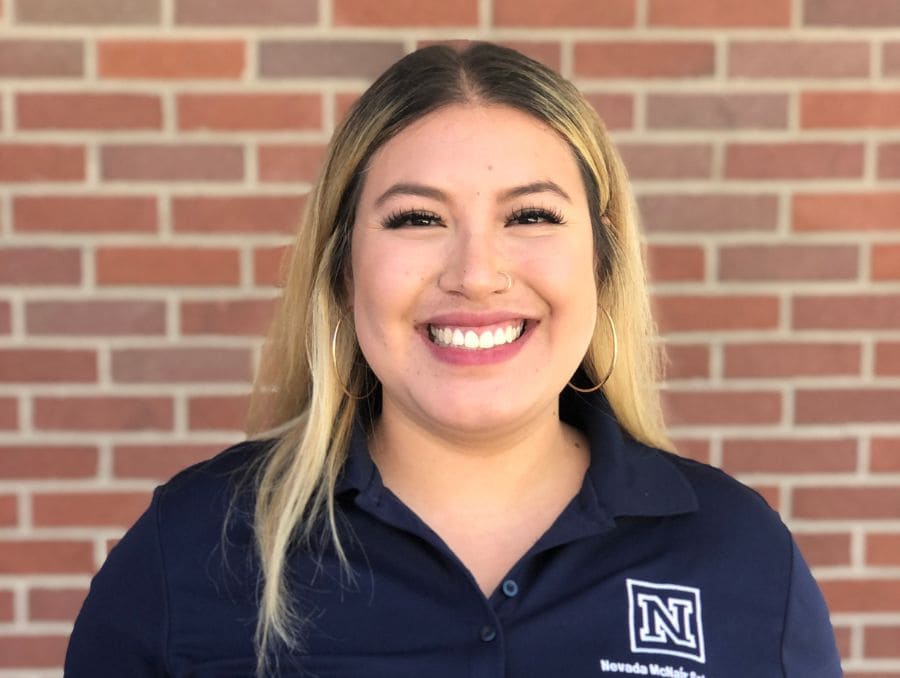
Carolina Rocha Becerra’s story is one of remarkable perseverance and transformation. Originally from Guanajuato, Mexico, Rocha Becerra ’22 (chemistry) arrived on campus as a young adult, facing the daunting challenges of adapting to a new culture, learning English and navigating the complexities of the American higher education system.
“When I got here, I was so incredibly lost,” she said. “The first six months were very, very stressful. The hardest thing for me is that I didn’t really know how to ask for help. When I talk to students now, I tell them the best skill they’re going to have is how to ask for help. Because there is help there.”
Despite holding a degree in chemical engineering from Mexico, to obtain a degree at the University, she was required to retake courses and start her studies anew—an experience that tested her resolve but ultimately shaped her journey.
Starting over in a new country
“I had such amazing professors,” she said. “I had a couple of professors who spoke Spanish. One of them asked me, ‘Where are you from?’ And I told him I’m from Mexico. He was like, ‘I'm from Costa Rica. Would it help if I talked to you in Spanish?’ And I was like, yes, please.”
After establishing this rapport, Professor Victor Vasquez sat down with Rocha Becerra to see which classes she had taken already and to help her navigate the courses in chemical engineering.
“He said, ‘Show me everything. I'll help you through this,’” Rocha Becerra said.
“It was the first interaction that I had with a professor where he wanted me to share my personal story, someone who took time out of their busy schedule to fix something that had nothing to do with his class. That was a very good experience.”
Finding support in unexpected places
Nonetheless, early on, Rocha Becerra struggled with isolation and uncertainty, compounded by language barriers and an unfamiliarity with campus life. Thanks to a friend who suggested she apply to participate in the First-Gen Center, she began to understand herself better and to find happiness. But first, she had to overcome fears related to applying to the Center.
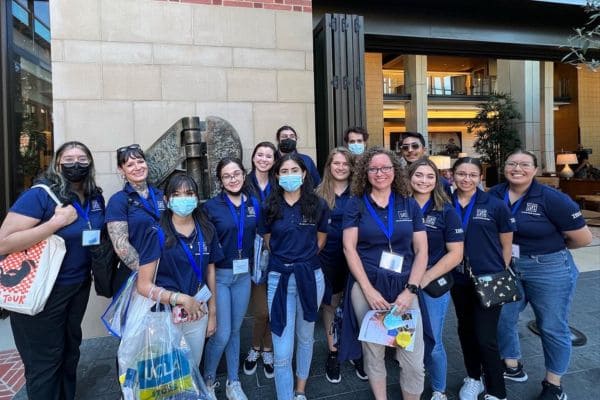
“One of my biggest worries is that I didn’t know how to write essays, and for the application, there’s an essay. But I applied, and I got an email saying they’d like to interview me,” Rocha Becerra explained. “I knew they were going to ask me why I want to be a part of the First-Gen Center, so I prepared to say something like, ‘I’ve never seen anybody like me in STEM, and it’d be great for a girl to see a woman in STEM. It’s important to me to show other people who moved here as adults that there’s still a chance to see their dreams come true.’ But when they asked me, I started crying, and I said, ‘I want to make my parents proud.’”
This was a critical moment in Rocha Becerra’s development. After being accepted into the First-Gen Center initially as a TRIO Scholars Classic participant and later as a TRIO McNair Scholar, she was connected with resources and people who helped shape her life. Of its transformational impact, she said, “I owe so much to these people, to this Center.”
Through the Center, she was made aware of another opportunity that transformed her life.
Understanding her background both as a first-generation immigrant and as an exceptional member of the STEM community, the First-Gen Center encouraged Rocha Becerra to apply for a role in the organization now known as the Community of Bilingual English-Spanish Speakers. CBESS aims to increase linguistic and geographic diversity in STEM fields and health care by supporting high school students and helping them find their path in higher education. The role was destined to shape Rocha Becerra’s life and career.
But first, as with the First-Gen Center, she had to interview.
“It was my first job interview, and I was so stressed out, just doubting myself,” she said. “I almost didn’t even show up to the appointment because I felt that I wasn’t going to understand what they asked me because of the language barrier.”
Drawing on reserves of courage and the support of the First-Gen Center, though, Rocha Becerra went to the interview anyway. The first thing Jafeth Sanchez, co-director of the program and director of the Latino Research Center, asked was for Rocha Becerra to tell her a little about herself.
“But because it is a bilingual program, she said, ‘Can you do it in Spanish?’” Rocha Becerra said. “I think in that moment, something changed inside my head because I used to believe that my ability to speak Spanish was what’s keeping me from being able to understand English better. I think that moment completely changed everything. I was super comfortable with the interview. I started talking about all these other qualities and aspects that I have, not just the limitation of the language. All these issues that I thought I had I started to see them as obstacles I’m overcoming but also seeing that I have all these other things to offer.”
A turning point
In that moment, Rocha Becerra found her life’s calling. She understood that the challenges that she had faced — and overcome — were the same challenges that other students looking to pursue their dreams were facing and that, if she spoke up and reached out, she could make a difference.
“I actually became a mentor for the program, and thanks to CBESS, I had the opportunity to work with other first-gen students,” she said.
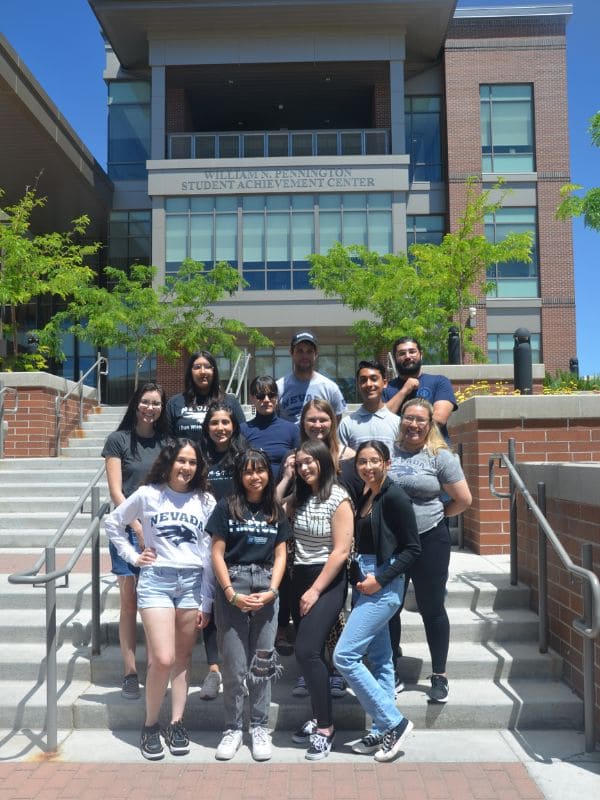
The power of her role hit home for Rocha Becerra when she made a visit to Incline Village for CBESS. There, she spoke with a prospective first-generation student who had been offered a full-ride scholarship. Her parents, however, were skeptical of the offer, thinking there must be a catch, that at the end of the program, the university she intended to attend would turn around and ask for money.
“This student was amazing. Straight-A student. But her parents wouldn’t allow her to go to college because they didn’t believe in scholarships. These are immigrant parents who have not had good experiences. And they just didn't believe that they were going to get money. They thought that there was a catch,” she said. “So I went and talked to this family, and I told them, ‘I’m giving you my word that that’s not going to happen.’”
Two weeks later, Rocha Becerra saw the impact of her work.
“The student called me, and she was crying. She told me, ‘Thanks to you, I’m going to be able to go to college,’” Rocha Becerra explained. “It was not thanks to me. She had worked so hard for this opportunity, but because I took the time to go and talk to her parents and they heard it from somebody else, now, she’s going to be able to have her dream. That moment really showed me that there is so much more in life than just being good at a job.”
From student to mentor
Now a Ph.D. student in higher education administration, Rocha Becerra is also an accomplished researcher. As part of her undergraduate experience, she performed research in the laboratory of Dr. Alpuche, who helped her grow as a scientist. Eventually, she presented her research in English at UCLA and in Spanish at the National Congress of the Mexican Society of Electrochemistry. Marrying her skills as a researcher and her passion for higher education advocacy and outreach, Rocha Becerra’s doctoral work is focused on supporting students from underrepresented backgrounds. As the University continues to pursue its designation as a Hispanic Serving Institution, Rocha Becerra’s research suggests that the benefits of the designation would extend beyond the Hispanic community.
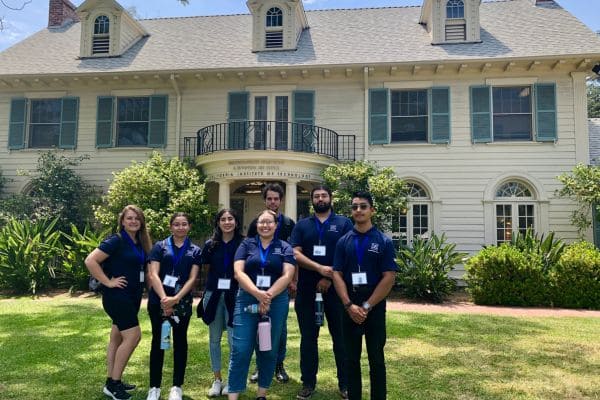
“HSIs and HBCUs are not just a benefit for that community,” she explained. “They’re actually a benefit for everyone, for all the underserved communities, because we share many different characteristics, just like first-generation students. We have so many things in common, and that designation will help us see the social capital that we have.”
A future focused on access and equity
Reflecting on the diversity on campus, Rocha Becerra added, “I love talking about how diverse our university is. I tell students that it’s great that you will have this experience because the world out there is diverse. We are preparing you to be part of a world where you can work with people that you don’t agree with, but you can be respectful, and you can be passionate, and you can be a good person and a good professional.”
Now a member of the Office of Prospective Students, Rocha Becerra has a simple message for students considering joining the Wolf Pack family.
“We care about them graduating. We care about them having a better life. We care about them feeling happy and proud, showing that they speak two languages, three languages, five languages, because they have so much to give,” she said. “I feel like we have so much to give. All of us, we have so much to give. And my dream is that all those students who feel that they don’t belong or who feel unsure or who feel scared, that they don’t feel that way.”
For Rocha Becerra, providing students with the opportunity to realize their potential personally is as important as realizing their potential professionally.
“That is part of the values and the mission of the University: Create better citizens of the world, not just good professionals,” she said. “Of course, we want to create good doctors, and of course, we want to create good engineers and good teachers, but we want people who are passionate about what they do, and they feel happy, and they feel like they can give something back.”
In reflecting on her own journey and the role the people at the University, from the staff in the First-Gen Center to Professor Sanchez to Professor Alpuche, she said, “I have seen so much change in myself, thanks to my whole journey being here. I hear people like talking about these big universities and I'm like, that's great, but they don’t have what we have.”
Rocha Becerra then named a half dozen individuals on campus who had taken time to help her—from First-Gen Center Associate Director Heather Williams to Professor Vasquez and Professor Sanchez, all the way through Director of Admissions Steve Maples ’96 M.A. (counseling and educational psychology), ’02 Ph.D.—and said, “These people are amazing. This university is different from any other. No matter who you are, every single student matters, and every single student has a different story. The University doesn’t just care about bringing students in. It cares about who they are, about their graduation, and about their happiness and growth.”